Almost a year after Charlie Kirk was shot dead at Utah Valley University, one man is sitting in a Utah jail cell facing the death penalty for it, and two very different kinds of doubt have grown up around whether the official story is the whole story. One started as the defendant's own dark joke about a lookalike. The other is a detailed, actively promoted theory that the fatal wound wasn't even from a bullet. Laying both out next to each other, and next to what the state actually says it can prove, is the only way to tell which kind of doubt is which.
What The State Says Happened
Before getting into the conflicting footage, alternative theories, and questions surrounding the identity of the person seen on campus, it helps to establish the version prosecutors have actually put forward. Their case rests on a combination of surveillance footage, physical evidence recovered near the scene, DNA testing, witness accounts, and Robinson's alleged communications after the shooting. Some of those pieces are stronger than others, and several have become subjects of dispute, but this is the evidentiary framework the state is asking the court to accept.
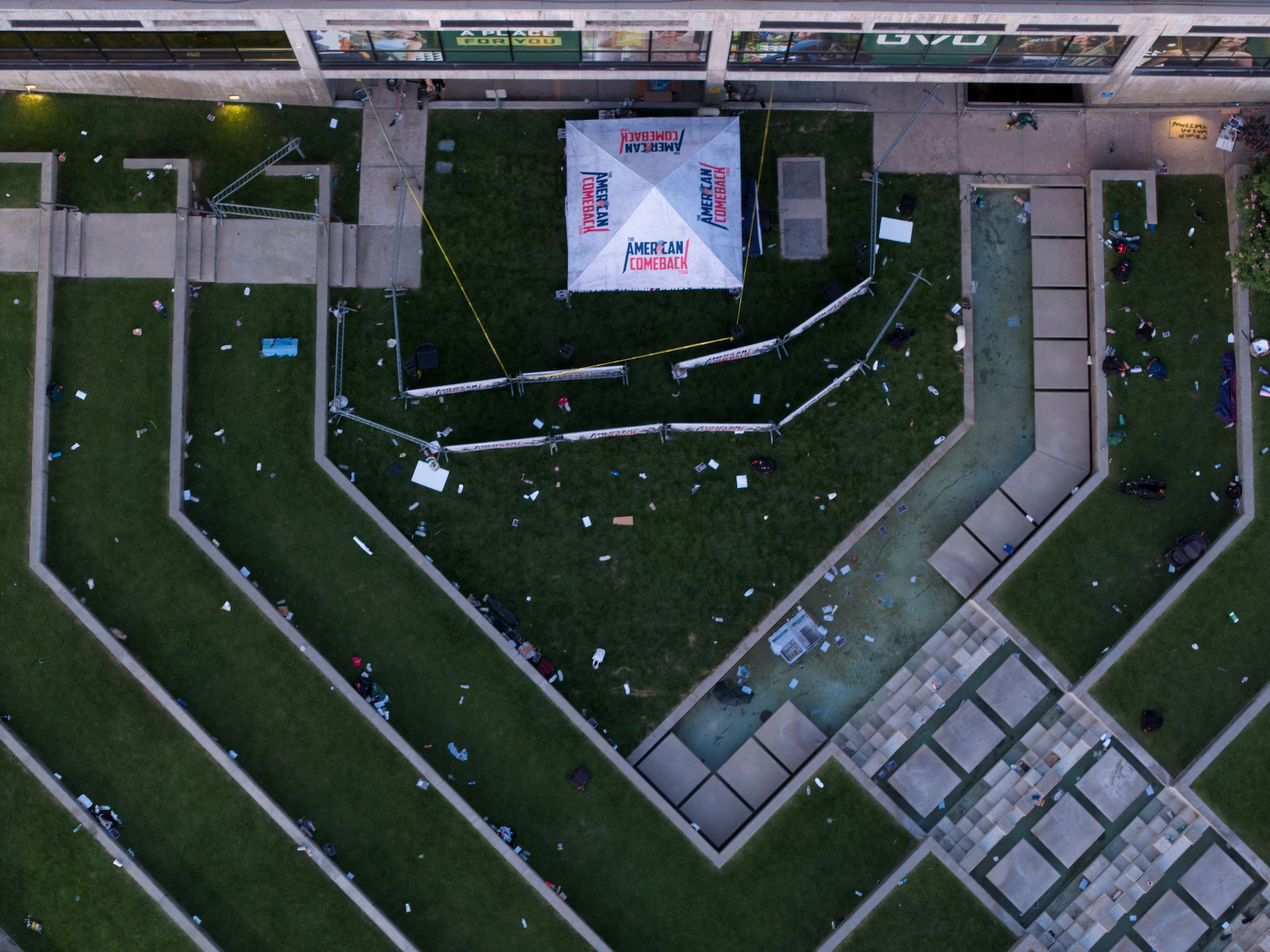
It's worth seeing what the venue actually looked like first. Kirk's "American Comeback Tour" stop was a tented setup in the courtyard outside the Losee Center, a folding table and two microphones under a canopy printed with "Prove Me Wrong," TPUSA staff and volunteers around him, a crowd of a few thousand seated on the surrounding steps and lawn.
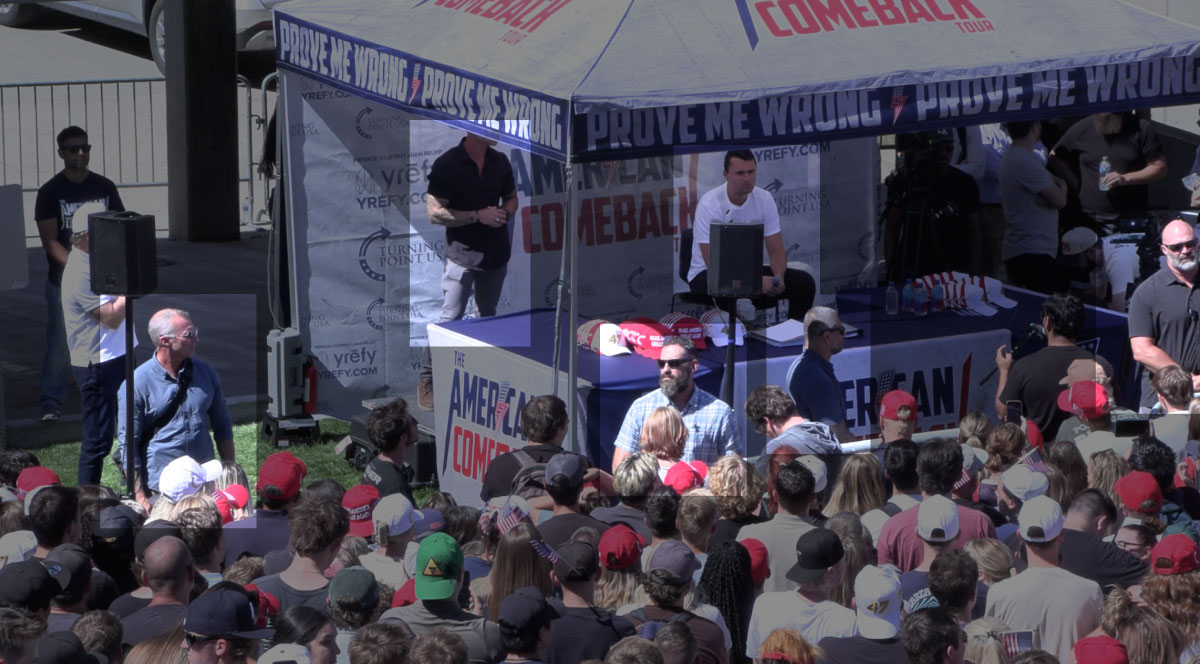
That's the layout the crowd and Kirk's team were working with that day: an open-sided tent, no barrier between the stage and the first few rows, and a security perimeter that amounted to a single row of metal barricades a short distance out.
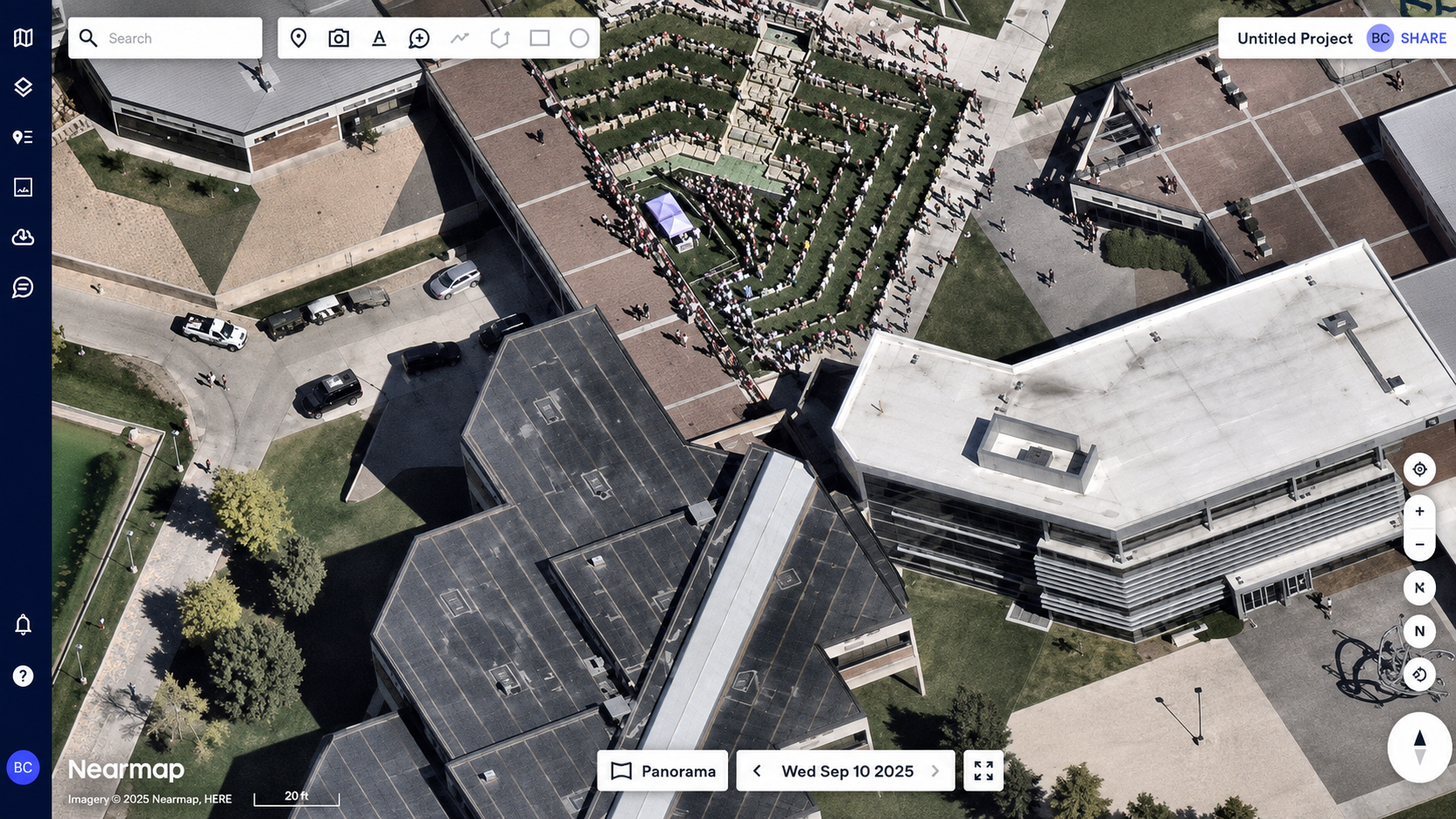
That's the geography from directly overhead, dated to that Wednesday: the tiered amphitheater seating funneling down to the tent and the small purple canopy marking the stage, with the Losee Center's flat roof sitting just across the walkway. It's a short, direct line of sight, which is the whole reason the roof mattered.
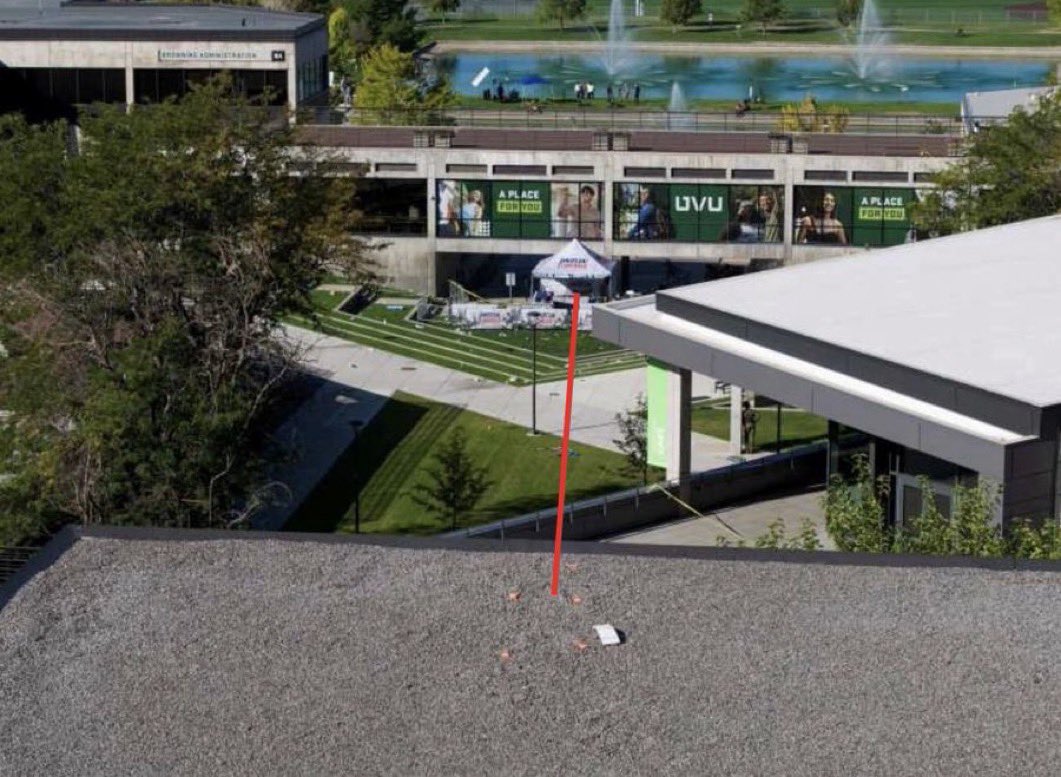
This is the view investigators reconstructed from the rooftop itself: the evidence markers on the gravel surface where casings and other material were recovered, and a straight line down to the same tent visible in the aerial shots above. It's the same roughly 130-to-175-yard shot referenced earlier, drawn out rather than just described.
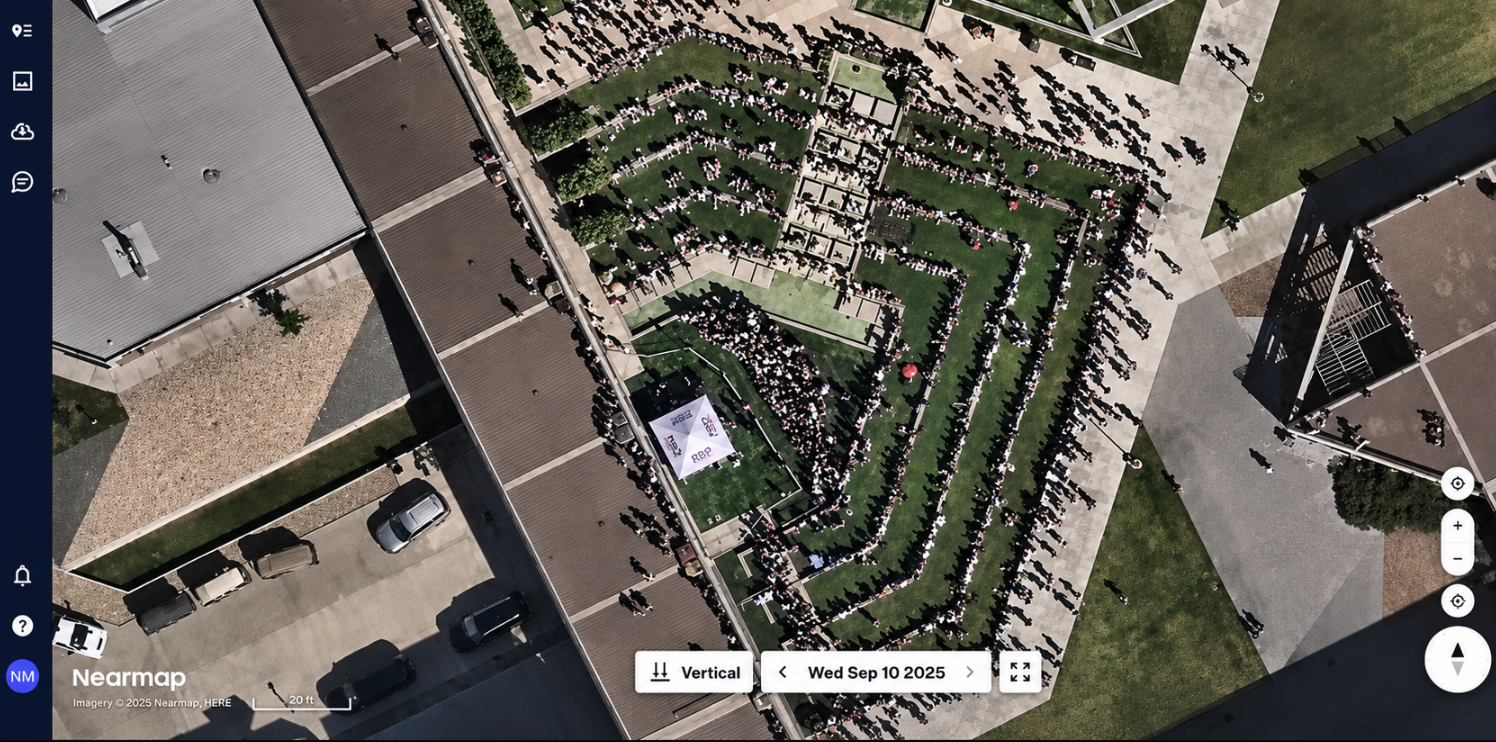
Pulled back a bit further, the same scene: the crowd already filling the tiers, the tent and stage small at the bottom of the amphitheater, the rooftop lines and walkways that would matter a few hours later already visible from above.
The night before, that posture was already being discussed directly. A screenshot circulating since mid-2026, attributed to a September 9, 2025 exchange between Kirk and his security team, has him being told that law enforcement was "fully supportive," that campus PD and his own team would cover the event, and that 11 people would be onsite. Kirk's alleged reply: remind them they were there for "1 person security only," adding, "I'm somewhat worried about the left trying to kill me." The reply back was, "I've got you. I'll do all in my power to make that extremely difficult."
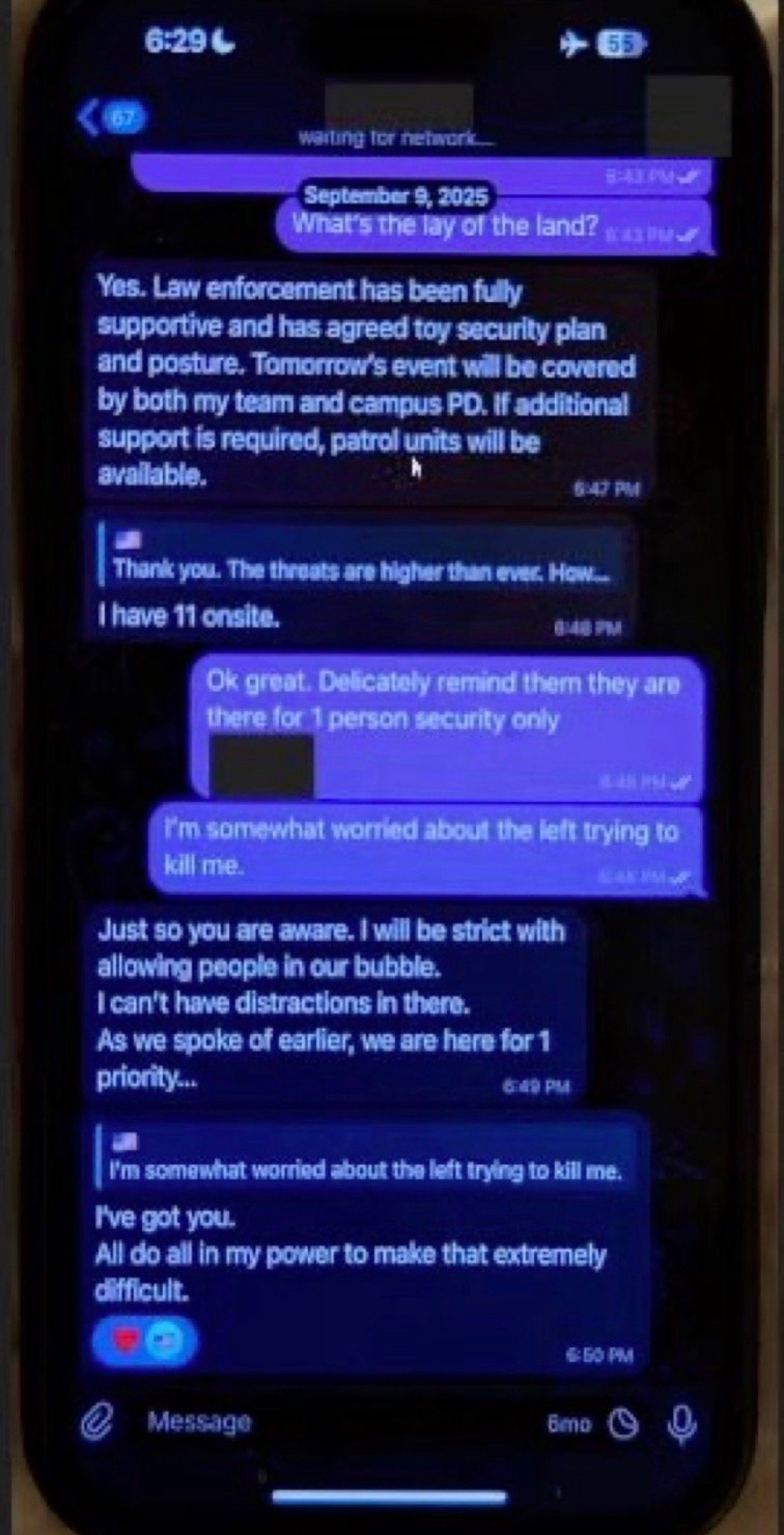
This particular exchange isn't on the same footing as the Twiggs texts read into the court record. It was surfaced by commentator Andrew Wilson on the PBD Podcast, not by prosecutors or Turning Point USA, and Wilson wasn't a party to the conversation himself, which has drawn its own questions about how he obtained it and why. TPUSA has confirmed the authenticity of other leaked Kirk messages in the past, but hasn't done so for this one. Read the same way as everything else in this section: a real screenshot in circulation, attributed to a specific source, unconfirmed by the people who would actually know.
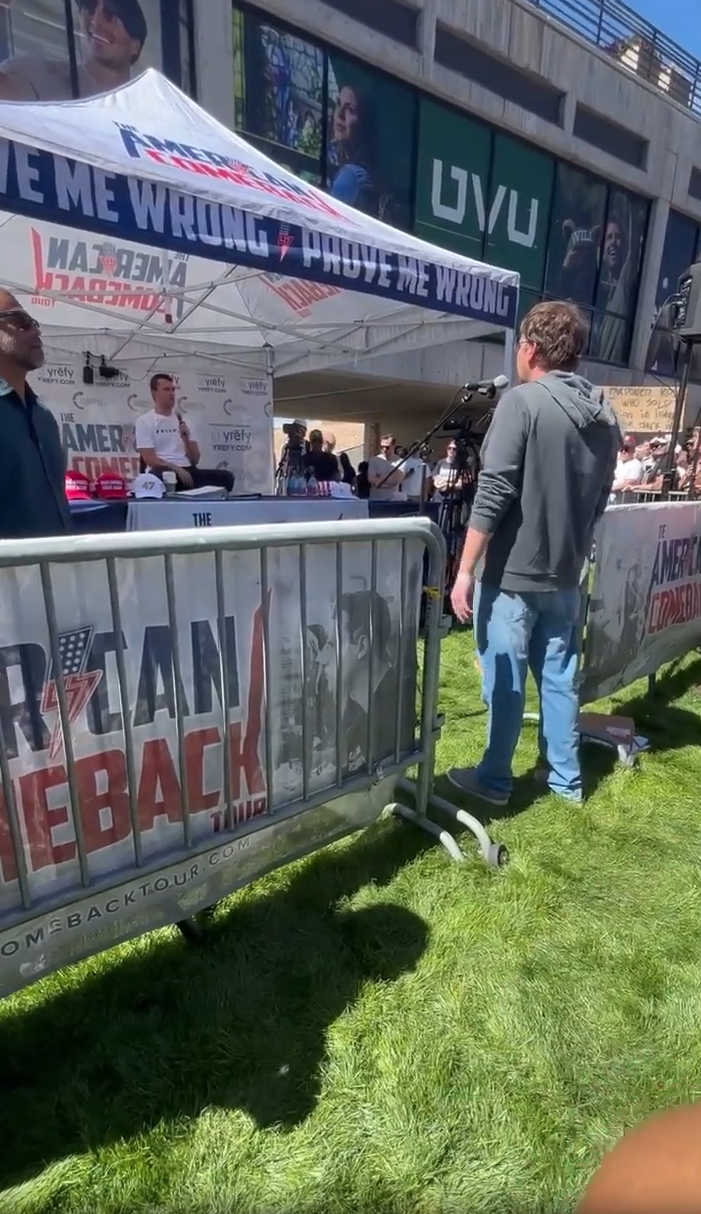
This still, pulled from crowd video shot that day, shows how close the barricade line actually sat to the stage, close enough that anyone standing at it was within easy earshot and a few dozen feet of Kirk himself. Nothing about the man pictured here is established beyond that; he's simply part of the crowd along that line, not someone investigators or prosecutors have named in connection with the case.
The panic afterward was captured from unlikely places, including from inside a campus building overlooking the courtyard.
That clip was filmed through a window in what appears to be an international-student lounge overlooking the plaza, a bystander's phone video rather than security footage. It doesn't show the shooting itself, only what came right after: the crowd below dropping to the ground and taking cover, and the people inside the room going quiet and moving to the glass to look. It's the same category of material the Salt Lake Tribune drew on when it reported on the 911 calls capturing panic across campus that day, a record of the aftermath rather than the act.
A third clip is ground-level rather than elevated, shot from just behind the barricade line a few feet from the stage itself, where a crush of people piled on top of each other trying to get down and away at once. This one is presented muted; the original audio captures a specific bystander's real-time panic rather than ambient crowd noise, and that felt like the wrong thing to rebroadcast without knowing who they are.
A second clip, shot from a similar elevated vantage point moments later, shows the same courtyard as people move out of it, no longer diving for cover but walking and jogging away in the same direction, the pink-and-blue vendor tent and the "UVU" signage still visible below.
Kirk was taken from the courtyard to Timpanogos Regional Hospital in Orem, a few minutes away, and was pronounced dead there that afternoon.
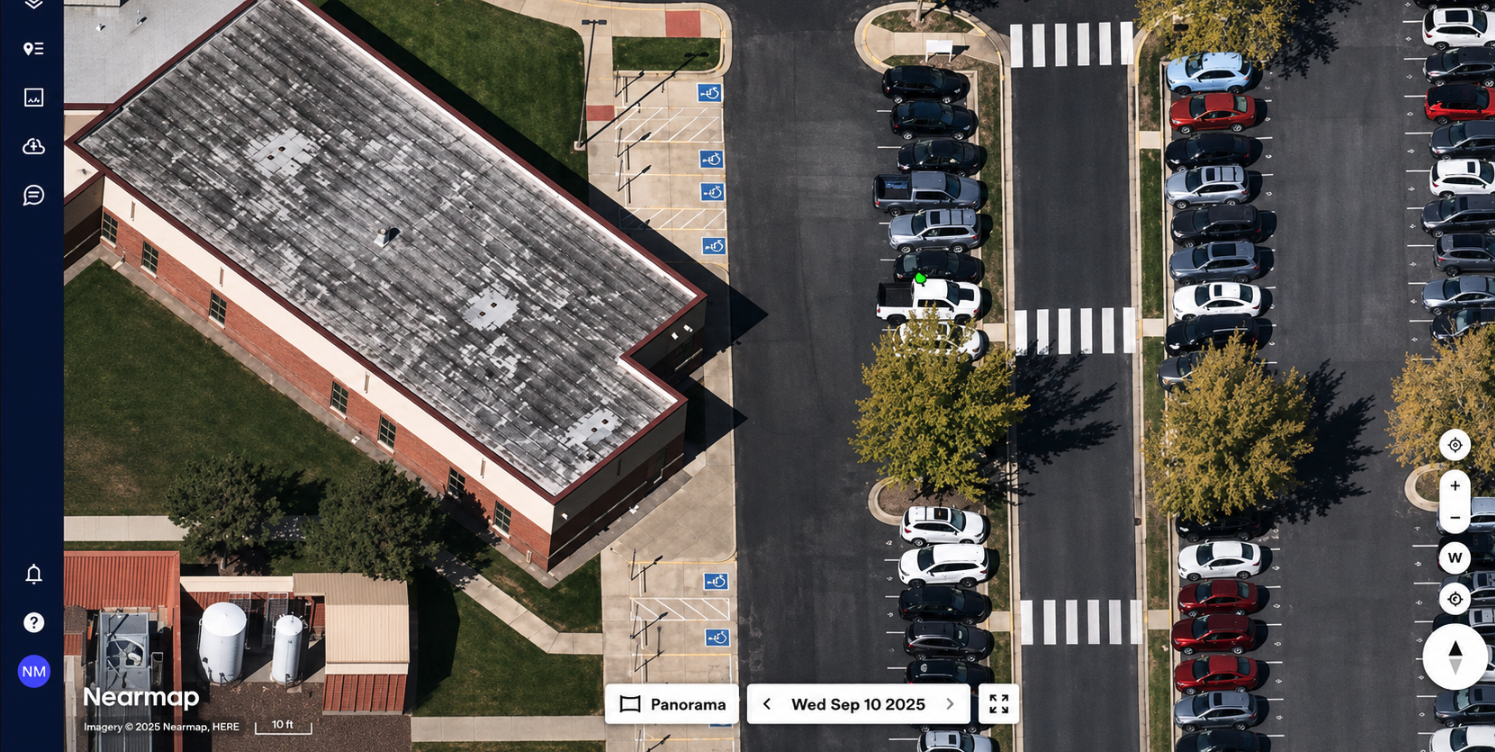
That's the hospital itself from overhead, the same Nearmap imagery dated to that week.
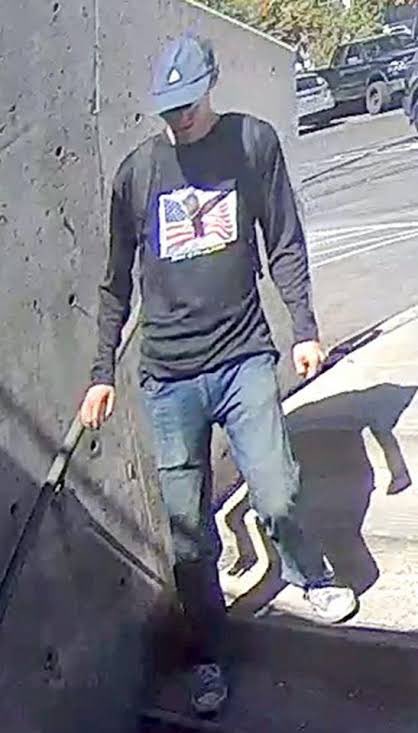
This is the image the FBI actually put out during the manhunt, before anyone had a name: black long-sleeve shirt, an American flag and eagle across the chest, cap, sunglasses, a $100,000 reward attached. It's the photo Robinson's own father recognized.
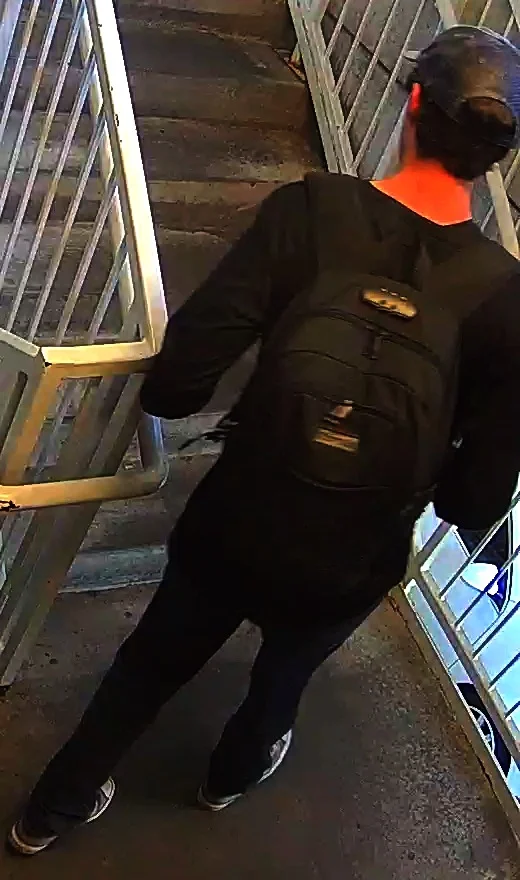
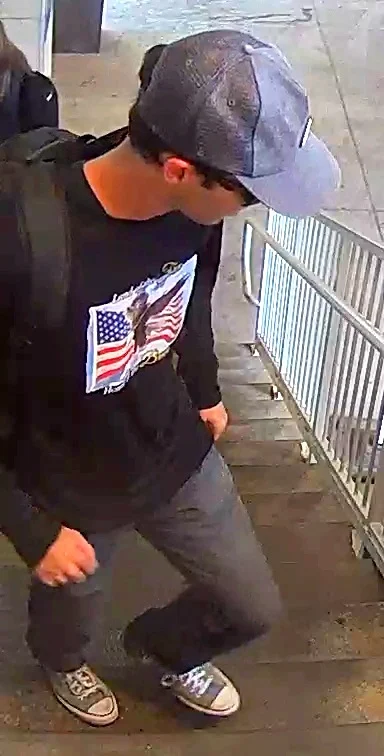
Two more frames from the same stairwell camera sequence, the backpack and the shirt's flag-and-eagle print visible from both angles. These are the same stills that made the composite image circulate so fast that week, distinctive enough that people who knew Robinson recognized him from a screen grab.
Lance Twiggs is the one doing that identifying in the clip below, and it's worth saying upfront that he hedges: he wasn't 100% sure, citing the camera quality, even as he says the shoes, the sunglasses, and the overall look matched what he remembered.
That recognition is on the record. In this clip, a witness is walked through the same FBI press-release images, the shoes, the sunglasses, the jeans, and asked directly whether they recognize the person. The answer: not with total certainty, given the camera quality, but enough of the details lined up. "They do look like Tyler Robinson."
Tyler Robinson, 22, was arrested on September 11, 2025, about 33 hours after Kirk was killed, following a manhunt that ended when his own father recognized him from surveillance images and called a family friend, a retired sheriff's deputy, to help arrange a surrender. Prosecutors say they have Robinson on video firing the fatal shot from the roof of the Losee Center, and that DNA recovered from the rifle at the scene, a bolt-action gift from his grandfather, ties directly back to him.
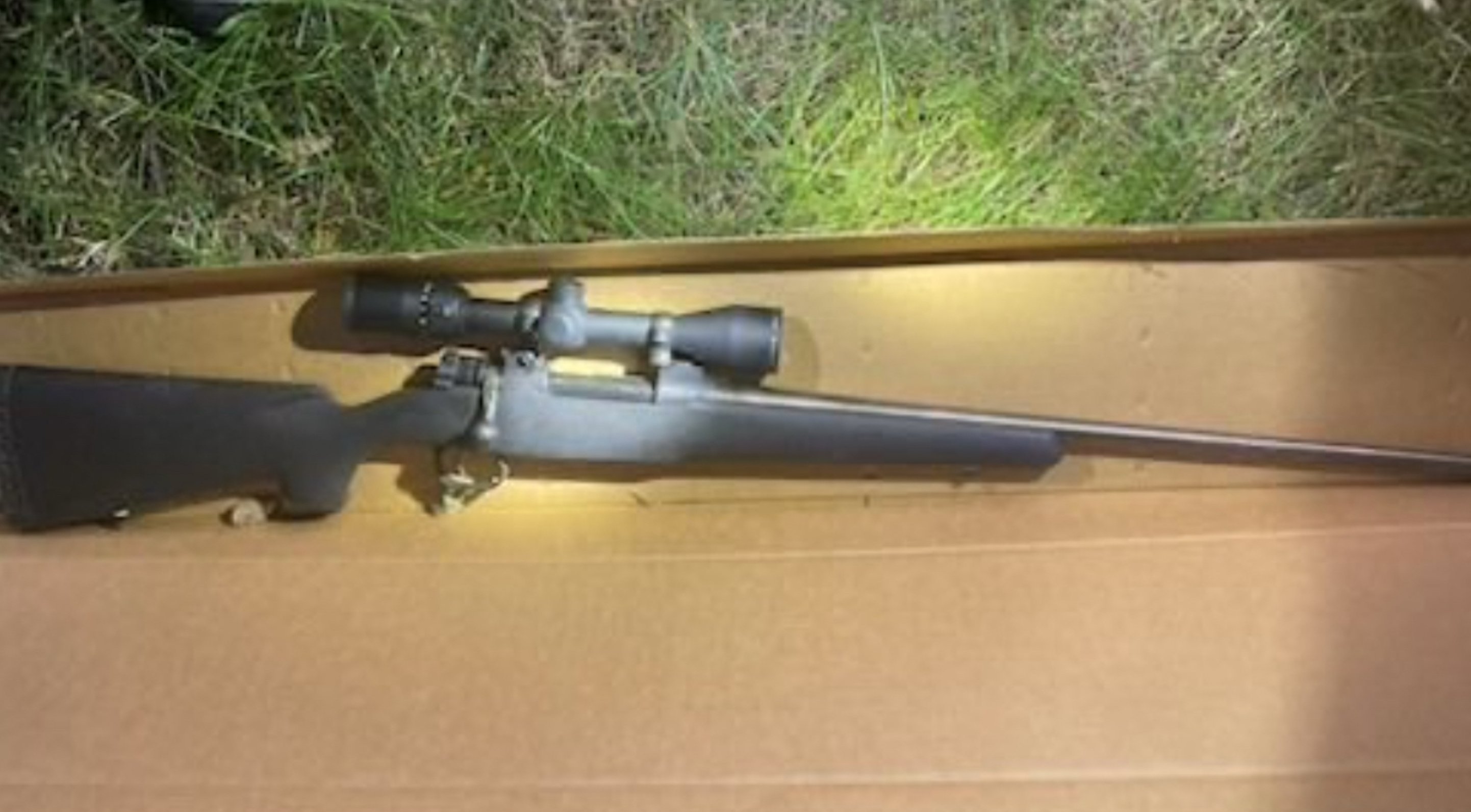
The rifle itself is a Mauser Model 98 chambered in .30-06, found wrapped in a towel in a wooded area near campus, with one spent casing and three unfired rounds still in it. All four were engraved: some with phrases like "Hey fascist! Catch!", one with the lyrics to the Italian anti-fascist folk song "Bella Ciao." Prosecutors say DNA on both the rifle and the towel around it ties back to Robinson at odds of roughly one in a trillion, the highest confidence figure the lab's own guidelines allow it to report.
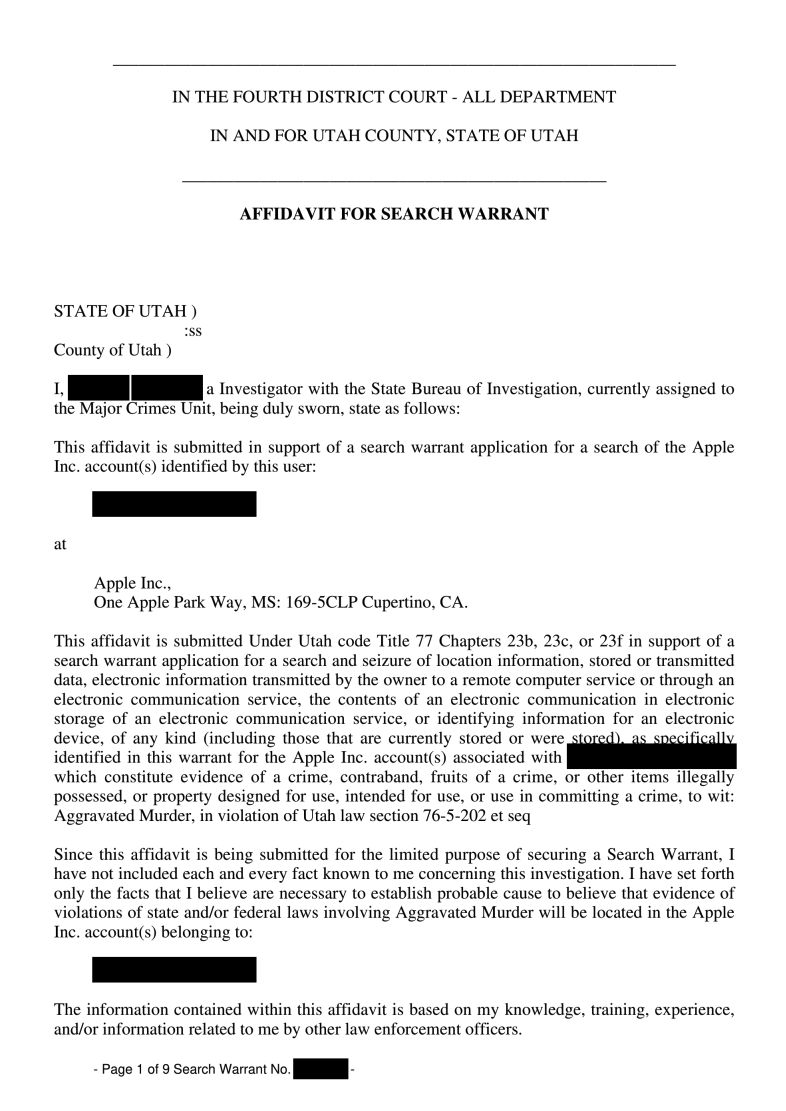
That's one of the search warrants investigators filed to build the rest of the case, this one addressed directly to Apple's law enforcement compliance office in Cupertino rather than to Robinson himself, seeking account, device, and location data tied to whatever Apple ID the state believes was his. The investigator's name and the specific account identifier are redacted in the public copy, but the citation is plain: Utah's aggravated murder statute, the same charge he's actually facing.
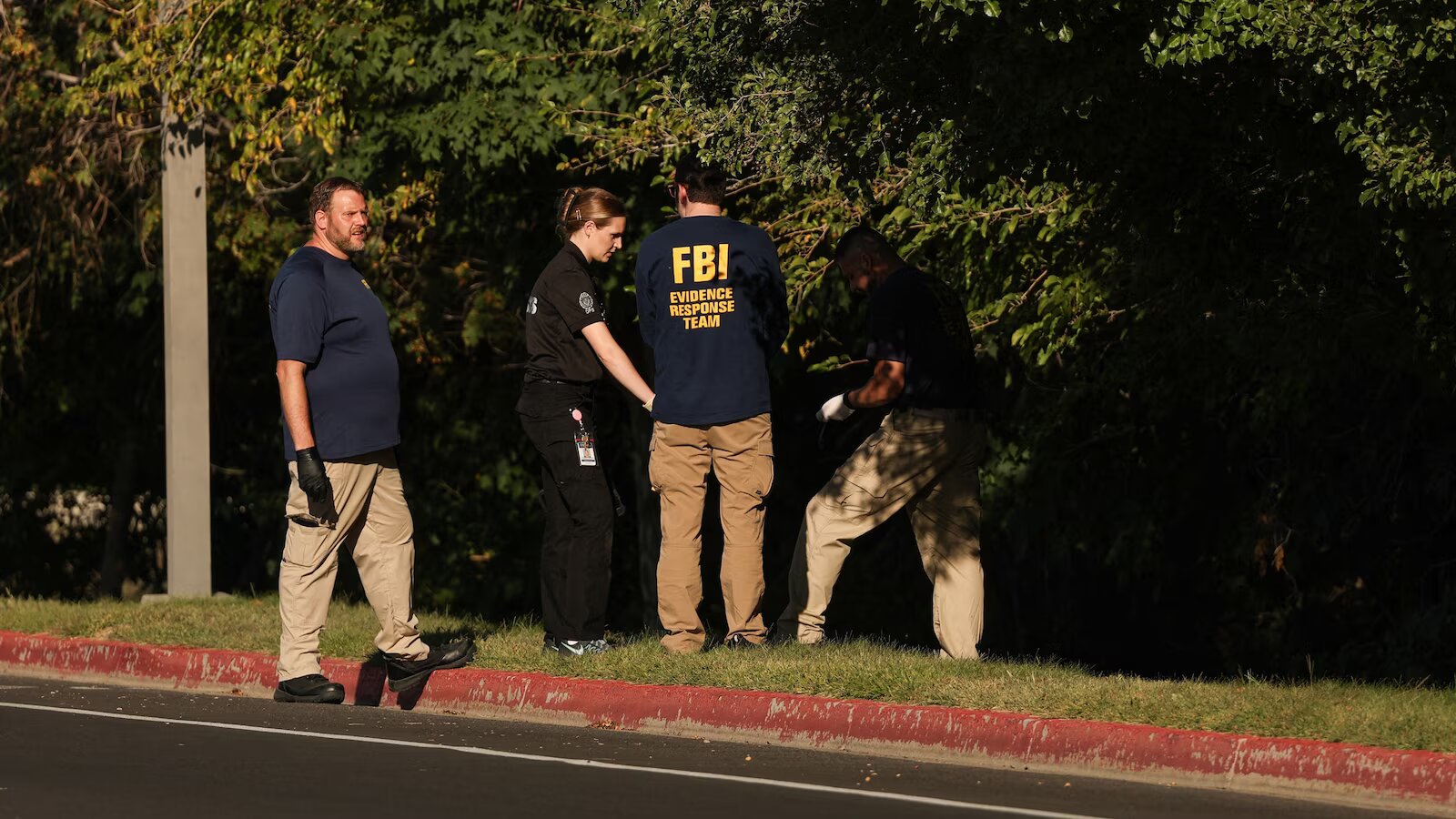
That's the search itself, an FBI Evidence Response Team working the tree line along the road near campus, the same general area where the rifle turned up wrapped in a towel.
The FBI's own campus-camera footage picks up the same figure seconds after the shot: running across the Losee Center roof toward the southwest corner, dropping over the edge, and disappearing into the wooded area where the rifle was later found. It does not show the shooting itself, only the seconds immediately after.
The strongest evidence made public isn't forensic at all. Robinson's roommate, Lance Twiggs, received a text telling him to look under a keyboard, where he found a note that read, "I had the opportunity to take out Charlie Kirk and I'm going to take it." Twiggs didn't delete the exchange, and prosecutors built much of their charging document around it. Utah's governor has separately said Robinson told his family at dinner that Kirk was "full of hate and spreading hate." None of that is seriously disputed by his own defense team, whose fight so far has centered not on whether Robinson was there, but on whether the state can prove the aggravating factor needed to seek execution rather than life in prison. A weeklong preliminary hearing wrapped in July 2026, and a judge is set to hear closing arguments on September 1 on whether the case is bound over for trial at all.
That's the frame everything else sits inside. Now, the two versions.
His Own Joke
The day after the shooting, an acquaintance in a Discord server tagged Robinson's username underneath the FBI's grainy surveillance stills and asked, essentially, where he'd been. Robinson wrote back that it must have been his "doppelganger," a lookalike trying to "get me in trouble." He kept going, joking that whoever framed him should "also get rid of this manifesto and exact copy rifle I have lying around." It reads, in context, like exactly what it was: a cornered 22-year-old being flippant with friends while he still thought he could talk his way out of it. But it's also the literal origin of the idea that there might be more than one Tyler Robinson in this story, a joke he told about himself that outlived the joke.
The joking stopped in the same server that same night. At 8:57 p.m. on September 11, using the handle zealousmonkey55095, Robinson posted a message a roughly 30-person Discord chat later gave to the Washington Post and Discord itself handed over to police.
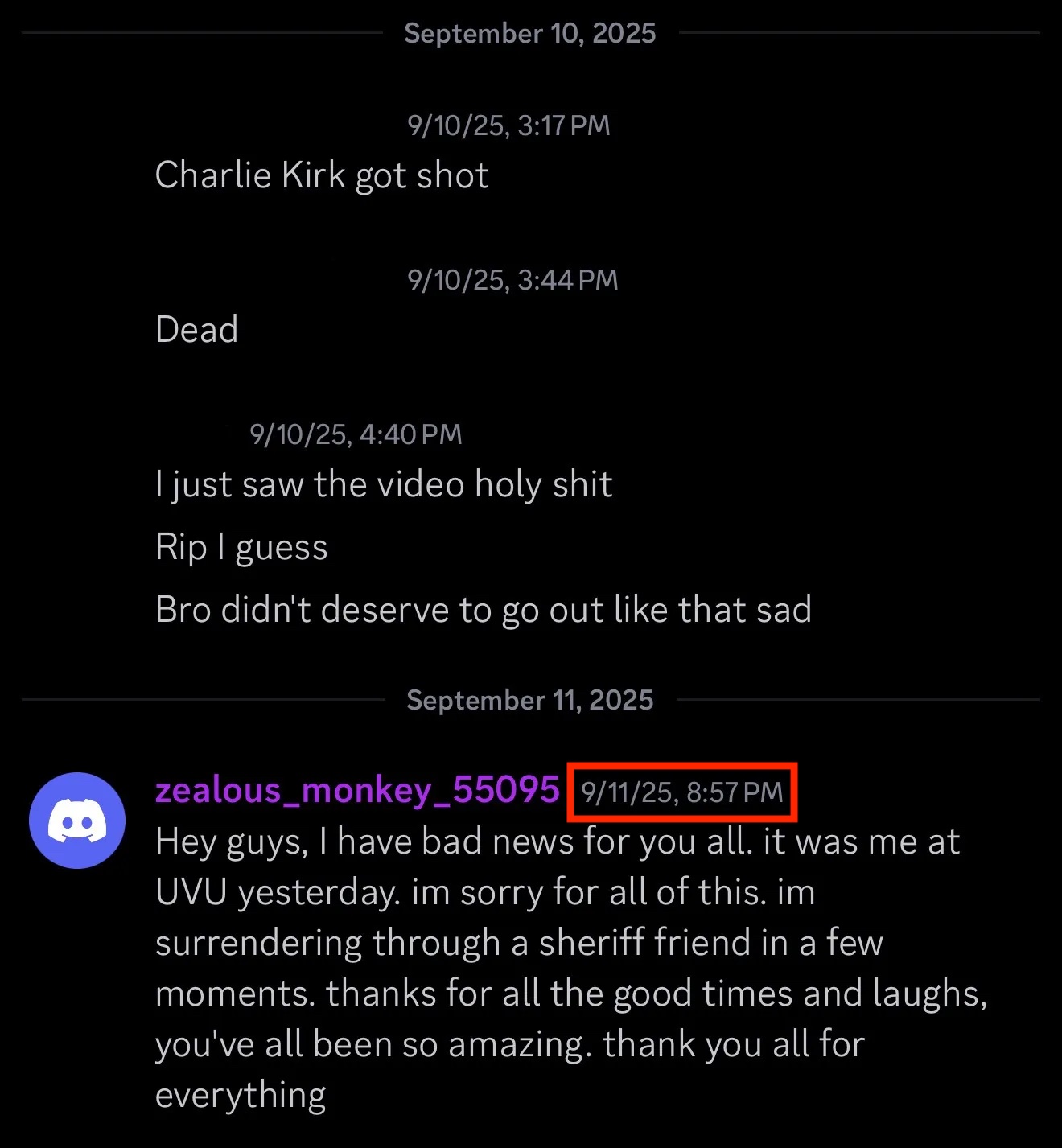
"Hey guys, I have bad news for you all," it read. "it was me at UVU yesterday. im sorry for all of this. im surrendering through a sheriff friend in a few moments. thanks for all the good times and laughs, you've all been so amazing. thank you all for everything." Newsweek, CBS News, and the BBC all reported the same text once Discord confirmed the account and the company's own records to investigators.
There's a wrinkle even here, though. Court records reviewed by other outlets show Robinson may have already been read his Miranda rights around 6:25 p.m. that evening, roughly two and a half hours before this message went out at 8:57 p.m., a discrepancy podcaster Baron Coleman was the first to flag publicly. If Robinson's phone had already been taken from him by then, the question of who actually typed that message doesn't have a clean answer yet. It's a genuine gap in the timeline, not a reason to doubt the message was his account or that its contents match everything else he'd already told his family and Twiggs directly.
The footage that later fueled a more serious version of the same doubt is real trial evidence, not a joke. At the preliminary hearing, Sergeant David Hull testified that Robinson's car was captured entering the on-campus parking garage around 8:30 a.m. that morning, and that stairwell cameras picked him up on foot before he walked to the courtyard and spoke briefly with Turning Point USA staff setting up for the event.
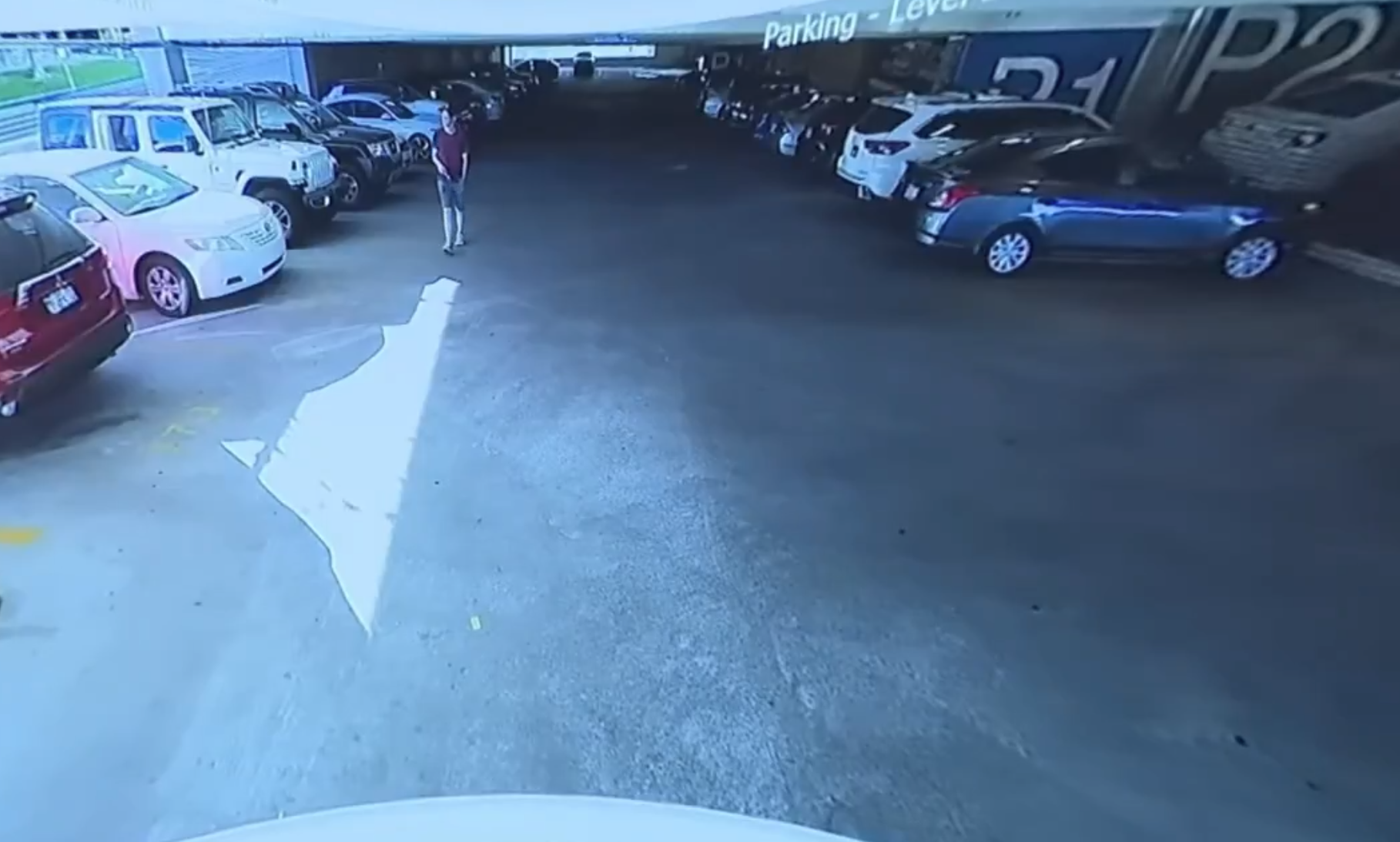
This is the frame prosecutors put up first, timestamped to that morning, the one Hull's testimony was built around: a man in a maroon shirt and cap walking past a row of parked cars on Level 2.
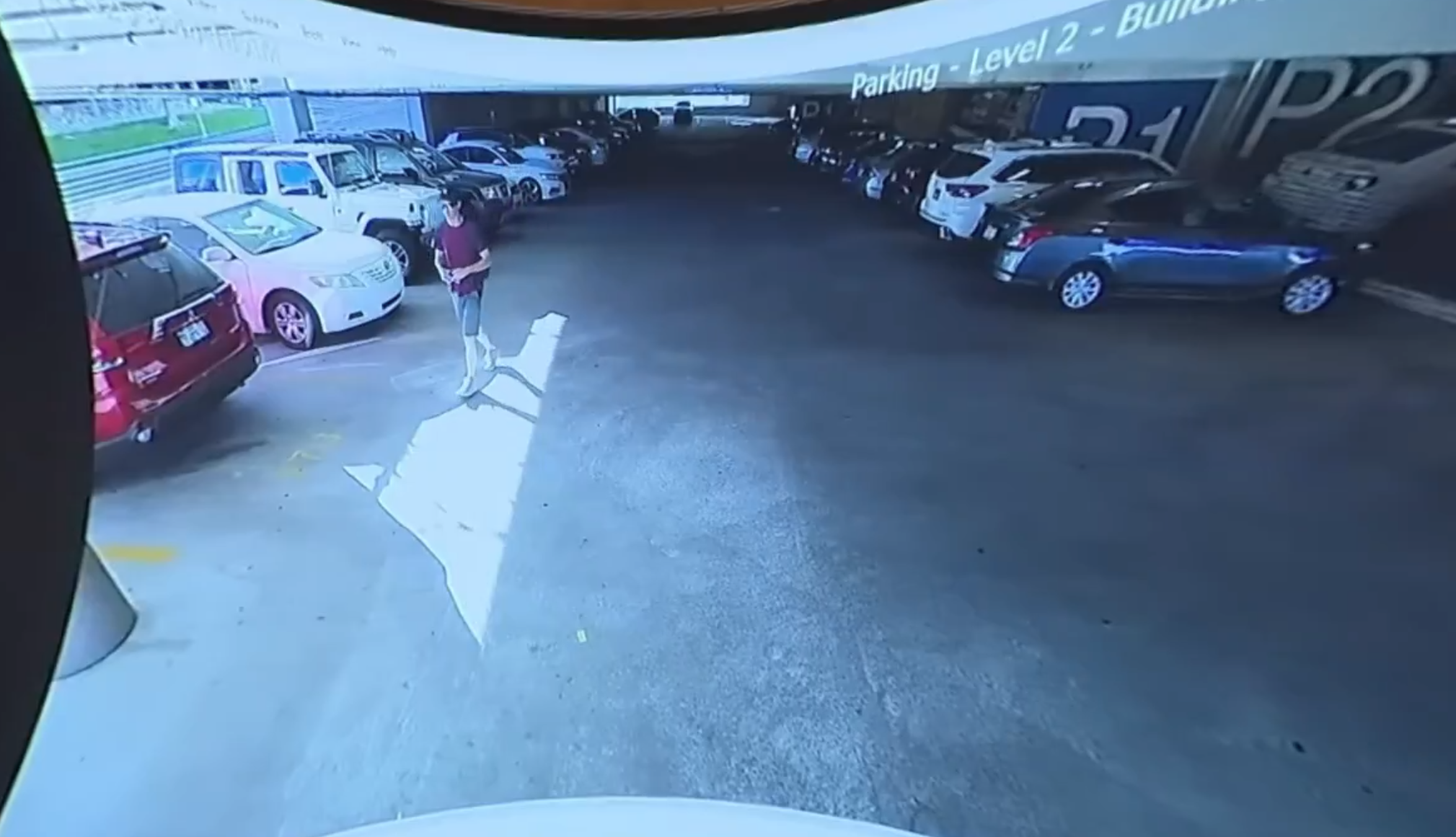
A few seconds later, the same camera catches him further down the row, closer to the lens, which is the angle the "compressed dimensions" argument leans on hardest, since it's the frame where the parked cars beside him are easiest to measure against his frame.
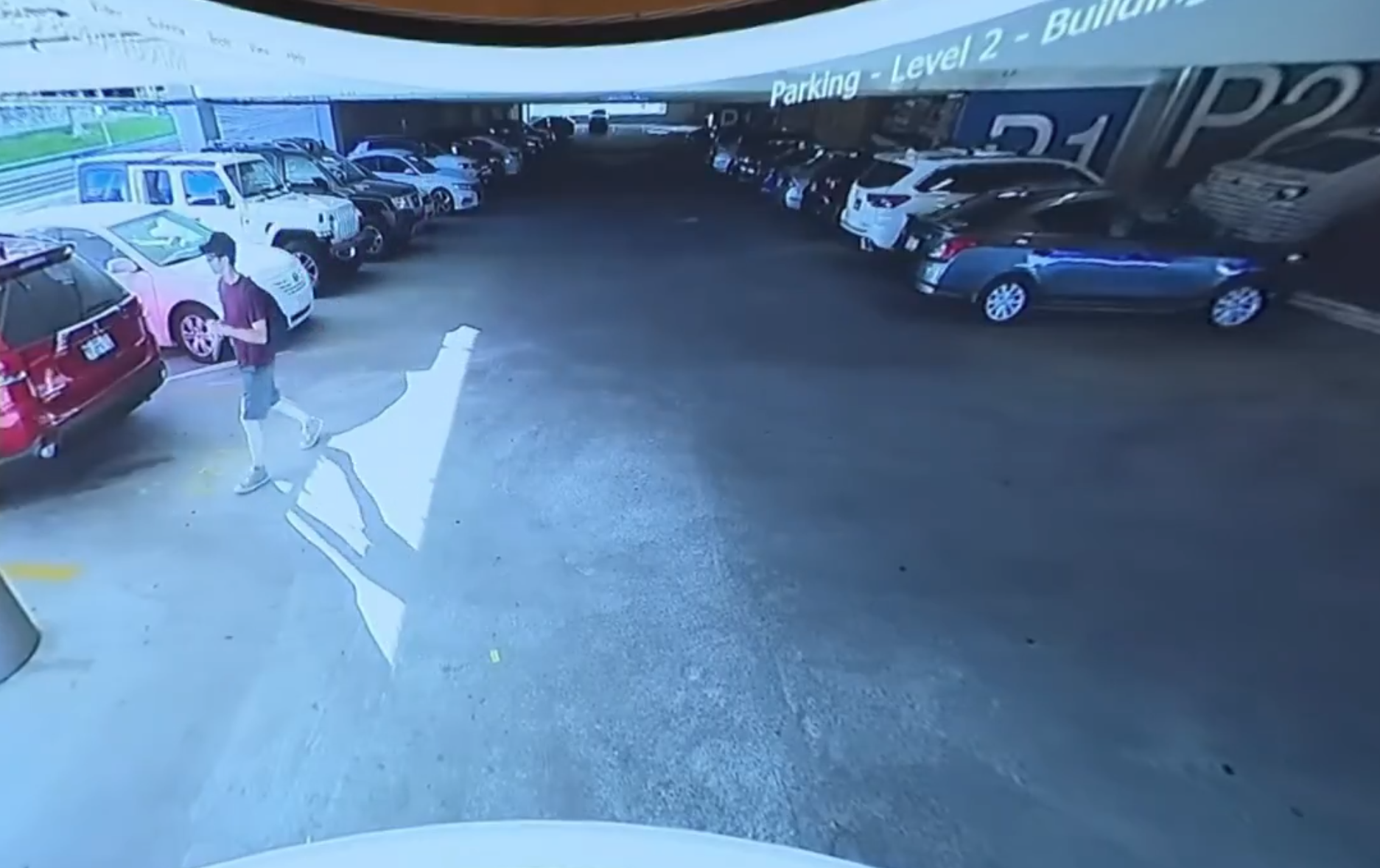
The third frame, further along the same level, is the one usually paired with the other two to argue consistency of build and gait across the sequence, rather than a single ambiguous frame.
That's the actual clip all three stills above were pulled from, the same row of cars, the same man in the maroon shirt, moving rather than frozen.
That's the footage prosecutors say shows Robinson. It's also the footage a smaller group of independent analysts has picked apart frame by frame, arguing the garage's camera lens compresses distance in a way that made the parked cars and the man walking past them measurably narrower than they should be, and that once you correct for it, the man in frame reads as broader through the shoulders and neck than Robinson's known build. Nobody making that argument has offered a second name to put in his place, and it hasn't been raised as a defense theory in court. What it has done is give the "which Tyler Robinson" question a second piece of actual footage to argue over, on top of his own joke about a doppelganger.
Sergeant Hull's testimony added a detail that cuts the other way. Reviewing roughly 16 hours of campus surveillance, he told the court that around 12:15 p.m. the man on camera, now in different clothes but the same shoes, was walking with a limp, his right leg not bending the way it had earlier that morning. The clip below is from the hearing itself, an attorney walking Hull through the same stretch of footage.
By the time he's tracked crossing back in front of the Losee Center after the shooting, Hull testified, the limp is gone. Prosecutors have pointed to that detail as evidence he was walking with a rifle down one pant leg beforehand, not as a reason to doubt it's the same person. Whatever it means, it's the opposite kind of question from the one the doppelganger joke and the compressed-footage argument raise: not who this is, but what he was carrying.
There's an older, less contested piece of video that ended up back in circulation the same week, for a different reason. His mother filmed it after his high school graduation in 2021: Robinson reading a letter out loud, informing him he'd been awarded a four-year, roughly $32,000 merit scholarship to Utah State University.
TMZ and Fox News both ran it once he'd been identified as the suspect, and it isn't in dispute the way the garage footage is; nobody has argued this one shows somebody else. What it's mostly been used for since is the same contrast every outlet that dug it up reached for on its own: a kid with a 4.0 GPA and a scholarship letter, four years before a rooftop in Orem.
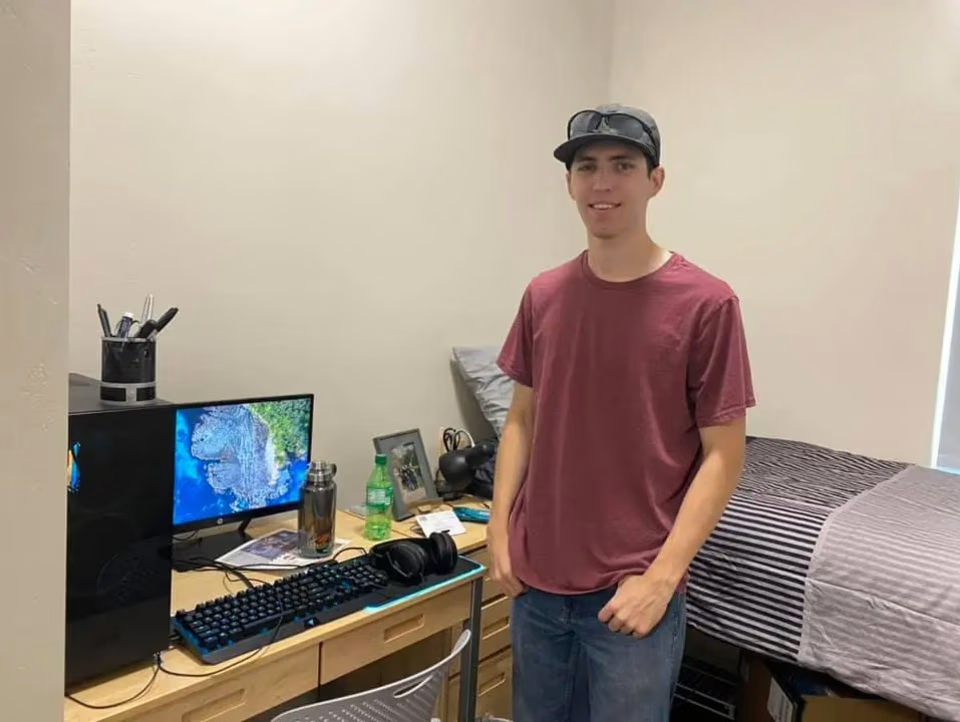
That same fall, his mother posted this one too: Robinson in his dorm room at the Logan campus, a gaming keyboard and headset on the desk behind him. He left after one semester and never went back.
Twiggs
Lance Twiggs was Robinson's roommate and, according to testimony in the case, his romantic partner. He was granted immunity and gave a recorded interview to investigators that April; a redacted version of it was played publicly for the first time on the fourth day of the preliminary hearing, July 9, 2026, in the Fourth District Court in Provo. Twiggs didn't testify live. He didn't need to. What investigators had from him was already on the record: "I just asked him in person if what he said was true the night before, and he said it was, started crying a little bit and said he wishes he hadn't done it."
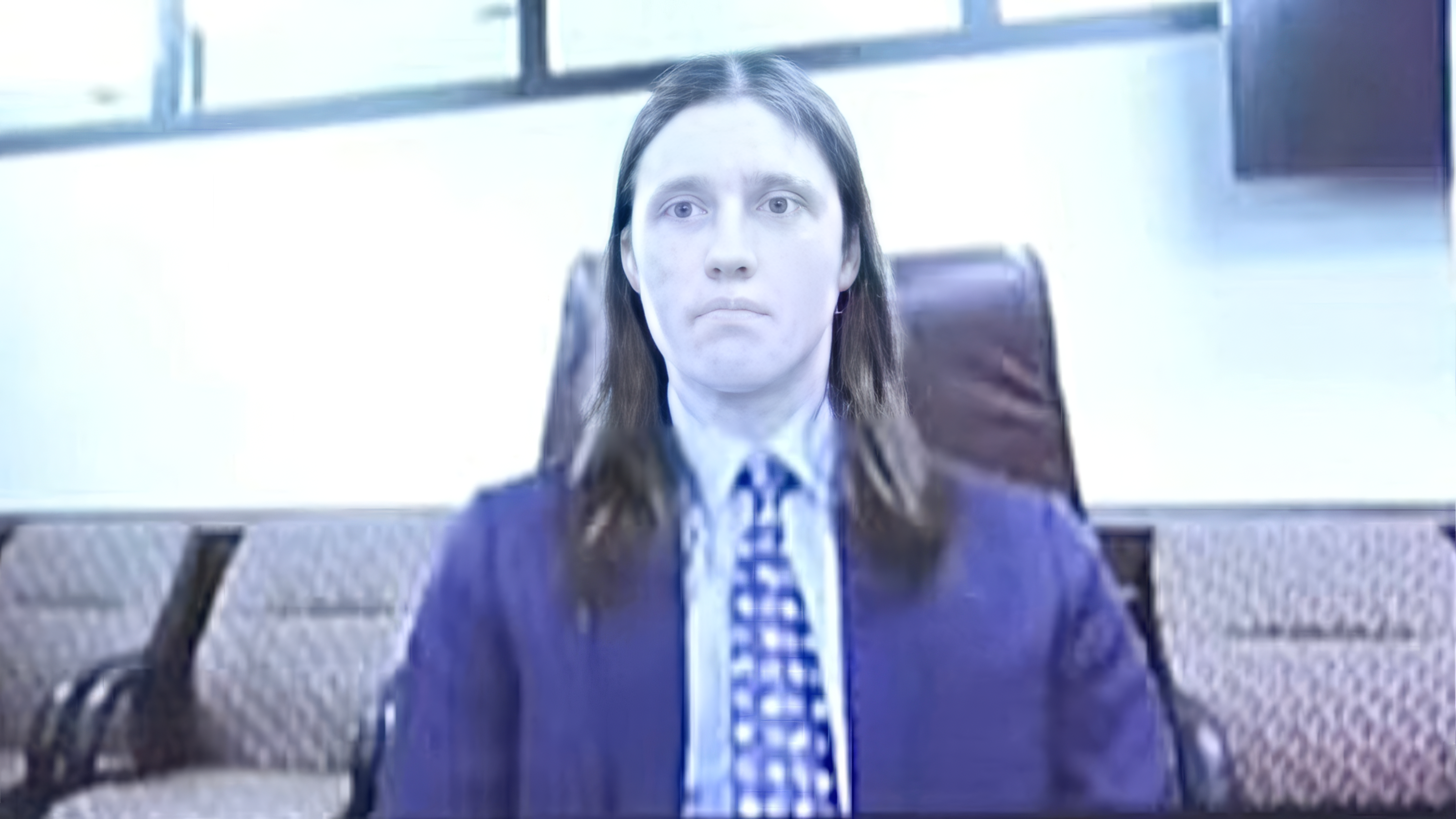
That's the interview itself, played back on a courtroom screen: a young man in a suit, answering questions about someone he loved.
The texts are the part that actually did the work in the charging document. Prosecutors read them into the record through Utah State Bureau of Investigation Agent Brian Davis, and outlets from Newsweek to Fox to CBS have since run the same screenshots.
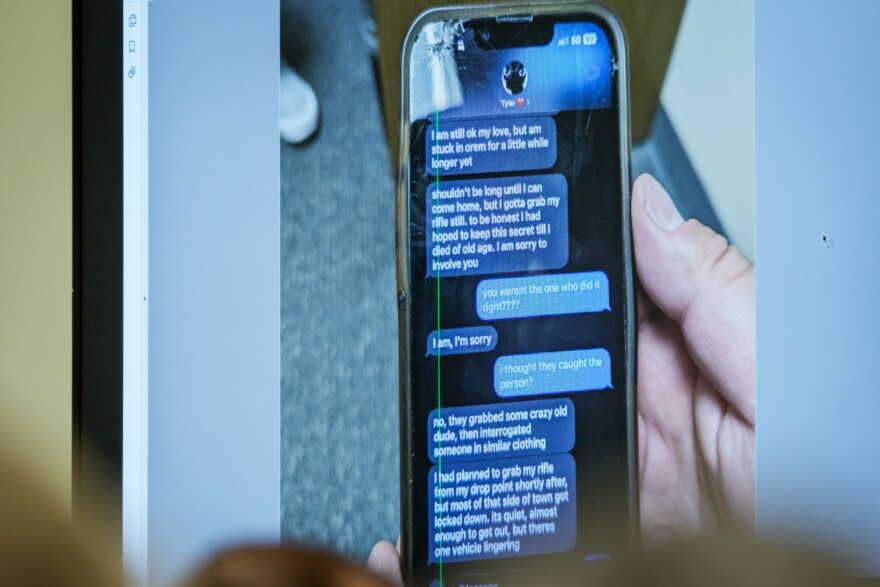
The exchange runs, in part: "I am still ok my love, but am stuck in orem for a little while longer yet... shouldn't be long until I can come home, but i gotta grab my rifle still. to be honest i had hoped to keep this secret till i died of old age. i am sorry to involve you." Twiggs asks, "you werent the one who did it????" Robinson answers, "I am, I'm sorry." A few lines later, Twiggs asks if they'd caught the person yet. Robinson's reply lines up with a detail already covered above in the wrong-men section: "no, they grabbed some crazy old dude, then interrogated someone in similar clothing," an apparent reference to Michael Mallinson and George Zinn, the two men wrongly swept up in the chaos that day. Robinson goes on describing his attempt to retrieve the rifle from where he'd stashed it, and that the neighborhood was locked down except for "one vehicle lingering." Social media users have questioned whether the texts were doctored; researchers and reporters who've reviewed the exhibit have found nothing to support that, and the defense hasn't argued the exchange was fabricated in court.
The Hamptons Meeting
Weeks before he was killed, Kirk was at a private gathering in Bridgehampton that ended up mattering far more in hindsight than it did at the time. The event, hosted by hedge fund manager Bill Ackman on August 4, 2025, brought together roughly thirty conservative media figures and was pitched around the threat Zohran Mamdani's mayoral campaign posed to New York. It didn't stay on topic.
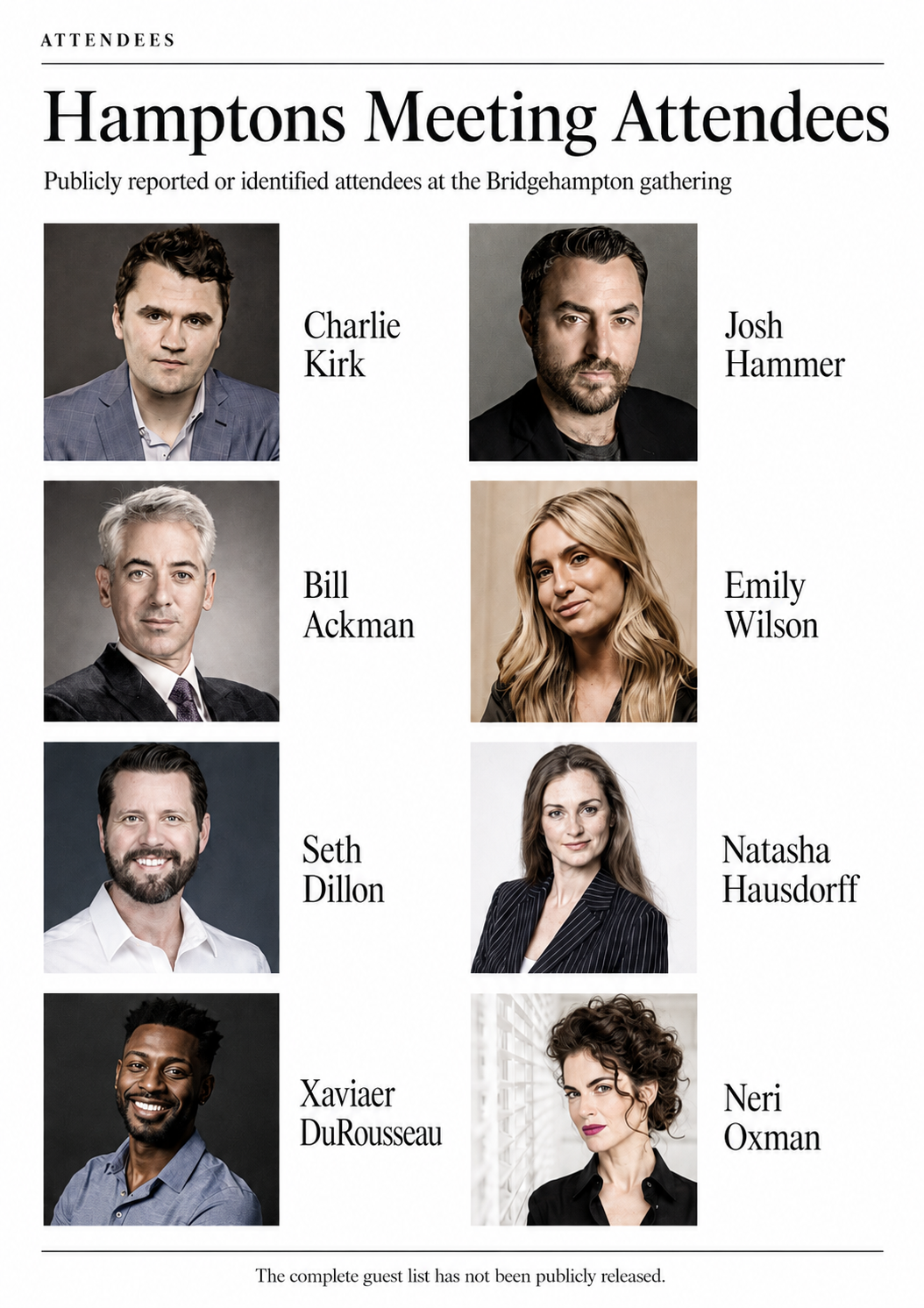
These are the people reporting has actually named as present, out of a guest list several times that size which has never been fully released. Ackman hosted; his wife, the Israeli-born MIT Media Lab designer Neri Oxman, was there too. Newsweek editor-at-large Josh Hammer, Babylon Bee CEO Seth Dillon, PragerU personality Xaviaer DuRousseau, podcaster Emily Wilson, and UK Lawyers for Israel's Natasha Hausdorff round out the group identified in reporting on the event, first published by The Grayzone's Max Blumenthal that September, citing anonymous sources.
By that account, the gathering turned into a confrontation over Kirk's increasingly public skepticism of the U.S.-Israel relationship and his habit of platforming Israel critics on his own show. Hausdorff, sources told Blumenthal, began "screaming" at Kirk. He was reportedly presented with an itemized list of grievances against him and pressed to rescind an invitation he'd extended to Tucker Carlson for that December's AmericaFest. Kirk came away rattled enough, according to those same sources, to talk privately about Israeli "blackmail" and to consider converting to Catholicism.
None of that is disputed by the people who were actually in the room. What they dispute is the word "intervention" and everything Candace Owens built on top of it after Kirk's death, when she publicly accused Ackman of staging the meeting to threaten and blackmail Kirk over his views. Ackman called the accusation "totally false" and "slandered," denied ever threatening anyone connected to Kirk or Turning Point, and posted a friendly WhatsApp exchange with Kirk from after the event to make his case. Seth Dillon confirmed the gathering happened while rejecting Owens' framing of it, and Josh Hammer devoted a full episode of his own show to what he called exposing her version of events. The event itself isn't in question. Whether it was a policy disagreement among allies or something closer to coercion is the part nobody in the room agrees on, and it's a different question still from whether any of it has anything to do with who pulled the trigger three weeks later.
Alternate Theories
The side-by-side image below has become part of a broader alternative theory surrounding the case. Some people examining the photographs have argued that the person shown may not be Tyler Robinson, pointing to apparent differences in build, facial proportions, posture, clothing, and overall appearance when compared with known images of him. Those differences may be worth examining, but the photograph by itself cannot establish identity. Camera angle, lens compression, lighting, image quality, and the provenance of the images can all affect how a person appears. The same broader theory also questions the state's account of the fatal injury through the separate rigged-microphone claim discussed below. Neither claim is established by the side-by-side image alone.
Before getting deeper into those claims, the broader chronology matters. The timeline below collects Charlie Kirk-related events leading up to September 10, 2025, so the letters, public disputes, political developments, appearances, and other events referenced by proponents of alternative theories can be viewed in sequence rather than as disconnected moments.

The timeline does not establish that the events shown are causally connected to Kirk's killing, nor does their proximity prove any of the theories discussed here. Its purpose is narrower: to show the sequence that alternative-theory proponents point to and give readers a common chronological reference before evaluating the photographs, surveillance footage, microphone claim, and other material below.
Another piece of footage frequently examined in this discussion is the rooftop video below. It is presented as showing a person moving across the roof of the Losee Center around the time of the shooting. At this distance, the figure is small and fine details are difficult to resolve, which is precisely why the clip has generated competing interpretations. The footage is useful for establishing movement and location, but on its own it does not identify the person with certainty or establish exactly what the figure is carrying or doing at every moment.
For proponents of the alternate theories, the significance of the rooftop footage is not simply that someone is visible above the courtyard. They focus on the figure's route across the roof, body position, timing, and apparent movements, then compare those details with the state's reconstruction and with other surveillance stills attributed to Robinson. Those comparisons can raise questions worth examining, but they remain interpretive unless the footage can be synchronized with authenticated timestamps, clearer imagery, physical evidence, and the other cameras used in the prosecution's timeline.

The comparison above is one of the visual references people have used to question whether every person shown in the available imagery is necessarily Robinson. That interpretation is not established by the image itself, but it helps explain why additional stills and photographs from the case have been examined so closely for differences in build, clothing, posture, and proportions.

This screenshot is another piece of material that has circulated among people attempting to reconstruct the events surrounding Kirk's killing. Like the other images in this section, its significance depends heavily on context: when it was captured, where the underlying information originated, and whether those details can be independently authenticated. It may provide another point of comparison with the established timeline, but the screenshot by itself should not be treated as proof of a broader claim without supporting records or corroborating evidence.

Taken on its own, this image does not resolve the identity question either. Its significance depends on when and where it was captured, how reliably it can be authenticated, and whether the person shown can be connected to the same timeline established by the other surveillance material.
The most detailed counter-narrative in circulation doesn't dispute that Tyler Robinson exists. It disputes what actually killed Charlie Kirk, and it comes largely from two people: Baron Coleman, an Alabama attorney and podcaster who has spent more time cataloging anomalies in this case than perhaps any other public figure, and Candace Owens, who picked up the theory and has devoted repeated episodes of her show to it. Neither claims Robinson is innocent of some role. What they argue is that the fatal wound wasn't a rifle shot at all.
The claim, credited originally to an X user named John Bray and expanded by Coleman, holds that Kirk's wireless Rode lavalier microphone, clipped to his shirt for the first time that tour alongside his usual handheld mic, was modified to contain a small directional charge, most often described as PETN, built to fire a shaped blast inward rather than outward, mimicking a bullet's wound track rather than spraying in every direction. Owens has argued a magnetic connector from the mic pack could have acted as the actual projectile. Coleman has gone further, pointing to a photo he says shows an unmarked rectangular patch of skin on Kirk's chest, arguing something was taped over the area beforehand, and stating he is "99.96% confident" the .30-06 round prosecutors describe isn't what killed him.

This photograph is one of the pieces proponents point to when discussing the microphone theory. The argument depends on interpreting visible details around the microphone and clothing as evidence of something unusual, but a photograph alone cannot establish what hardware was present or whether anything had been modified. The diagram below shows the mechanism supporters of the theory say could explain what they believe they are seeing.
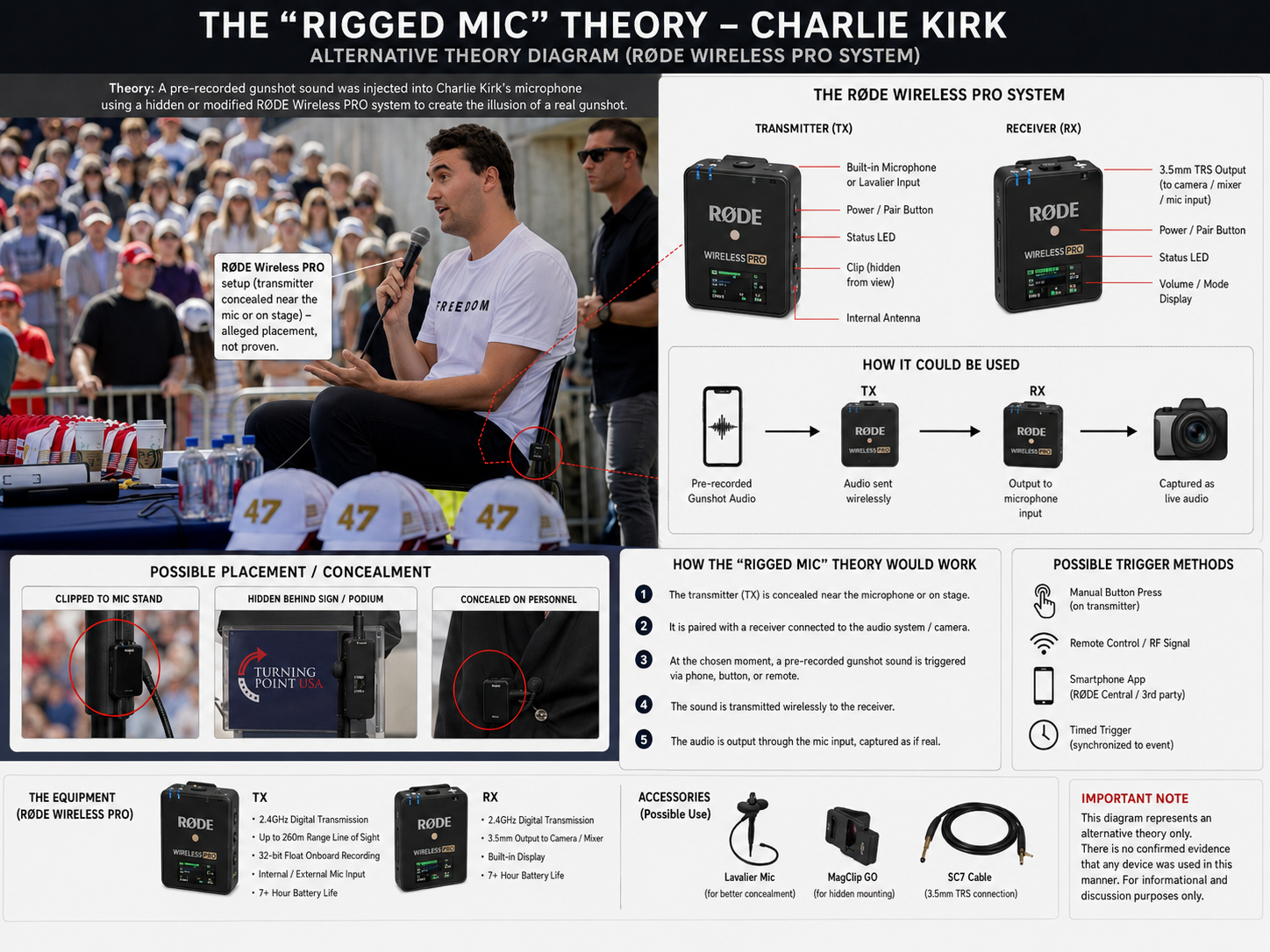
The diagram is useful for understanding the theory as a proposed mechanism rather than as proof that such a device existed at the event. Its value is explanatory: it shows how proponents connect the microphone, a possible trigger, and the sound or injury they argue occurred.
That's the mechanism as its proponents diagram it, transmitter concealed near the mic, a pre-recorded gunshot sent wirelessly to a receiver, triggered by a button, an app, or a timer. The diagram itself carries the caveat its own creators attached: the placement is alleged, not proven, and no confirmed evidence shows any device was actually used this way.
None of this has held up under scrutiny from people who aren't already inside the theory. Utah's official autopsy lists the cause of death as a gunshot wound to the neck, the manner of death homicide, with testimony describing a bullet that obliterated the left side of the C2 through C7 vertebrae and severed the spinal cord, consistent with a high-velocity rifle round fired from roughly 130 to 175 yards away, not a few grams of explosive clipped to a shirt. Independent fact-checkers reviewing the same event video have concluded the bulge conspiracy theorists point to on Kirk's chest is the lavalier pack itself, visible in footage of him wearing the identical setup at earlier events, and that the wound and bleeding pattern match a ballistic injury rather than a staged one. Even Piers Morgan, interviewing Owens directly, pressed her on whether she was profiting from a theory with no supporting physical evidence, comparing the pattern to Alex Jones. Owens hasn't backed off the microphone theory the way she eventually walked back her Israel claims, but nine months in, it remains something she and Coleman argue from photographs and inference, not something any medical examiner, ballistics lab, or court filing has independently confirmed.
A separate strand of the broader alternate-theory landscape involves aircraft rather than the microphone. Owens has spent months arguing that Egyptian-registered planes have shadowed Charlie or Erika Kirk's own travel for years, citing flight-tracking data showing dozens of overlapping locations between 2022 and 2025. One diagram built around that claim traces three Egyptian aircraft, operated by Al Masria Universal Airlines, flying from Cairo to Teterboro, New Jersey by way of Shannon, Ireland in late August 2025, and departing Teterboro again on September 10, 2025, the day of the shooting.
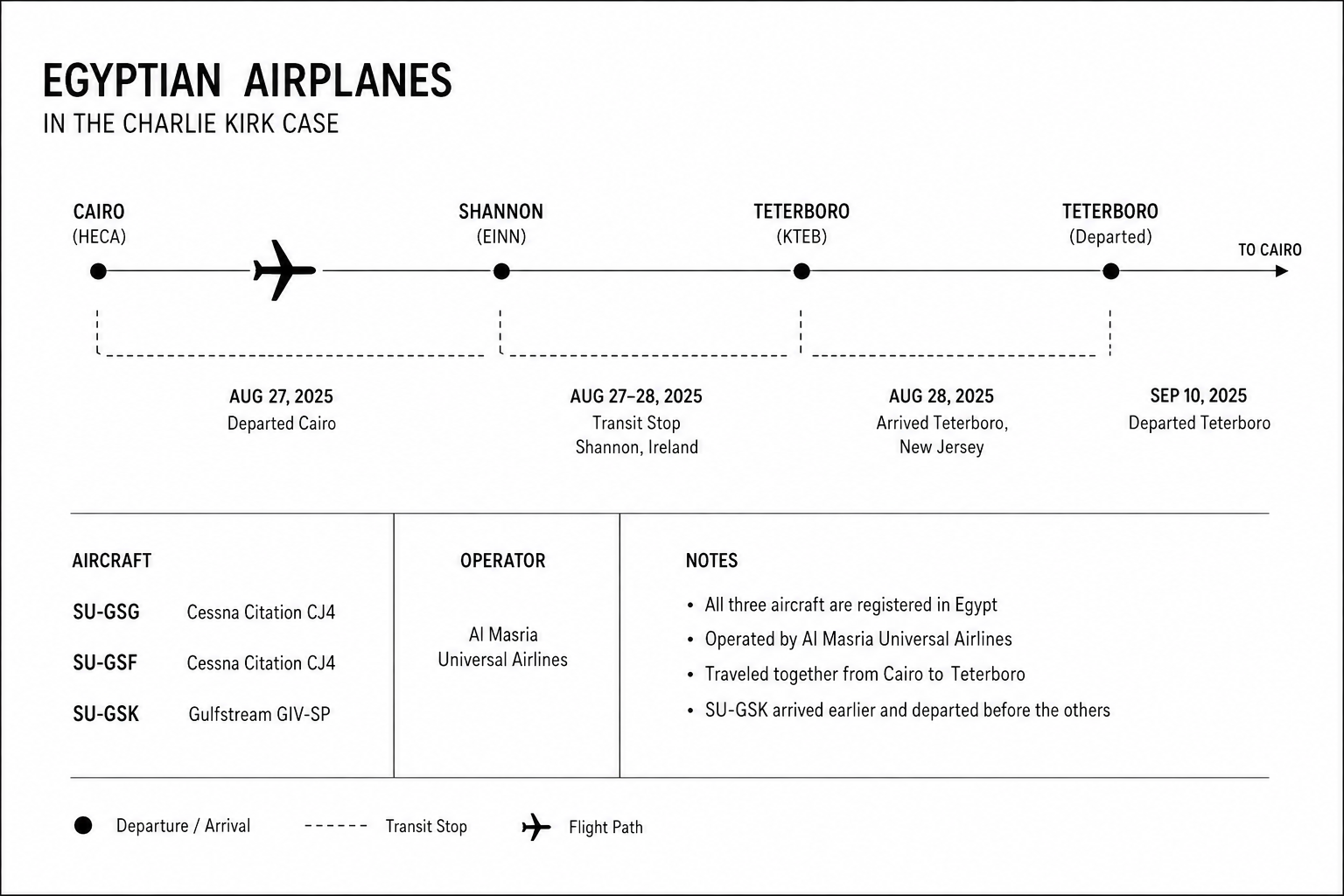
Two things are worth knowing before reading too much into the dates lining up. First, an earlier and more specific version of this same theory, that an Egyptian military plane fled immediately after Kirk was shot, turned out to rest on a UTC time zone error; the flight in question had actually departed hours before the shooting, not after it. Second, nothing in the public record ties these particular tail numbers to Kirk, Robinson, or the investigation beyond the fact that they were airborne on dates that can be looked up. The official case against Robinson doesn't reference any foreign or additional actor, and no prosecutor, defense filing, or independent investigator has connected this flight data to the shooting. A true flight path is still just a flight path until something more than timing links it to the event.
A pair of short audio clips have also circulated alongside the theory, shared by people describing them as scanner traffic from Utah Valley that day. Both are embedded below exactly as they were provided, and both come with the same label: unverified. Neither matches the actual dispatch audio Utah authorities released and that CBS, Fox, NBC, and the Salt Lake Tribune have all reported on consistently, which describes officers searching for a masked figure in tactical gear on a rooftop, not a hospital chase or an SUV pursuit. Where these two clips actually came from isn't clear, nothing ties them to this case beyond the claim attached to them, and the first one in particular doesn't sound like two-way radio traffic at all. Treat them accordingly.
The first recording is the clip described as involving activity at or near the hospital. As with the other audio in this section, that description is part of the claim attached to the recording rather than independently established provenance, so it should be heard as an unverified piece of material rather than confirmed dispatch traffic.
The second recording is the one circulated with the claim that officers were describing an SUV moving at high speed with a person's legs hanging out. That interpretation has not been independently authenticated, and the clip should be weighed alongside the same provenance problems that apply to the first recording.
Conclusion
There are real gaps in what the public has seen, and some of the surveillance footage is imperfect enough to invite questions. But questions are not all equal. Robinson's own doppelganger comment was a joke, and the arguments about his build, gait, and clothing in the garage footage remain interpretations of ambiguous video rather than proof that a second person took his place. The rigged microphone theory goes further still. It proposes a completely different cause of death, but the material presented for it so far is photographs, inference, and disputed audio rather than independently verified forensic evidence.
The larger point is that the unanswered questions in this case are not all of the same kind. Some concern interpretation, such as how a person appears in a particular frame or whether a visual detail is meaningful. Others would require new evidence capable of changing the underlying forensic or chronological record.
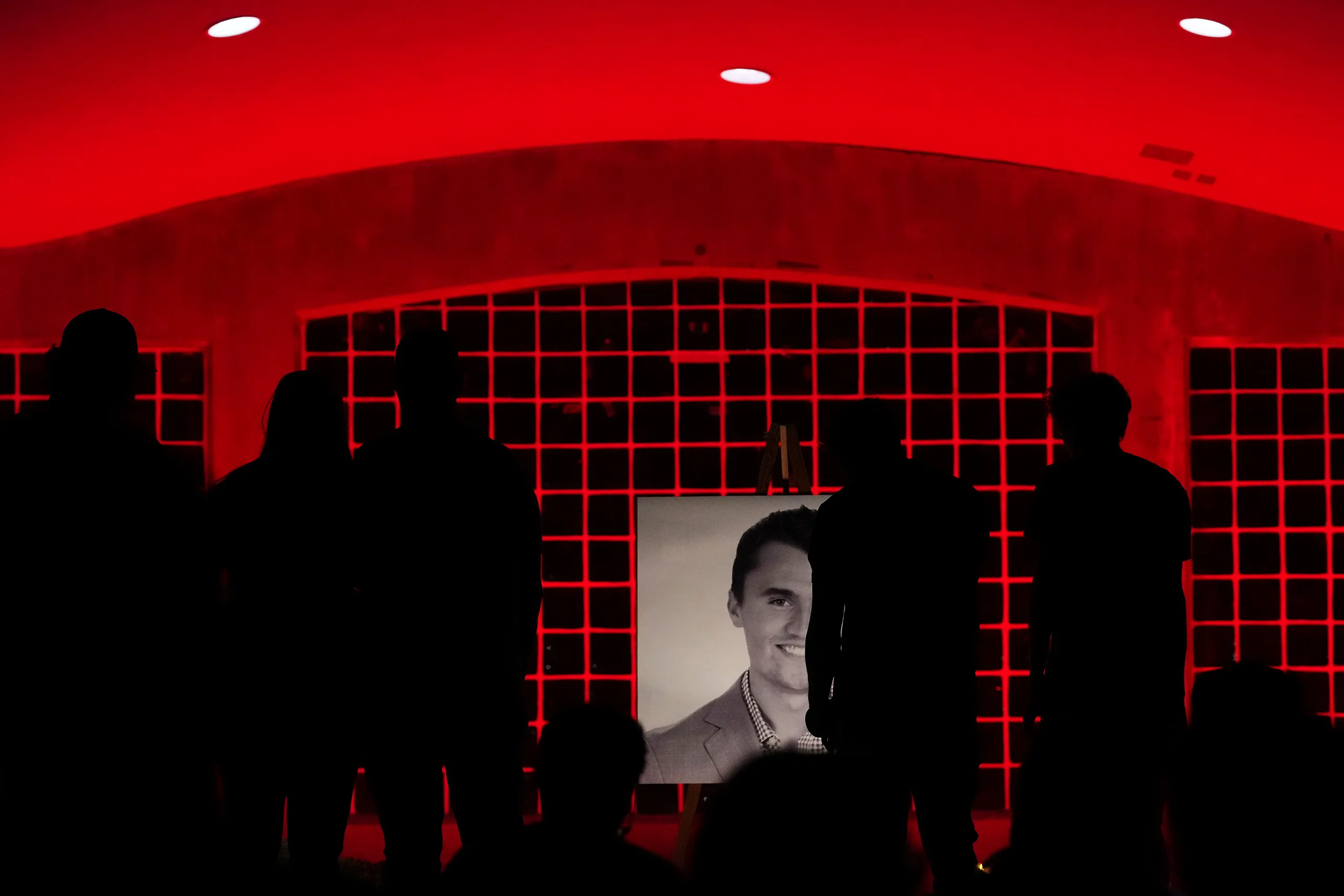
That distinction matters because a striking image can make a theory feel more concrete without necessarily making it more evidentiary. The photograph above belongs in the discussion because it is part of the material people are using to question the official account, but its significance still depends on authentication, context, and whether it can be connected to independently verifiable facts.
That does not mean every unanswered detail should be dismissed. It means the strongest conclusion has to follow the strongest evidence. Based on the record described above, the state's case still has substantially more direct support than either alternative theory. If new forensic evidence, authenticated recordings, additional surveillance, or court testimony materially changes that picture, then the analysis should change with it. Until then, the distinction is simple. There are things about the case that remain worth questioning, and there are claims that have not yet been proved.