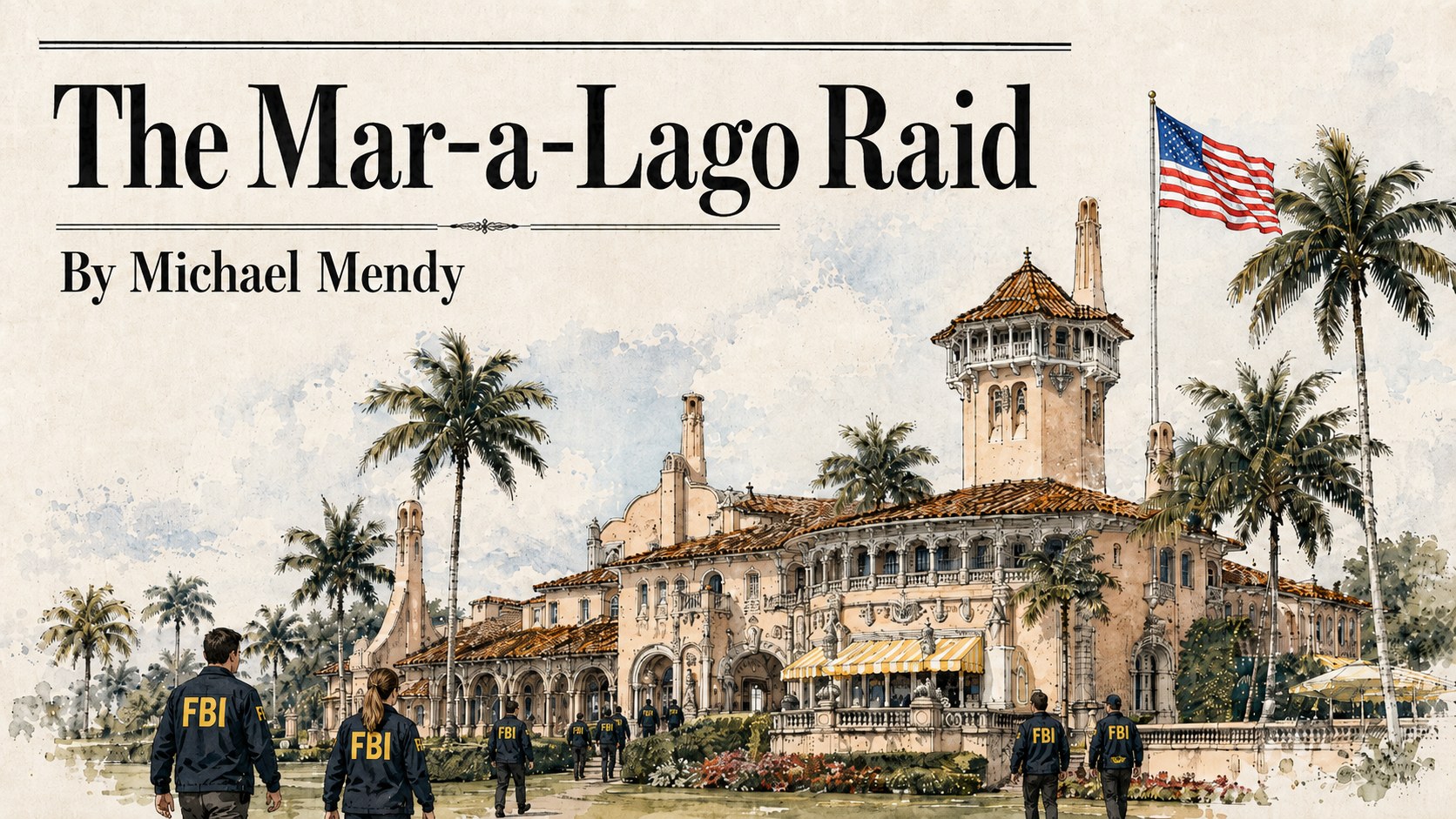
On the morning of August 8, 2022, FBI agents executed a court-authorized search of Donald Trump's home at Mar-a-Lago, the first time in American history federal agents had searched the residence of a former president. It was not a raid that came out of nowhere. It was the last step in an eighteen month standoff between the National Archives and a former president who did not want to give his boxes back.
How It Started
The National Archives had been asking for records since early 2021, the kind of routine handoff every outgoing administration is legally required to complete under the Presidential Records Act. Trump's team was slow, and in January 2022 the Archives finally retrieved fifteen boxes from Mar-a-Lago. When Archives staff went through them, they found 184 documents bearing classification markings mixed in among the paper, some marked Confidential, some Secret, some Top Secret, some with special access program markings on top of that.
That discovery is what turned a records dispute into a criminal referral. In May 2022, the Justice Department issued a grand jury subpoena demanding the return of any classified material still at Mar-a-Lago. Trump's attorney at the time, Evan Corcoran, searched a storage room at the property, with Trump aide Walt Nauta unlocking it for him, and came away believing everything had been located. On June 3, 2022, the department's top counterespionage prosecutor and FBI agents came to Mar-a-Lago in person and left with a folder of documents and a signed certification stating that a diligent search had been conducted and all classified material had been returned. Corcoran drafted that certification. Another attorney, Christina Bobb, signed it at his instruction.
It was false. The August search would turn up more than twice as many classified documents as the June handoff had produced.
The Search
Agents arrived with a warrant approved days earlier by a federal magistrate, citing three statutes: the Espionage Act's prohibition on willfully retaining national defense information, a law against concealing or destroying government records, and a separate obstruction statute covering the destruction of records to impede an investigation. They left with 33 boxes and containers pulled from Trump's office and a storage room, containing just over a hundred documents with classification markings, among them at least one marked Top Secret/SCI, the tier reserved for the most sensitive compartmented intelligence in the government.
Those numbers only mean something once you know what the three tiers behind them actually look like in practice.
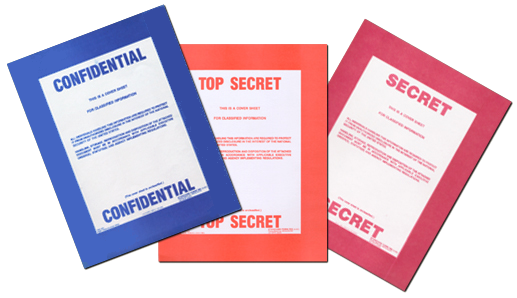
Confidential, Secret, and Top Secret are the standard classification system every document in the seizure got sorted into once agents catalogued it. The cover sheets themselves are unclassified. Their entire purpose is to sit on top of a stack of paper and announce, in large red or blue print, exactly how careful the person holding it needs to be before turning the page.
The property receipt the FBI left behind itemized every box by number, and reading it is a strange experience, because classified national security material sits right next to old magazines and press clippings with no distinction in the formatting at all.
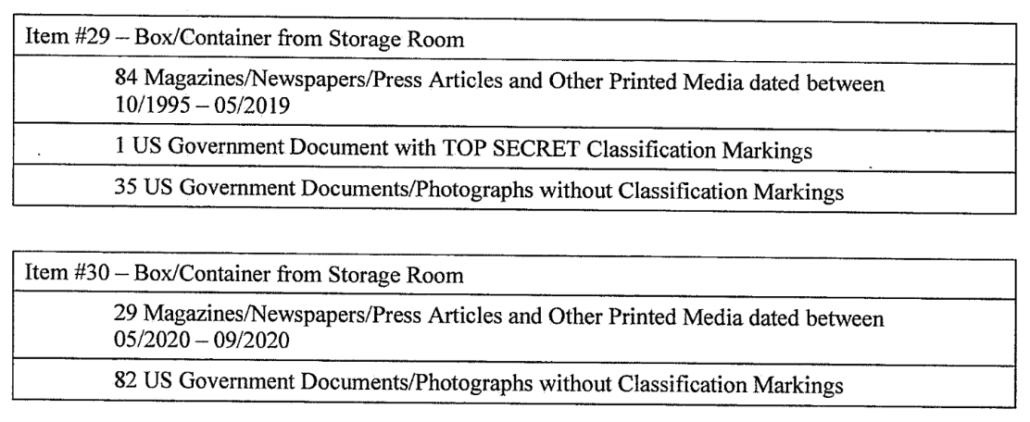
Item 29 alone held eighty four magazines and press clippings spanning almost twenty five years, one document marked Top Secret, and thirty five more government documents and photographs with no markings at all. Item 30, right next to it, was almost entirely unmarked government paperwork.
Item 33 is the one worth slowing down on. Along with eighty three more press clippings and forty four unmarked government documents, it contained two empty folders, both stamped "Return to Staff Secretary/Military Aide." Empty classified folders are their own kind of evidence. Something had been in them once, and whatever it was isn't accounted for in the box it was supposed to be filed in.
A compiled breakdown of individual boxes, cross-referencing item numbers against actual box labels, fills in detail the property receipt alone doesn't spell out as plainly.
Item 2, box label "Leatherbound," is the standout row. Ninety nine press clippings, seven documents marked Top Secret, fifteen marked Secret, two marked Confidential, seventy four more with no markings, and on top of all of that, forty three empty folders still stamped "CLASSIFIED" and twenty eight more stamped for return to a staff secretary or military aide. One box held more empty classified folders than any single number of documents it actually contained. Box A-35, item 18, has its own oddity: only four press clippings and a single Secret document, but 1,578 unmarked government documents and photographs, by far the densest single container in the entire seizure.
The office itself told a similar story to the storage room, just more concentrated. Agents found that leatherbound box, along with a diplomatic passport, a document marked Secret, and personal mementos, all sitting together the way a person keeps the things they actually care about close at hand rather than filed away.
None of that had to stay abstract. When Jack Smith's team filed the indictment in June 2023, they attached photographs, taken during the search itself, showing exactly how these boxes had been kept.
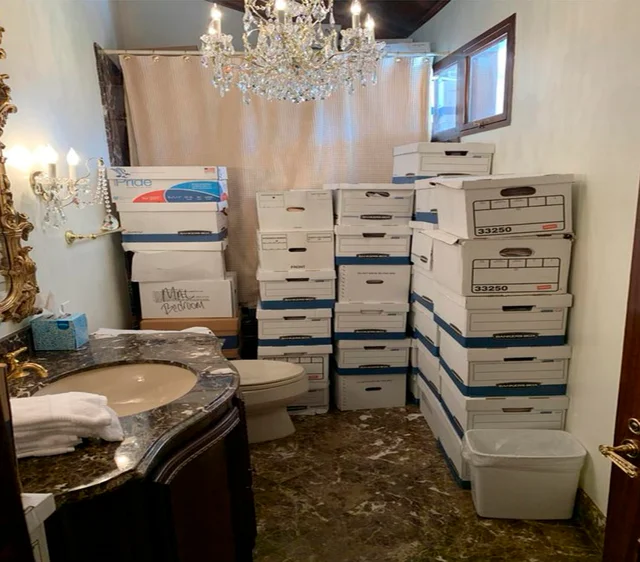
One image, cited directly in the indictment, shows a bathroom stacked floor to ceiling with boxes, a crystal chandelier hanging over the toilet as though the room had simply been repurposed as overflow storage. It's the kind of image that needs no caption to make its point.
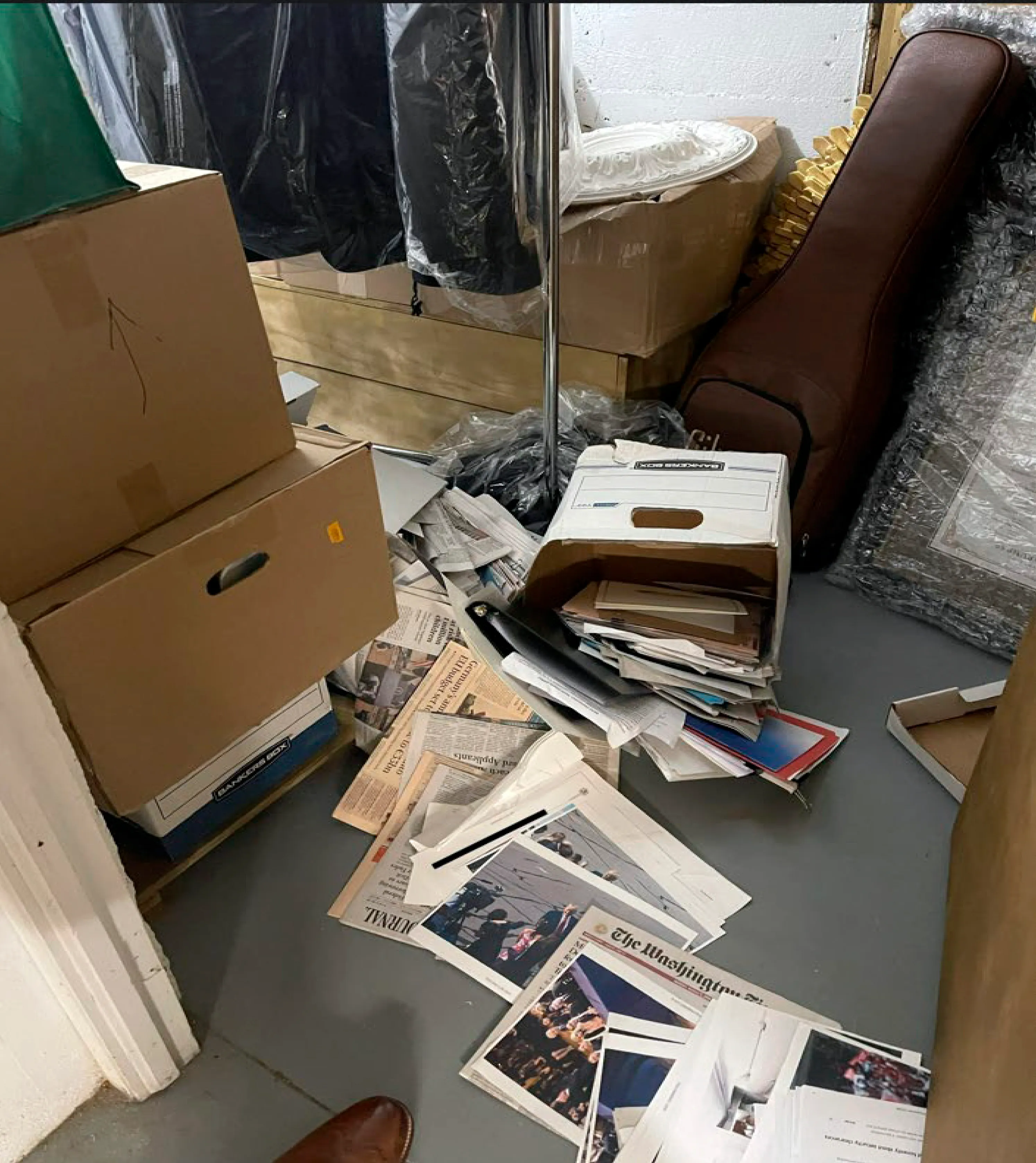
Another shows a storage room where at least one box had come apart entirely, spilling press clippings and loose photographs across the floor next to a guitar case and a stack of dry cleaning. This is what "boxes from the storage room" looks like from the inside, not a tidy row of labeled containers but a room where things had clearly been shifted, stacked, and left more than once.
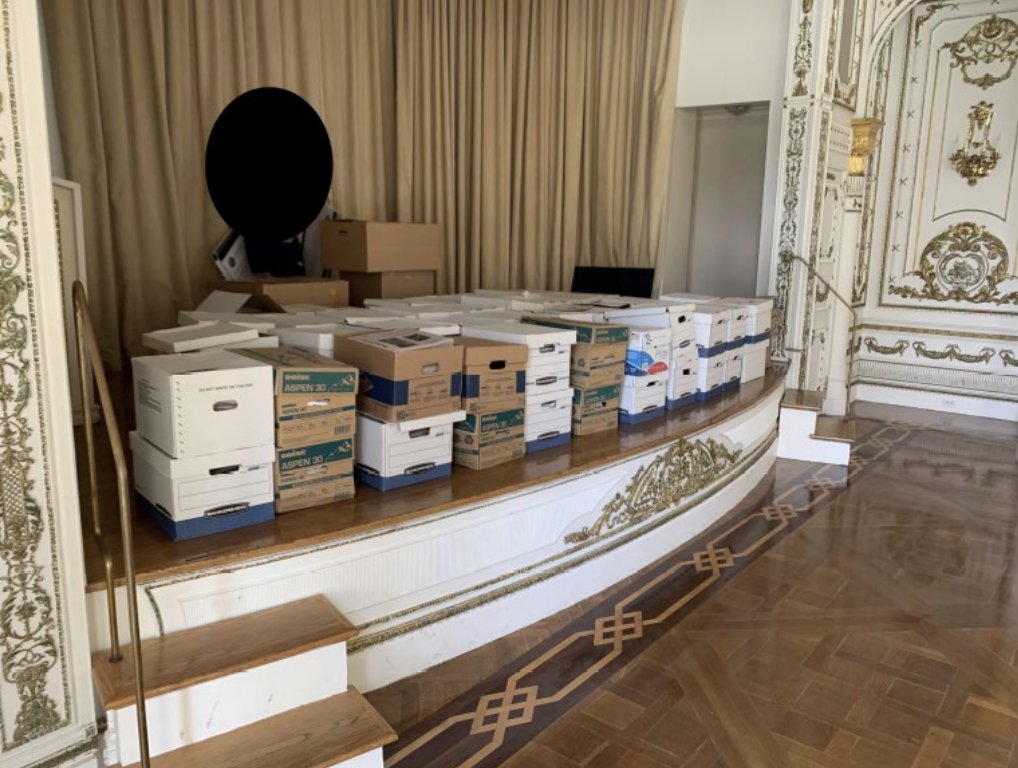
A third photo shows dozens more boxes stacked on the stage of Mar-a-Lago's White and Gold Ballroom, gilded molding and a chandelier sconce framing a scene that looks more like a moving company's warehouse than a former president's residence. Taken together, the three photos make the same point the property receipt makes in dry, itemized prose: whatever was supposed to happen to these records after January 2021 never really happened. They just kept getting moved from one room to another.
Scattered through the boxes were a few items that got outsized attention once the inventory became public: a document describing a foreign government's nuclear defense capabilities, an executive grant of clemency for Roger Stone, and a handwritten note. None of that made the classified material any more or less classified. It just made clear that whatever system had once existed for keeping state secrets separate from personal keepsakes had stopped functioning well before anyone from the FBI walked through the door.
The Special Master Fight
Trump's lawyers went to federal court within days, asking for an independent review of everything seized before prosecutors could look at it, arguing that some of it might be protected by attorney-client privilege or executive privilege. Judge Aileen Cannon, a Trump appointee in the Southern District of Florida, agreed in September 2022 and appointed retired judge Raymond Dearie as special master, tasked with sorting more than eleven thousand pages into what could be released to investigators and what couldn't.
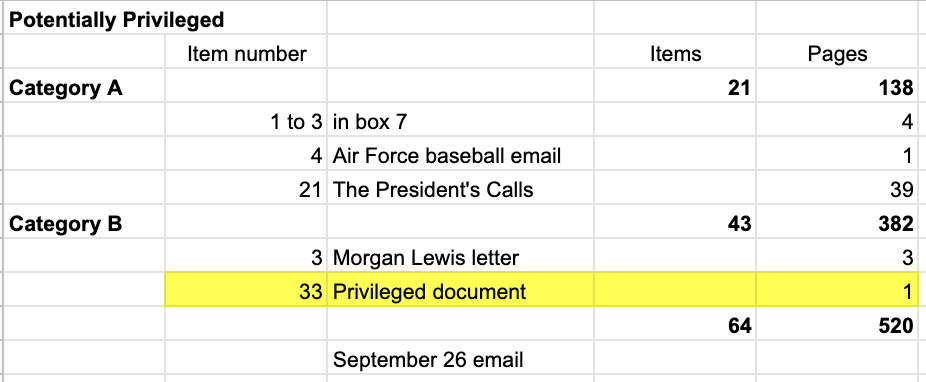
That table is a fragment of the actual privilege log filed with the court. Category A ran twenty one items across 138 pages, including a letter from Trump's outside law firm Morgan Lewis. Category B ran forty three items across 382 pages, including a single document, item 33, flagged and highlighted as genuinely privileged out of everything reviewed. Sixty four items and 520 pages went through that filter in total, and among the specific documents Dearie's review released back to prosecutors as non-privileged was, of all things, a printed email from the Air Force Academy's head baseball coach about the state of the program.
The special master process never finished on its own terms. In December 2022, a unanimous three judge panel on the Eleventh Circuit, two of them Trump's own appointees, reversed Cannon and ruled she never had jurisdiction to order the review in the first place. The classified subset of documents went straight back to the Justice Department's investigators, months earlier than Cannon's original timeline would have allowed.
Jack Smith Steps In
Three days after Trump announced his 2024 campaign, Attorney General Merrick Garland appointed Jack Smith, a career prosecutor who had run the department's Public Integrity Section and later served as chief prosecutor at an international war crimes court in The Hague, as special counsel over both the documents case and the separate January 6 investigation. Garland's stated reasoning was straightforward: the public interest required an investigation insulated from the appearance of being run by political appointees, at the exact moment the person under investigation and the sitting president were both likely to be on a ballot together.
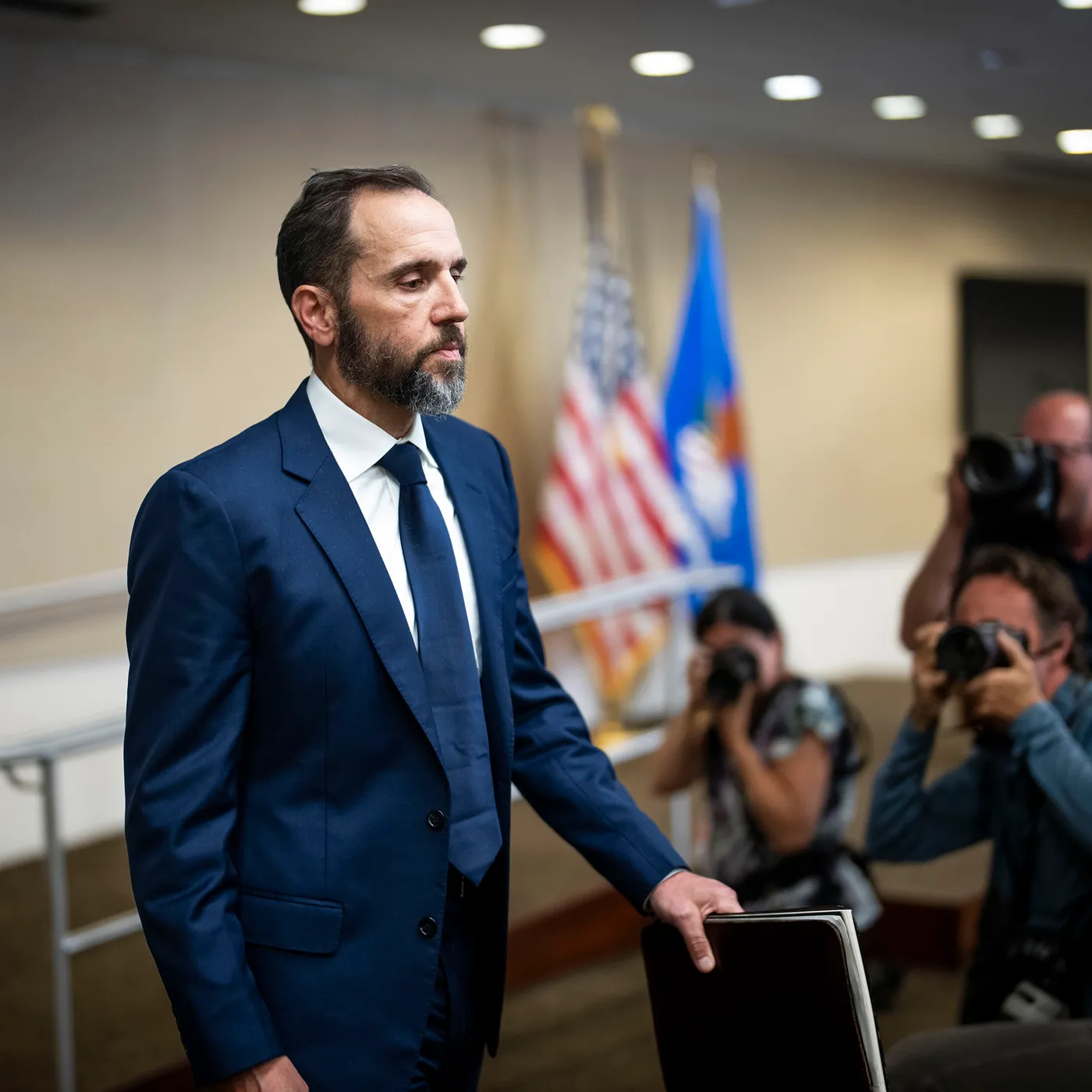
Smith inherited a case that already had a property receipt, a reversed special master, and a documented false certification behind it. What he still needed was an indictment, and that took him another seven months to bring.
The Indictment
In June 2023, a grand jury indicted Trump on 37 federal counts, the bulk of them for willfully retaining national defense information under the Espionage Act, along with obstruction and false statement charges tied to the June 2022 certification. Walt Nauta was charged alongside him. A month later, a superseding indictment added a third defendant, Mar-a-Lago property manager Carlos De Oliveira, and new charges alleging that Trump, Nauta, and De Oliveira had tried to get an IT employee to delete security camera footage the grand jury had subpoenaed. Three people, one former president among them, were now formally accused of trying to make evidence disappear after they knew investigators were looking for it.
How Trump's Case Compared
Trump wasn't the only recent former official found holding onto classified material he shouldn't have had. Biden's lawyers found documents from his time as vice president at his old office in Washington and at his Delaware home in late 2022 and early 2023. Pence's own lawyers found a smaller batch at his Indiana home around the same time and self-reported it. Neither man was charged with anything.
Volume alone explains a lot of the gap. Trump's case involved roughly ten times as many marked documents as Biden's and more than twenty times Pence's, and the rate per year in office is even more lopsided. But volume wasn't the only difference cited when prosecutors explained their decisions. Neither Biden's nor Pence's case involved an obstruction allegation, a false certification to the government, or a search that recovered documents after investigators had already been told, in writing, that everything had been returned. Pence and his team let the FBI search essentially the entire property voluntarily. Trump's team fought that same access for months.
None of that resolves the broader argument about whether the two cases should have been handled more alike than they were. It does mean the comparison is more complicated than a single number, and worth looking at directly rather than assuming either version, "it was all the same" or "it wasn't close," without the actual side-by-side in front of you.
Judge Cannon Dismisses The Case
Aileen Cannon was a 2020 Trump appointee to the Southern District of Florida, and by the time she ruled on the case that had already defined her time on the bench, from the special master fight through to the end.

In July 2024, more than a year into the prosecution, she threw the entire case out. Her reasoning wasn't about the documents, the boxes, or the deleted footage. She ruled that Jack Smith's appointment itself was unconstitutional, that Garland lacked the authority to install a special counsel from outside the normal Senate confirmed ranks of the department, and that funding his office violated the Constitution's appropriations clause.
Legal scholars who had spent decades watching special counsel appointments, including ones the Supreme Court had already upheld, treated the ruling as a significant outlier rather than a serious constitutional correction. Smith's team called the reasoning unsupported by precedent and appealed to the Eleventh Circuit the next month.
How It Ended
The appeal never reached a decision on the merits. After Trump won the November 2024 election, Justice Department policy against prosecuting a sitting president took over, and Smith's office moved to drop the case against Trump personally before the inauguration. The prosecution of Nauta and De Oliveira initially continued without him, since neither one holds the office that triggers that policy. That didn't last either. In January 2025, under a new U.S. Attorney appointed by the incoming administration, the department reversed course and moved to drop the remaining charges against both men as well. By February 2025, the Eleventh Circuit had formally closed the case. Nobody was ever convicted of anything.
What's left, once all of that has played out, is the property receipt. Thirty three boxes, pulled out of a house in Florida, item by item, magazines next to Top Secret material next to a handwritten note, empty folders that should have had something in them. The case that grew out of that inventory never reached a jury, and the constitutional question at the center of its dismissal never reached the Supreme Court either. The boxes themselves are the only part of this story that got fully documented before anyone had the chance to argue about what should happen next.