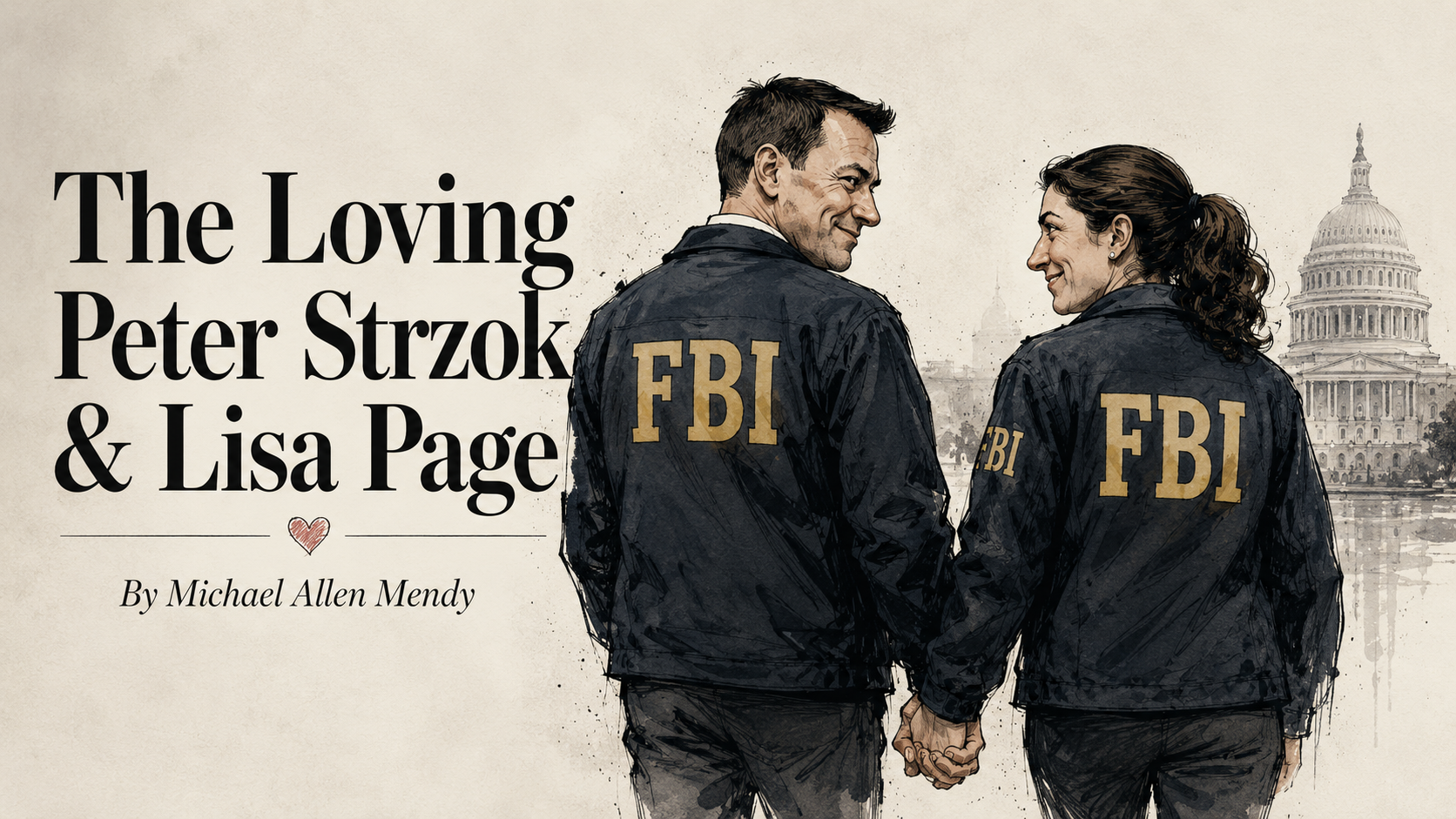
Peter Strzok and Lisa Page were two of the most senior people inside the FBI's Clinton email and Russia investigations. They were also, for a stretch of that same period, sleeping together, and doing it on the same FBI-issued phones they used to run those investigations. Neither fact alone is the scandal. Together, they became one.
Who They Were
Peter Strzok was a career FBI counterintelligence agent, senior enough by 2016 to be deputy assistant director of the Counterintelligence Division. He helped lead the investigation into Hillary Clinton's private email server, opened the case file that became Crossfire Hurricane on July 31, 2016 at Deputy Director Andrew McCabe's direction, and was one of the first people Robert Mueller brought onto the special counsel's team in May 2017. The formal decision to authorize that investigation is credited elsewhere in the Inspector General's account to Counterintelligence Assistant Director Bill Priestap, Strzok's own boss at the time.
Lisa Page was an FBI attorney serving as special counsel to Deputy Director Andrew McCabe, advising on both the Clinton and Russia matters from inside the front office. She briefly worked on Mueller's team as well, starting a few weeks after Strzok did.
They were also involved in an extramarital affair with each other, conducted for a period spanning roughly 2015 into 2017, largely in writing, over text message, on phones the government had issued them to do their jobs.
An Affair Conducted On Government Phones
Nobody would have known any of this if the Justice Department's Inspector General, Michael Horowitz, hadn't gone looking for something else entirely. While reconstructing the FBI's handling of the Clinton email investigation in 2017, Horowitz's office pulled forensic images of FBI mobile devices and found more than 40,000 unique text messages between Strzok and Page outside a separate five-month gap in message collection, discussed further below, plus thousands more recovered from each of their phones once investigators went back and filled that gap in. Most of it was ordinary workplace chatter and relationship talk. A slice of it was commentary on the presidential race, written by two people directly involved in investigating one of the candidates in it.
One exchange, recovered from that same trove, shows how casually the personal and the professional blurred together. On May 19, 2017, two days after Mueller's appointment as special counsel, one of them was talked through whether to join his new team full time.
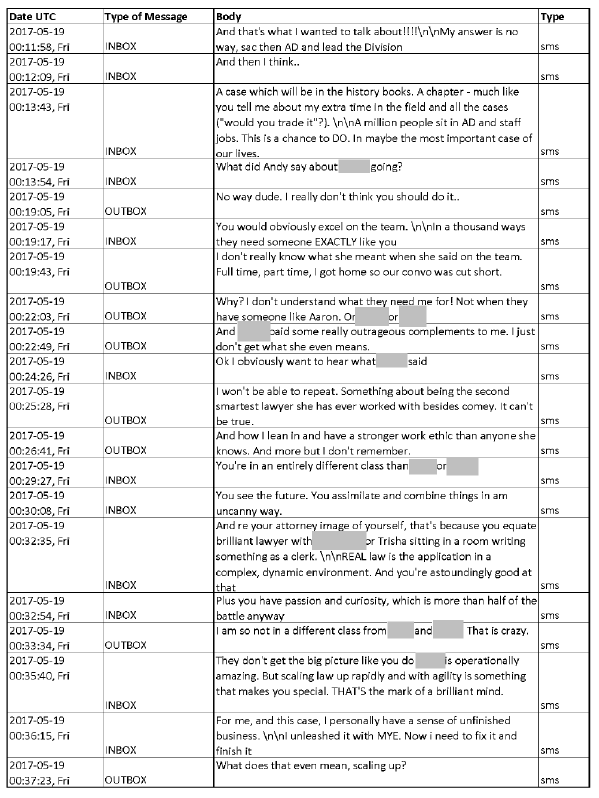
"A case which will be in the history books," one message reads. "A million people sit in AD and staff jobs. This is a chance to do... in maybe the most important case of our lives." The other side of the conversation is more hesitant: "No way dude. I really don't think you should do it." The message log and the Inspector General's own reconstruction both identify the enthusiastic voice, the one weighing history books and unfinished business, as Strzok's; the cautious "No way dude" reply is Page's. Both of them ended up on Mueller's team regardless, Strzok first and Page a few weeks later. Versions of this exchange were already circulating in news coverage by early 2018; this particular screenshot, showing the raw phone export with its INBOX/OUTBOX labels, comes from a 2021 Justice Department FOIA release of the underlying phone data.
The rest of that same page of the log settles the attribution question directly rather than by inference. A few minutes later, the OUTBOX side of the conversation, worried about how the back-and-forth would look, writes: "Pete. Let's talk about this tomorrow." Only one person in this exchange would address the other by that name, and it isn't Strzok addressing himself.
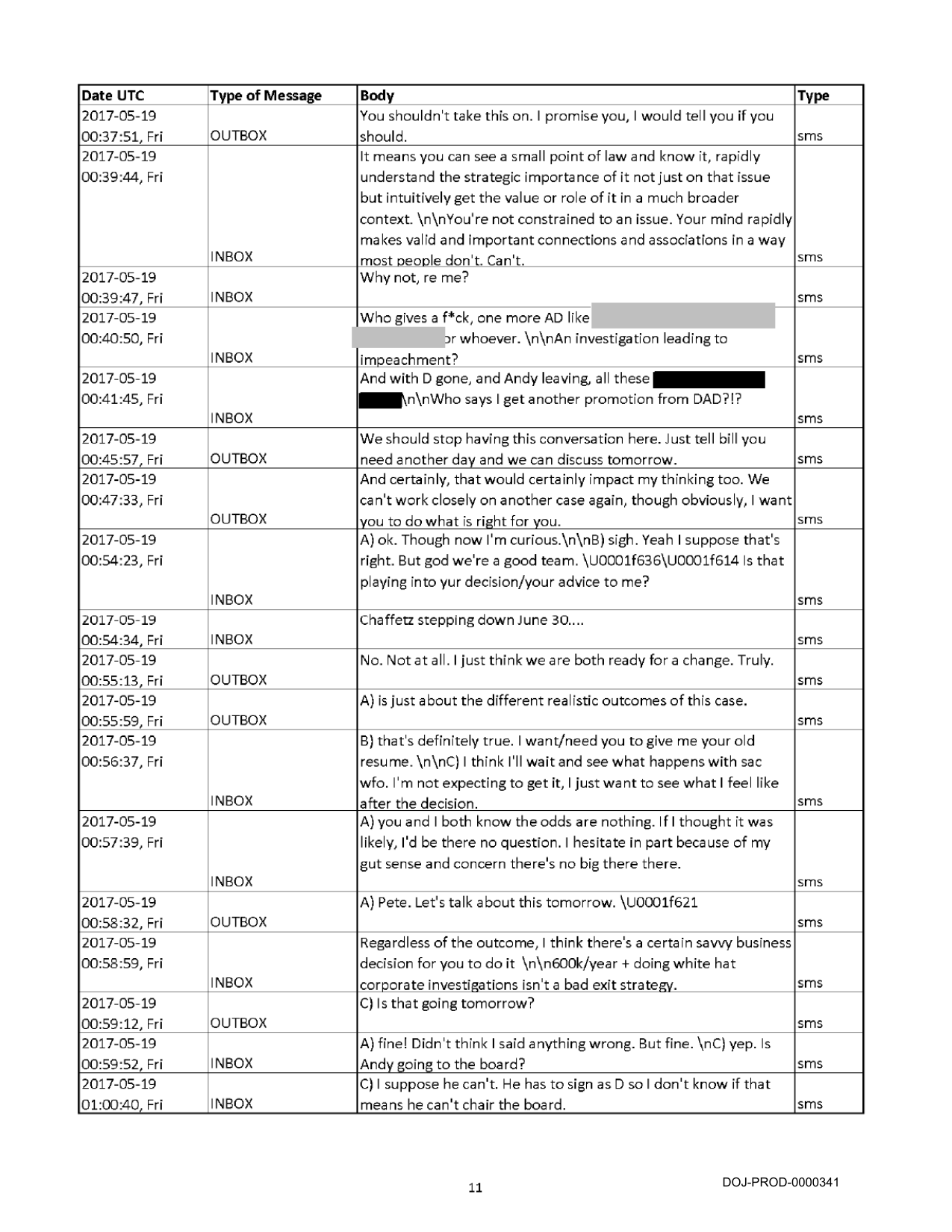
The same page carries the two lines quoted earlier as evidence Strzok didn't take the underlying case especially seriously by that point: "Who gives a f*ck, one more AD... An investigation leading to impeachment?" and, a little later, "you and I both know the odds are nothing... concern there's no big there there." Both are on the INBOX side, meaning both are his.
That same channel is also where the political commentary lived. Strzok and Page were both Clinton supporters and both hostile to Trump, and they said so to each other constantly, in language investigators later described as insulting and disparaging toward Trump and other political figures, worded in a way no FBI employee handling a politically sensitive case should have put into writing.
One line in that exchange needs a caveat the raw text doesn't carry on its own. Page's April 2016 message about switching to a phone that "can't be traced" reads, out of context, like two investigators plotting to dodge oversight. The Inspector General's report found she was talking about hiding the affair from their spouses, not about the Clinton investigation. That doesn't answer every question about why two people running sensitive cases wanted an untraceable channel in the first place, but it does mean the line isn't the smoking gun it looks like on its own.
"We'll Stop It" And The Insurance Policy
Two messages did more damage than the tens of thousands of others combined.
On August 8, 2016, Page texted Strzok asking whether Trump would ever actually become president. Strzok wrote back: "No. No he won't. We'll stop it." A week later, on August 15, 2016, he sent a longer message referencing a conversation in Deputy Director Andrew McCabe's office: "I want to believe the path you threw out for consideration in Andy's office — that there's no way he gets elected — but I'm afraid we can't take that risk. It's like an insurance policy in the unlikely event you die before you're 40."
Strzok and Page have both said, under oath and in public, that "insurance policy" meant the FBI couldn't assume Clinton would win and had to keep investigating the Russia allegations seriously regardless of the polls. Critics read it as evidence the FBI was hedging against a Trump presidency it intended to undermine. The surviving text doesn't resolve the argument either way, and the Inspector General's report didn't fully resolve it either. What the IG did conclude, in its June 2018 report, was that "We'll stop it" reflected "a willingness to take official action to impact the presidential candidate's electoral prospects," language investigators called deeply concerning regardless of what Strzok meant by it privately.
The "Media Leak Strategy" Panic
A third batch of texts became its own flashpoint in September 2018, built around two words: "media leak strategy."
On the morning of April 10, 2017, Strzok vented to Page about the Justice Department's own internal politics over leak investigations, a meeting he'd been left out of, a DOJ that seemed to be "getting all political and about to blow up the media leak regs and turn this into a circus."
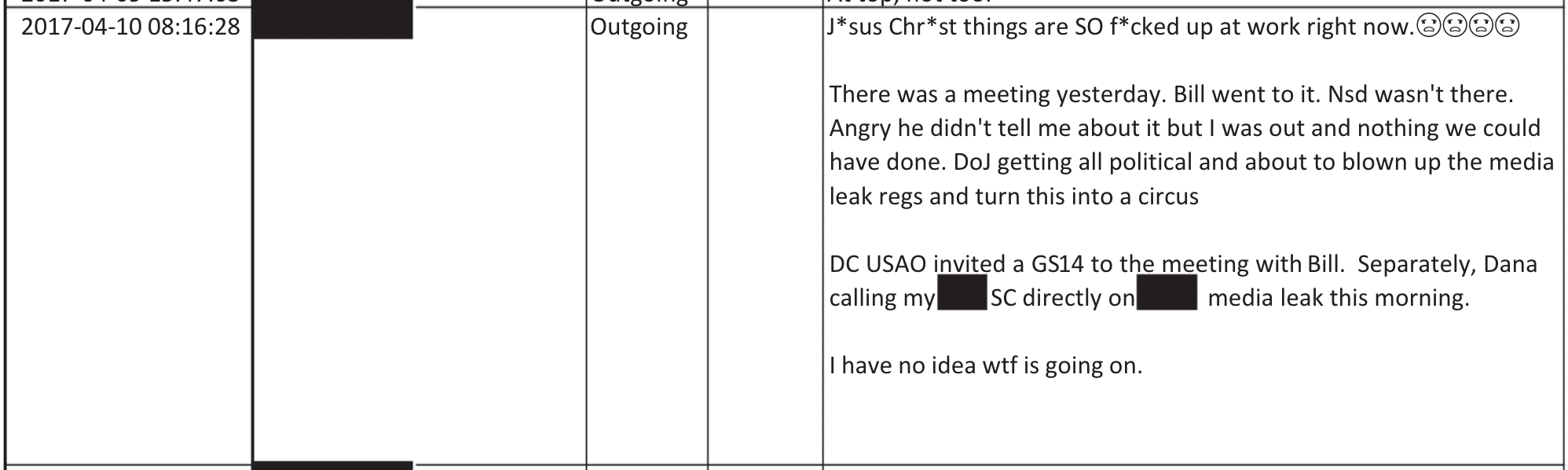
In a separate message from that same exchange, not pictured here, Strzok told Page he wanted to talk to her about a "media leak strategy" DOJ leadership wanted to see. The next day, April 11, the Washington Post published its first report that the FBI had obtained a FISA warrant to surveil former Trump campaign adviser Carter Page. In a September 2018 letter to Deputy Attorney General Rod Rosenstein, Rep. Mark Meadows put those two facts side by side and suggested the FBI had coordinated leaks to reporters, then intended to point to the resulting coverage as justification for the Page surveillance. Trump amplified the claim on Twitter that same day.
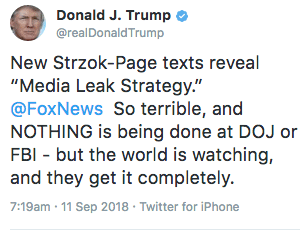
Fox News, Sara Carter, Donald Trump Jr., and a good chunk of the rest of conservative media ran with Meadows' reading: a coordinated anti-Trump leak operation running out of the FBI's own leadership.
What that reading skips over is how often Strzok and Page used the same shorthand, "ML," for media-leak investigations that had nothing to do with Trump. When the first reports surfaced that Mueller was investigating Trump directly, Strzok texted Page about "media leaks and what I do for a living" while trying to guess the Washington Post's sources, talking about leaks as something he chased for a living, not something he was orchestrating. On June 3, 2017, Page texted him that a suspect was in custody: "the first ML arrest of the Trump era."

That arrest was Reality Winner, an NSA contractor picked up that day for leaking a classified report on Russian attempts to probe U.S. election systems to The Intercept. She pleaded guilty roughly a year later and was sentenced to more than five years, one of the longest sentences ever handed down in a media-leak case. A year after her arrest, in June 2018, a separate leak investigation led to James Wolfe, the Senate Intelligence Committee's longtime director of security, indicted on three counts of lying to the FBI about his contacts with reporters, including a New York Times reporter he'd been in a relationship with.
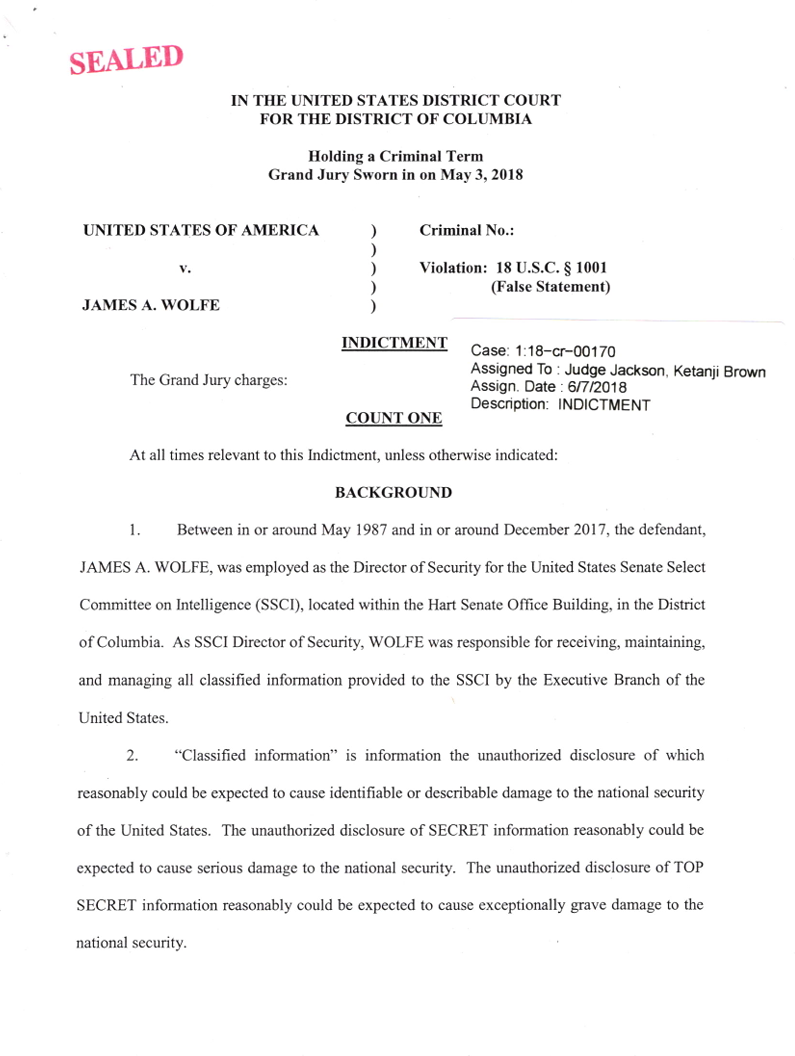
Wolfe pleaded guilty to one count and served two months in prison. He was never charged with the leak itself, only with lying about his contacts with reporters, but his case is about as close as the public record gets to identifying who was actually talking to the press about Carter Page, and it was Strzok's own division doing the chasing.
Strzok's attorney addressed the "media leak strategy" text directly once Meadows' letter went public: "The term 'media leak strategy' in Mr. Strzok's text refers to a Department-wide initiative to detect and stop leaks to the media." That statement alone doesn't settle anything; it's a lawyer's account of his own client's words. But a phrase Strzok and Page used the same way in a text about an NSA contractor's arrest and a text about a Senate staffer's indictment is hard to square with the idea that it meant something uniquely sinister only in the one text Mark Meadows chose to highlight.
Did The Texts Actually Change The Investigations?
This is where the record gets more complicated than either side's shorthand version of it.
Horowitz's 2018 review found that the messages created a legitimate appearance of bias serious enough to undermine public confidence in the FBI. It did not find evidence that political opinions drove the specific investigative and prosecutorial decisions it examined in the Clinton email case, and Strzok was never the sole decision-maker on any of them. The one place the IG said it could not rule out bias entirely was the delay in examining Clinton emails found on Anthony Weiner's laptop. FBI headquarters had the key information by September 29, 2016, then largely sat on it for close to a month before the matter was revived in late October. Investigators found no evidence the laptop was deliberately buried to protect Clinton, but they couldn't rule out that political considerations played some part in that month of inaction, either.
A separate 2019 IG review of Crossfire Hurricane itself found the FBI had sufficient basis under its own rules to open the investigation, and found no documentary or testimonial evidence that political bias drove the specific covert investigative techniques it examined. That report also documented serious, unrelated failures in the Carter Page FISA applications, which is its own story and not one the Strzok-Page texts are directly responsible for.
The Phones Get Wiped
The Strzok-Page texts produced a second controversy of their own, involving a separate set of devices. In January 2018, the Justice Department disclosed to Congress that a five-month window of messages between the two, December 15, 2016 through May 17, 2017, was missing from the FBI-issued Samsung Galaxy S5 phones they'd been using; the Senate Judiciary Committee dated the disclosure to DOJ's production of messages on January 19, 2018. The FBI blamed a software compatibility problem tied to that phone's rollout, not a deliberate deletion, and the Inspector General's office eventually went back through other devices and backups and recovered thousands of the missing messages: 9,311 pulled from Strzok's phone and 10,760 from Page's. Those figures include duplicates and messages involving other people, not just each other, so they're not a clean count of "missing conversations between the two of them" so much as everything investigators could dig up from that stretch. Horowitz's office ultimately found no evidence the gap itself was intentional.
That's a different episode from the document below, which involves different phones entirely. This spreadsheet is headed "JCON iPhone Property Number," an internal DOJ tracking log for iPhones assigned to FBI and DOJ personnel connected to the Russia investigation and the Special Counsel's office, recording who reviewed each device, whether it held anything relevant, and what happened when a phone turned up wiped, reset, or missing. It's its own records-preservation controversy involving Special Counsel-era device handling, not a continuation of the earlier Samsung text-message gap, even though the two stories tend to get told as one.
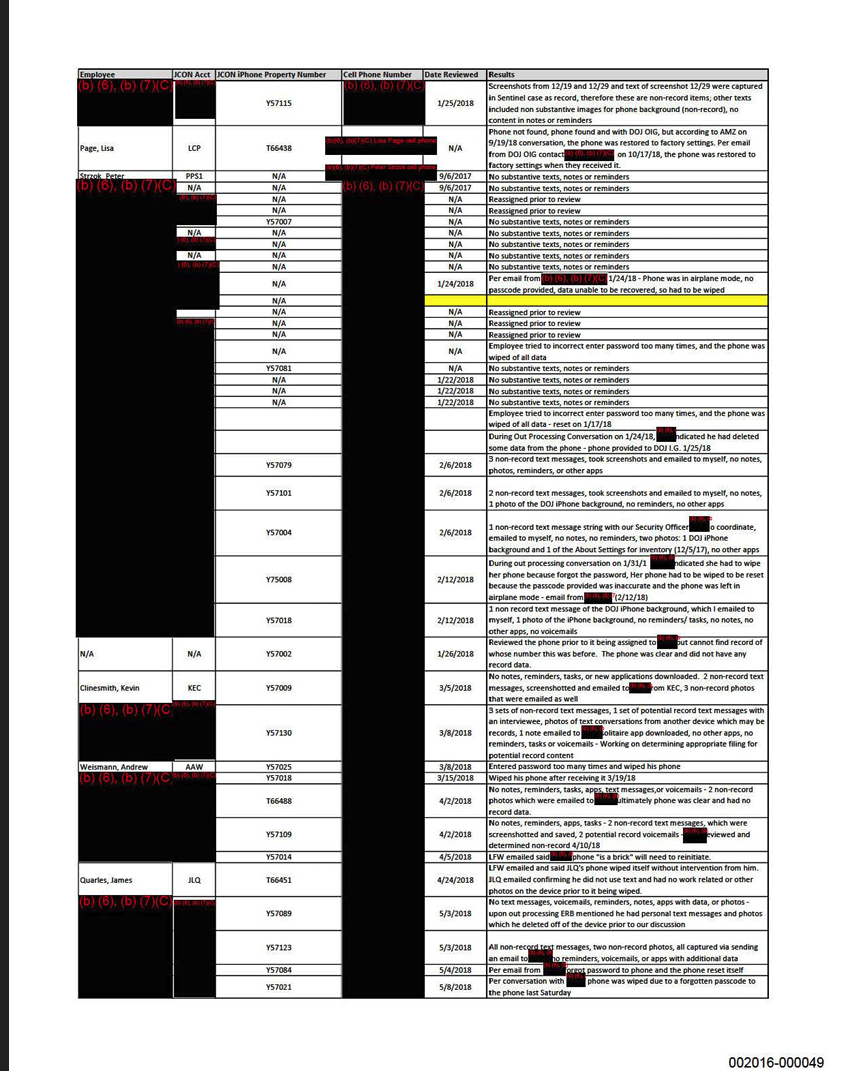
Lisa Page's own row says her phone "was restored to factory settings," per a DOJ contact's account relayed weeks after the fact. She isn't the only recognizable name on the page. Kevin Clinesmith, the FBI lawyer who later pleaded guilty to altering an email used in a Carter Page FISA renewal, appears with a note about non-record texts and photos of text conversations from another device. Andrew Weissmann and James Quarles, two of Mueller's senior prosecutors, both show up with entries describing forgotten passwords, phones reset after too many incorrect passcode attempts, or devices left in airplane mode until the data on them couldn't be pulled. None of this is proof of a cover-up; the plain, repetitive language of "forgot the passcode" and "reassigned prior to review" reads far more like ordinary government device-management sloppiness than a coordinated effort to destroy evidence. But it's exactly the kind of document that, dropped into an already distrustful environment, made the missing-texts story impossible to fully put down.
Strzok's Other Paper Trail
The texts weren't the only handwriting of his to end up in a public court file, though even that part of the record turned out to be less certain than it first appeared. Strzok was the FBI case agent who personally interviewed Michael Flynn on January 24, 2017, four days into the new administration, working alongside a second agent who was also present. Flynn was a retired Army lieutenant general who'd just been sworn in as Trump's National Security Advisor, and the interview that morning was about a narrow, specific question: what he'd actually told Russian ambassador Sergey Kislyak in a series of phone calls made during the transition, before Trump had taken office. Notes from that interview period surfaced years later as exhibits in Flynn's own criminal case, after his attorneys pushed for the release of material the government had originally withheld.
The government's first attempt at labeling those notes was wrong. In a November 5, 2019 letter to Flynn's attorney Sidney Powell, the U.S. Attorney's Office for the District of Columbia admitted it had swapped the authorship: pages it had identified as Strzok's were actually the other agent's, and pages attributed to the other agent were actually his.
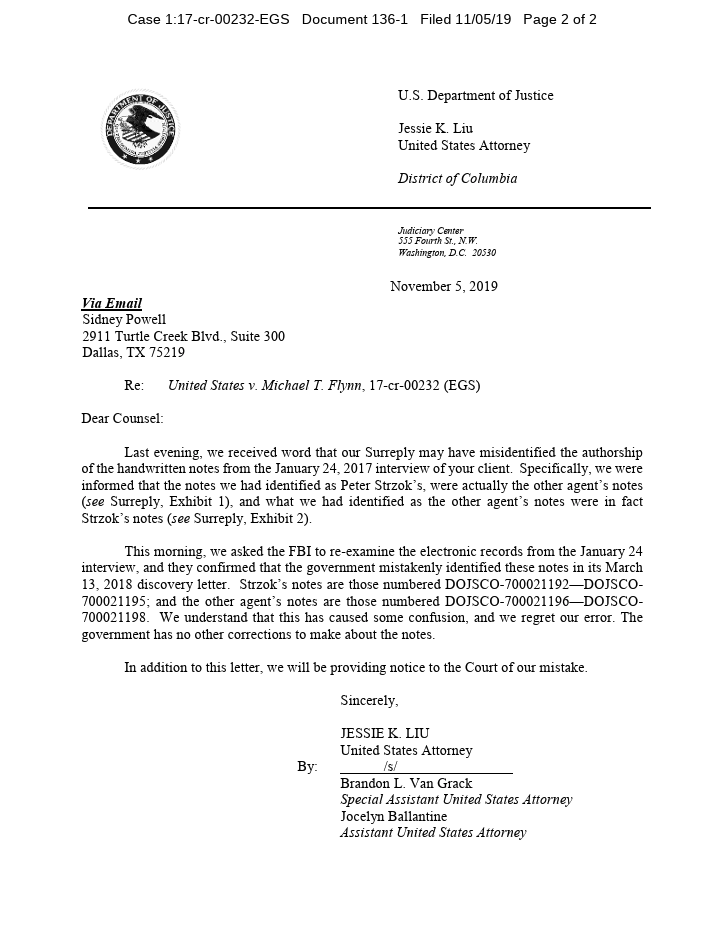
The government said it had the FBI re-examine its electronic records, confirmed the correct numbering for each set of pages, and called it a mix-up rather than anything more. It's a small, almost bureaucratic footnote next to everything else in this story, but a useful reminder that even the physical documents here came with their own chain-of-custody problems, well before anyone gets to arguing about what the notes actually mean.
The notes themselves, whoever's handwriting they turn out to be, are some of the most argued-over pages in the entire Flynn case. One page from that same January 24 file, headed simply "Afterwards," walks through a discussion the night before the interview about what the goal of talking to Flynn actually was: "Truth/Admission or to get him to lie, so we can prosecute him or get him fired?" The same page goes on to reason that the FBI "regularly show[s] subjects evidence, with the goal of getting them to admit their wrongdoing," and weighs what happens "if he initially lies" versus what happens "if we get him to admit to breaking the Logan Act."
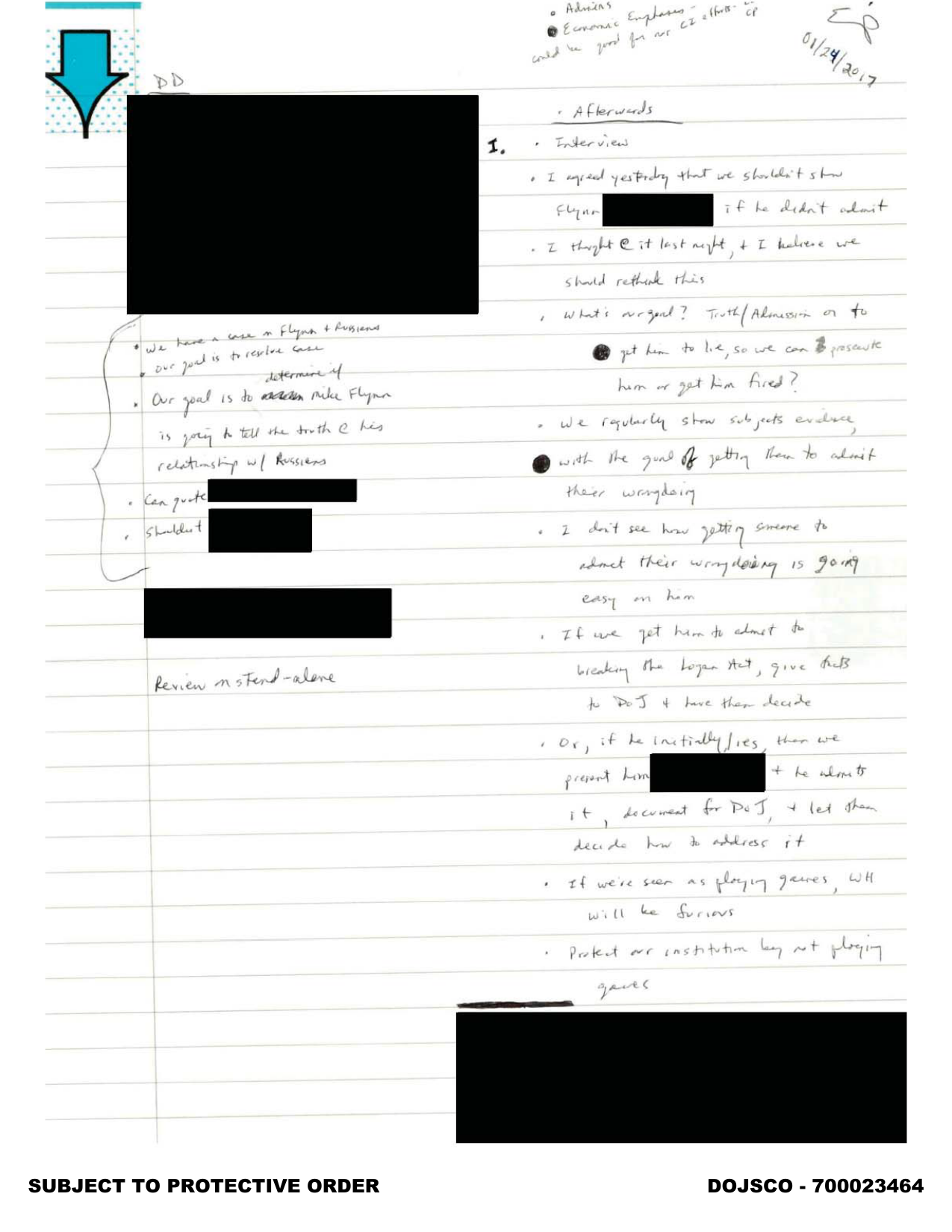
Flynn's defenders have pointed to that page for years as evidence the FBI went into the interview hoping to catch him lying rather than get at the truth. It's a fair reading of an unflattering document. It's also not the only email from that same 48 hours. The night before the interview, Lisa Page emailed Strzok and another colleague asking a startlingly basic procedural question: "Could the admonition re 1001 be given at the beginning at the interview? Or does it have to come following a statement which agents believe to be false?" She went on to suggest that if the warning didn't have to come first, "it would be an easy way to just casually slip that in."
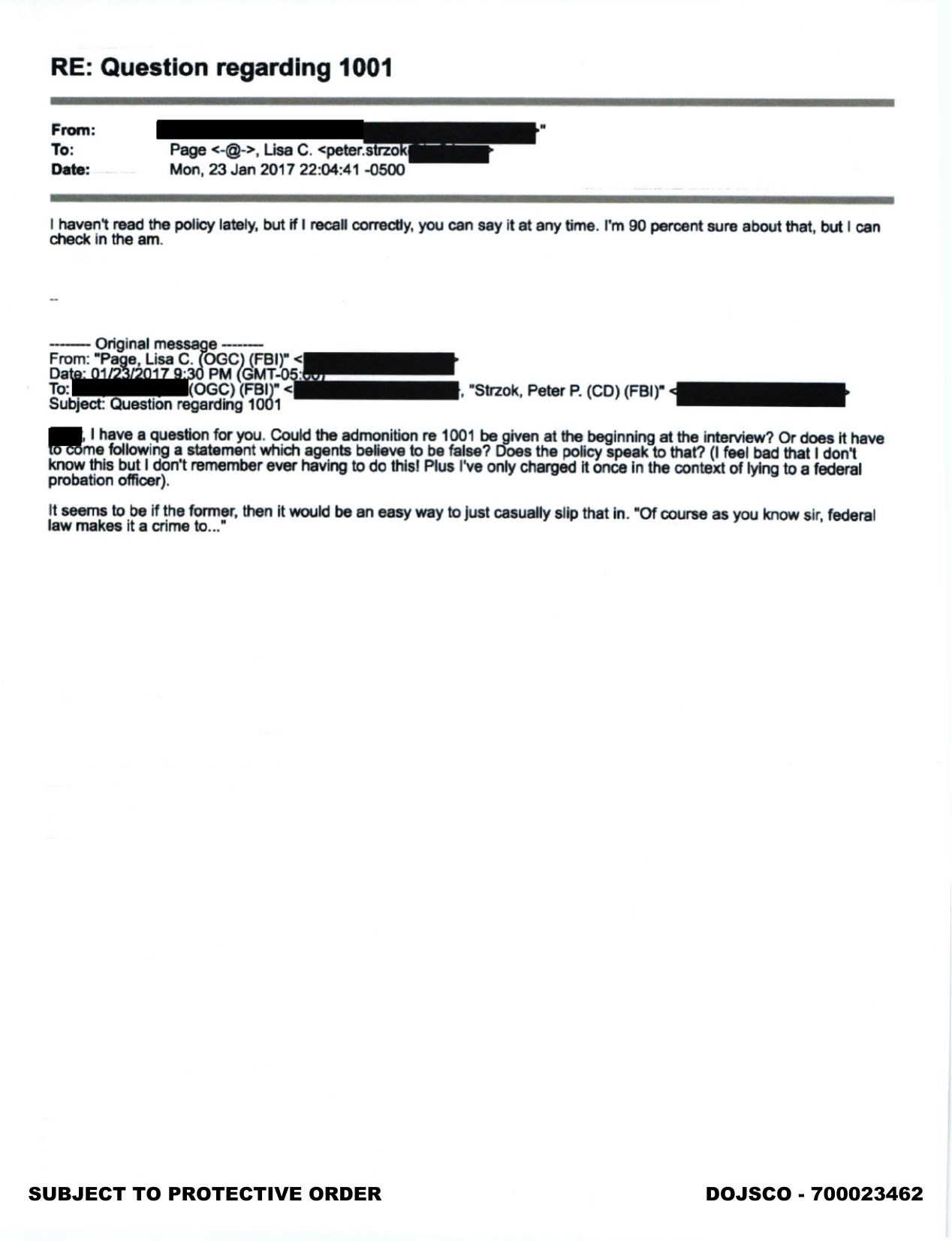
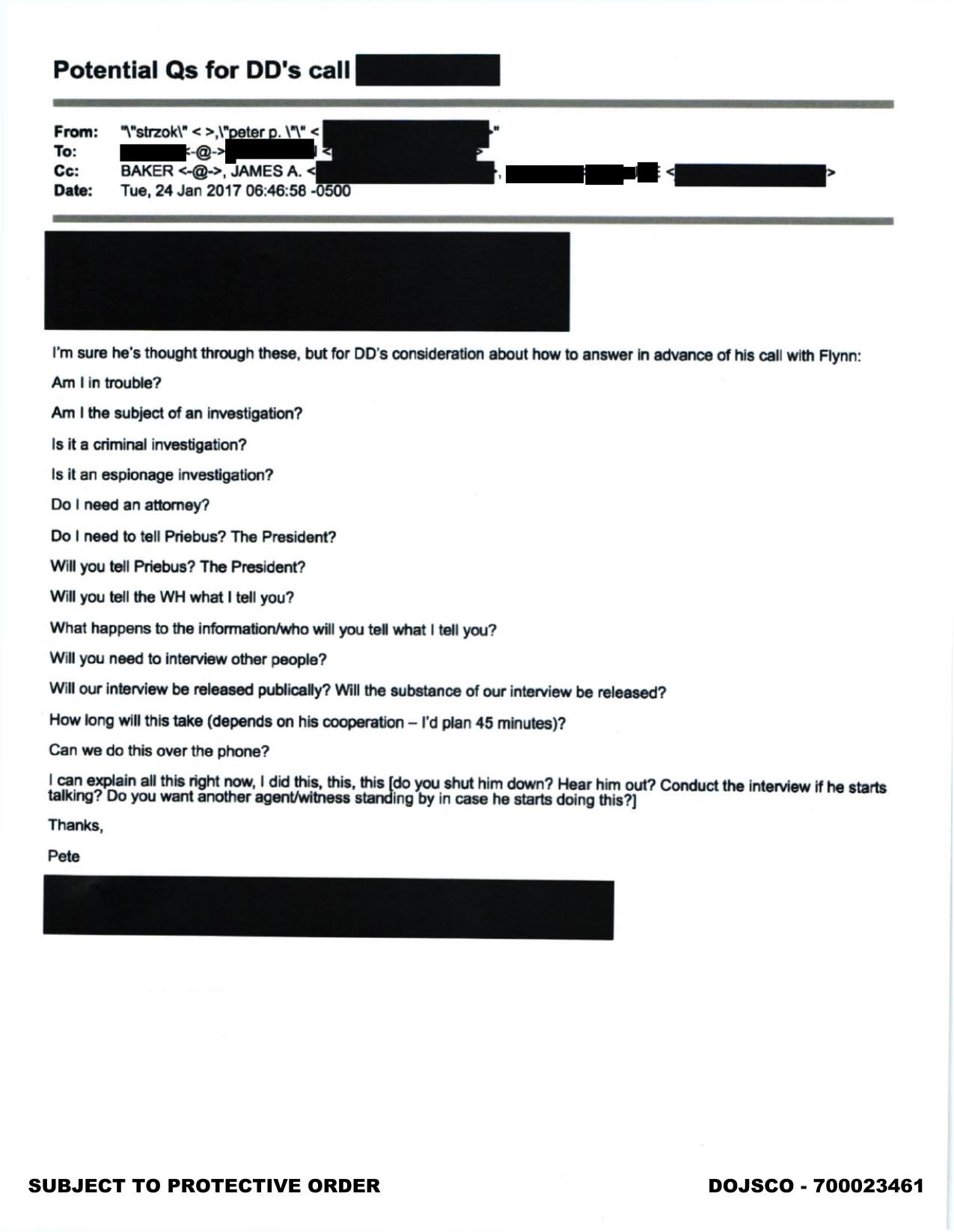
Standard FBI practice doesn't require agents to warn an interviewee up front that lying is itself a crime, so Page's question reads as genuine uncertainty about policy rather than a scheme being hatched in real time. But paired with the "get him to lie" notes from the same file, it's easy to see why Flynn's lawyers made as much of these two documents as they did. Strzok was busy that same morning too. Hours before the interview, he emailed a list of questions he expected Flynn might ask the FBI's Deputy Director on a call, questions like "Am I in trouble?", "Am I the subject of an investigation?", and "Do I need an attorney?", signing off simply as "Pete."
A separate FBI agent who worked the Flynn case as its lead investigator, William Barnett, told the Justice Department in a 2020 interview that he considered Flynn the "outlier" among the four Trump campaign figures being scrutinized under Crossfire Hurricane, meaning he didn't think the evidence against Flynn personally was as strong as it was against the other three. Barnett's account, like Strzok's texts, has become a fixture on one side of the argument over how fairly Flynn was treated. Neither Barnett's opinion nor the "get him to lie" notes are proof the interview itself was conducted improperly; Flynn was ultimately convicted of nothing tied to how the interview was run; he pleaded guilty to lying to the FBI about his calls with the Russian ambassador, a plea he later moved to withdraw before the case was dropped entirely in 2020. But the documents explain, better than a summary can, why the Flynn case became such a lasting flashpoint independent of anything in the Strzok-Page texts themselves.
One of the correctly attributed pages, from a separate notebook dated March 28, 2017, has nothing to do with the Flynn-Kislyak calls at all. It records a briefing about Flynn's undisclosed lobbying work for Turkey, tied to that country's campaign against the cleric Fethullah Gülen, a question about his obligation to formally register as a foreign agent, and a reference to "$530k" that lines up with the fee Flynn's firm was paid for that work.
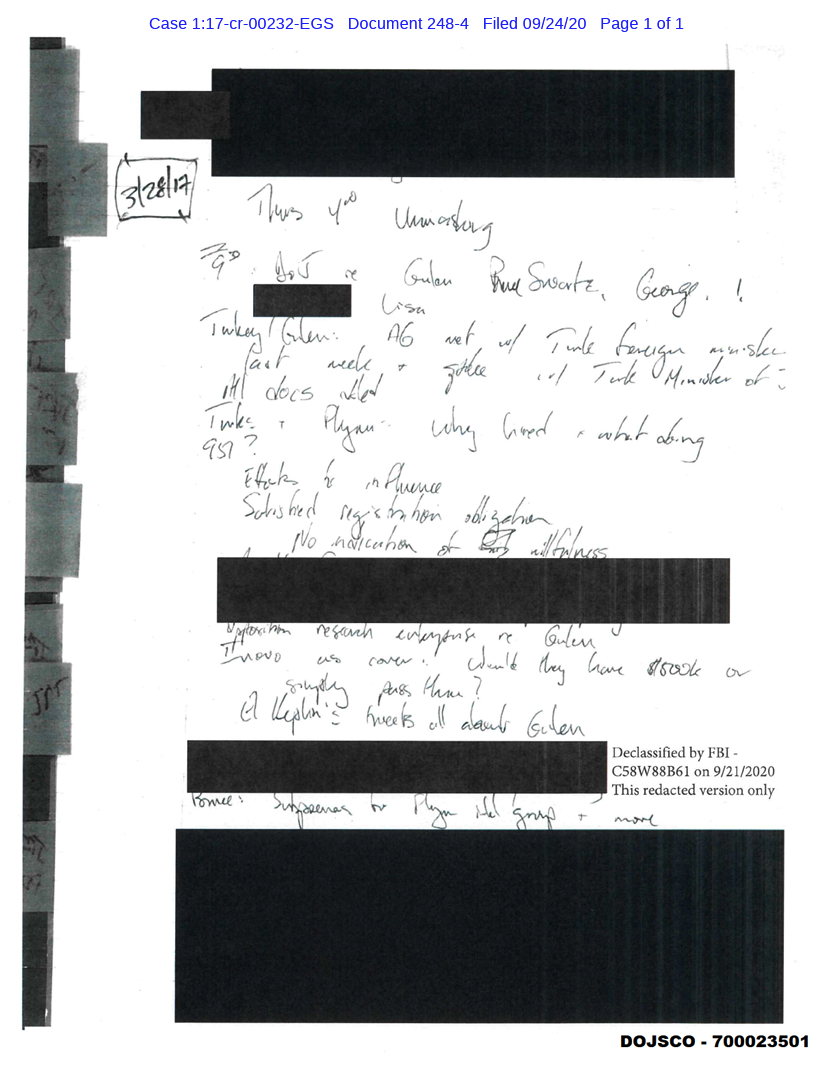
That page was filed twice, once in September 2020 and again a month later marked "subject to protective order," its own small sign of how contested the material in Flynn's case had become by the time any of it reached daylight.
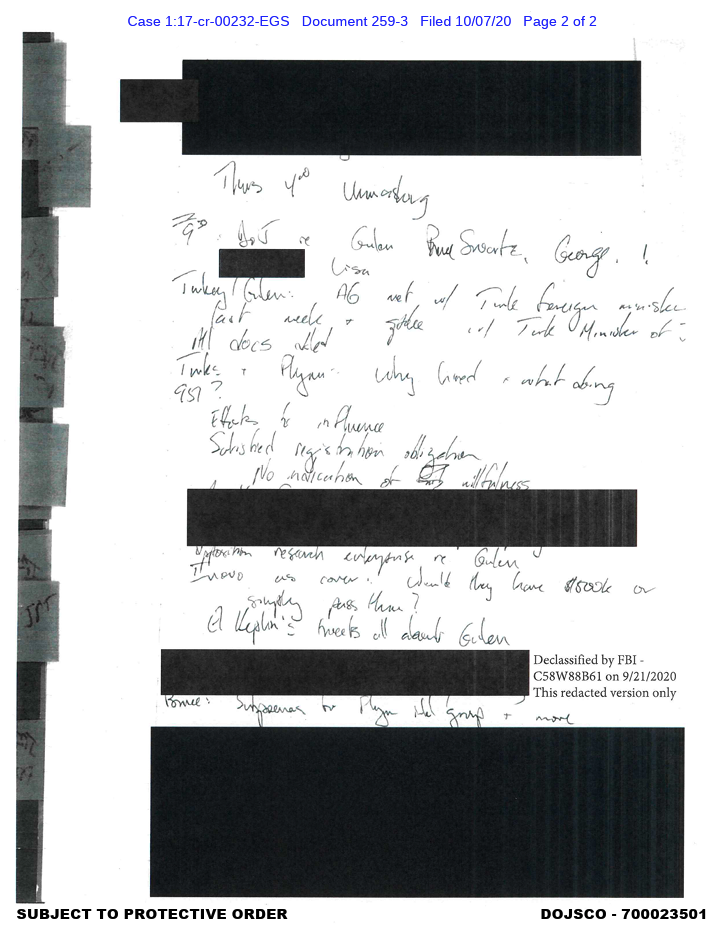
Together, the interview notes and the Gülen briefing are a reminder that Strzok's paper trail in this period extended well past his relationship with Page, into a case that had nothing to do with either of them personally.
What Happened To Them
Once Horowitz's office found the texts, Mueller removed Strzok from the special counsel's team on the night of July 27, 2017, the same day he learned the Inspector General had flagged them. Page had already left Mueller's team on her own timeline that summer. When the messages became public in December 2017, both of their careers were effectively over, even though neither was fired immediately.
Page resigned from the FBI on May 4, 2018. Strzok held on a few months longer, until August 10, 2018, when he was fired outright. The FBI's own Office of Professional Responsibility had recommended a lesser penalty, demotion plus a 60-day suspension. Deputy Director David Bowdich overruled that recommendation and ordered termination instead.
Trump made both of them recurring targets at his rallies for years afterward, at one point in October 2019 acting out a mocking impression of Strzok texting Page from the stage. Page later said watching that performance was "the straw that broke the camel's back" that pushed her to sue. Both she and Strzok eventually filed Privacy Act lawsuits over the government's disclosure of their personal messages to reporters, and in July 2024 the Justice Department agreed to settle: $1.2 million to Strzok, $800,000 to Page, roughly $2 million combined. That settlement was about how the messages were leaked, not a finding that the messages themselves were appropriate or that the underlying investigations were flawed.
Strzok separately argued his firing violated his First Amendment rights. On September 23, 2025, U.S. District Judge Amy Berman Jackson dismissed that claim, ruling that the FBI's interest in avoiding the appearance of political bias outweighed his speech interest as a government employee texting from an FBI-issued phone. She didn't rule on whether firing, specifically, was the right call as opposed to the demotion his own bureau's disciplinary office had recommended, only that the government was within its rights to fire him for it.
Bottom Line
The strongest fair criticism of Strzok and Page isn't complicated: two officials entrusted with two of the most politically sensitive investigations in the FBI's modern history spent two years saying exactly what they thought about the candidates in writing, on government phones, while running those investigations. That alone was enough to hand their harshest critics a legitimate, evidence-based case that the bureau's neutrality couldn't be trusted, independent of anything else that did or didn't happen.
The stronger allegation, that the texts prove a functioning conspiracy that successfully rigged the outcome of either investigation, isn't what the official record shows. Two separate Inspector General reviews looked hard for that proof and didn't find it. What's left instead is messier and, in its own way, less satisfying to either side of the argument: unmistakable personal bias, a genuinely reckless disregard for how their own devices would look under scrutiny, and no demonstrated manipulation of the specific decisions investigators went back and checked.