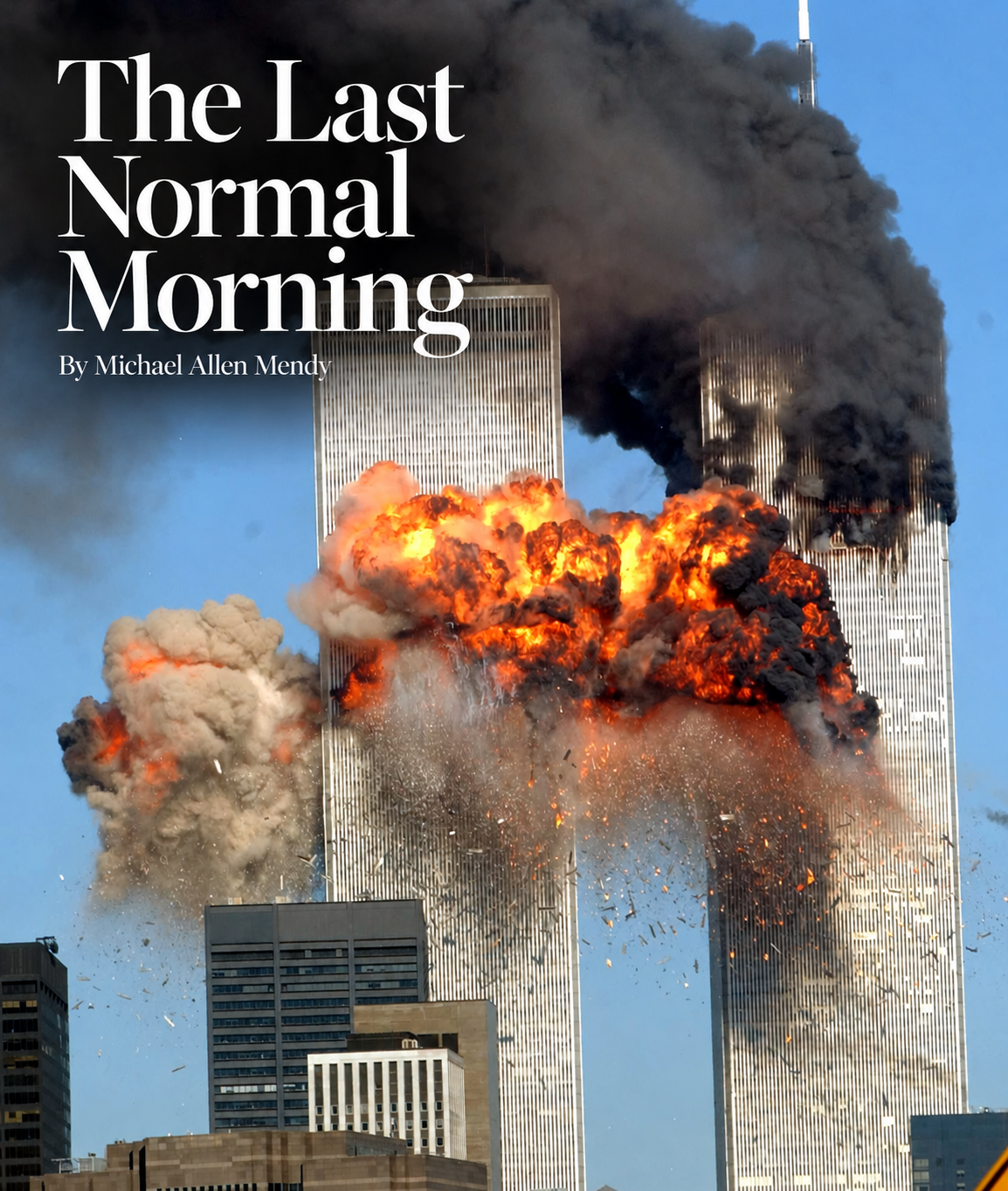
Pilots have a name for the kind of weather New York woke up to on Tuesday, September 11, 2001. They call it severe clear. No clouds, no haze, visibility as far as the eye can go. A storm front had moved through overnight and scrubbed the sky, and what it left behind was one of those early fall days that make people in the Northeast forgive the city for August. It was a little cool. The sky was a deep, flat blue.
It was also primary day. New Yorkers were picking the nominees to replace Rudy Giuliani as mayor, and people stopped at their polling places on the way to work and stood in short lines in school gyms and church basements. The sports pages were full of rumors that Michael Jordan was about to come out of retirement again to play for the Wizards. The big political fight in Washington that week was over Social Security and the shrinking budget surplus. The night before, the Giants had lost to the Broncos on Monday Night Football.
Nobody remembers any of that, because of what came after. But that's the point. For most people in the country, the morning started like any other, and that ordinariness is a big part of why the day still has the hold on people that it does. Ask anyone old enough where they were, and they'll tell you without thinking, and the story nearly always starts with something mundane: a commute, a classroom, a TV left on in a break room, a phone call from someone who said to turn on the news.
A Different Kind Of Airport
It's hard now to picture how easy it was to fly in 2001.
You could walk a friend all the way to the gate without a ticket and wave to them through the window as the plane pushed back. You kept your shoes on. You could bring a full bottle of water through the checkpoint. Screening was handled by private companies hired by the airlines, and screeners were often paid close to minimum wage, with turnover so high at some big airports that most of the workforce would be gone within a year. The Federal Aviation Administration's rules allowed knives with blades under four inches on board. Box cutters weren't on the banned list.
Cockpit doors were thin and often left unlocked during flights. That was a choice, and it rested on decades of experience with hijackings, which had a script. A hijacker wanted to go to Cuba, or wanted money, or wanted a prisoner released, and the plane would land somewhere and there would be a negotiation. Crews were trained to stay calm, cooperate, and get the aircraft on the ground, because cooperation was what kept people alive. Nobody's training contemplated a hijacker who meant to die.
Two of them had started the trip the day before. On Monday, September 10, Mohamed Atta and Abdulaziz al-Omari drove from Boston up to Portland, Maine, and checked into a motel in South Portland for the night. That evening, security cameras recorded them.
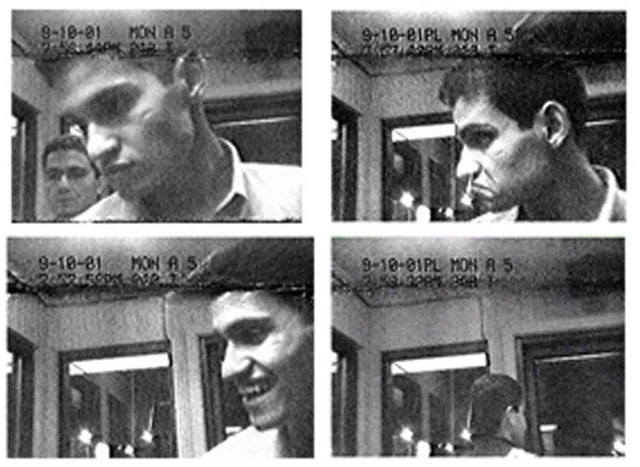
These are frames from those cameras, stamped Monday evening, September 10. Two men in collared shirts, one of them grinning at something. Nothing in the pictures would have made anyone look twice. The next morning they caught a 6 a.m. commuter flight from Portland to Boston to connect to American 11. Atta's checked bag made the flight to Boston but never made the transfer to American 11, and investigators found it at Logan afterward.
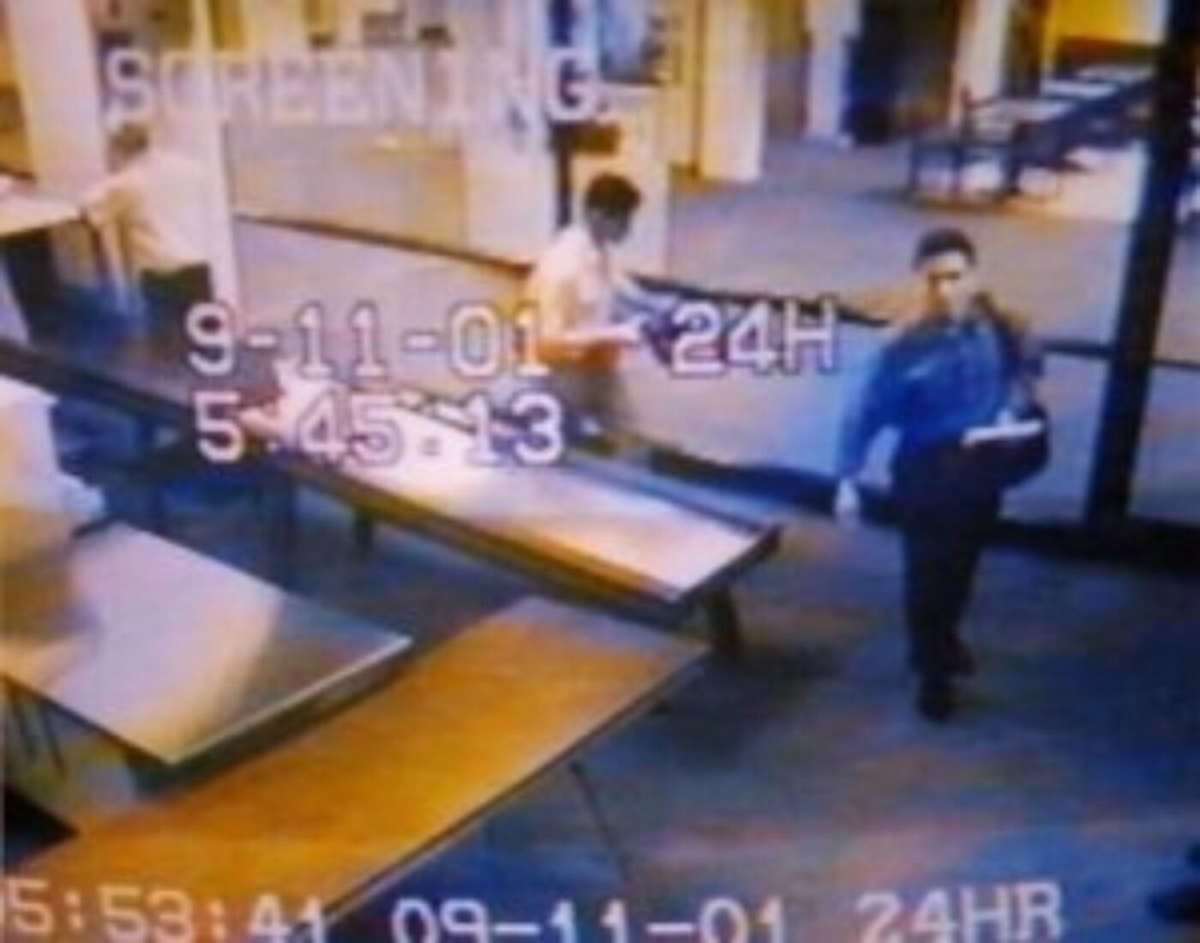
A few hours later they were back on camera, this time at the security checkpoint at the Portland International Jetport. The frame is stamped 5:45 on the morning of September 11, with a second clock along the bottom reading 5:53, and the FBI identified the two men in it as Atta and al-Omari. It became one of the most reproduced images of the whole day, mostly because of how little is going on in it. The computer screening system had flagged Atta at the ticket counter, and under the rules then, all that meant was that his checked bag stayed off the plane until he boarded. He walked through the checkpoint like everyone else.
That morning nineteen men passed through security at three airports, Logan in Boston, Dulles outside Washington, and Newark in New Jersey. Several were flagged by an automated screening system, CAPPS, that the airlines used to pick out passengers for extra attention. Under the rules then, being selected meant only that your checked bag wasn't loaded until you'd boarded. Two of the men set off metal detectors at Dulles and were wanded and waved through. Everything about how they got on the planes was, by the standards of the day, normal.
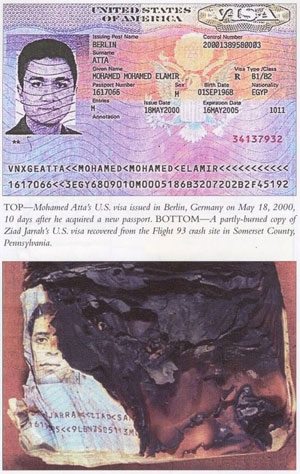
So were the papers that got them into the country. At the top is the U.S. visa Mohamed Atta was issued in Berlin in May 2000, ten days after he got a new passport. Atta was on American 11 that morning and is believed to have flown it into the North Tower. Below it is what was left of Ziad Jarrah's visa, partly burned, found in the debris at the Flight 93 crash site in Somerset County, Pennsylvania. Jarrah was the hijacker at the controls of United 93.
Four Flights
Here's the whole morning in the air, all four planes on one clock.
American Airlines Flight 11 left Boston for Los Angeles with 92 people aboard, including the five hijackers. About fifteen minutes into the flight it stopped responding to air traffic control. A flight attendant, Betty Ong, called the American Airlines reservations office from the back of the plane and calmly told them the cockpit wasn't answering and that someone had been stabbed. Another, Madeline Amy Sweeney, got through to a manager at Logan and gave him seat numbers for the hijackers. Near the end of her call she looked out the window and said she could see water and buildings, and then, "Oh my God, we are way too low." The plane hit the North Tower of the World Trade Center between the 93rd and 99th floors.
This is Betty Ong's call. She was 45, a flight attendant out of Boston, and she was sitting in jump seat 3R at the back of the plane. You can hear how hard she's working to keep her voice level: "The cockpit is not answering, somebody's stabbed in business class, and I think there's Mace, that we can't breathe. I don't know, I think we're getting hijacked." The agents on the other end keep asking her to repeat things, her name, her seat, what's happening, and she answers every question. She tells them the purser, the lead flight attendant, has been stabbed and that nobody can get up to the front of the plane. She stayed on the line for about 25 minutes, almost until the end, but American's system recorded only the first four. They were played in public for the first time at a 9/11 Commission hearing in January 2004.
Most people who saw it on television in the next few minutes assumed it was an accident, a small plane, a navigation error. Seventeen minutes later the second plane, United Airlines Flight 175, also out of Boston, flew into the South Tower on live TV, and there was no more thinking it was an accident.
American Airlines Flight 77 had left Dulles for Los Angeles. It turned back over Ohio and flew east with its transponder off, and it hit the west side of the Pentagon in Arlington, Virginia.
The Pentagon's own security cameras caught it. This is from the cameras at a parking lot checkpoint outside the building, footage the Defense Department released in May 2006, after the Moussaoui trial, in response to a Freedom of Information Act lawsuit. The cameras were made to log cars at a gate, not to film a jet at more than 500 miles an hour, so the plane itself barely registers. You see the lawn and the side of the building, and then the fireball. The crash killed 125 people inside the Pentagon and all 59 passengers and crew on the plane, along with the five hijackers.
United Airlines Flight 93 left Newark for San Francisco more than forty minutes behind schedule because of the usual morning congestion on the runways. That delay mattered. By the time the hijackers took the plane, the towers had already been hit, and when the passengers and crew got on the seatback phones and their own cell phones to call home, the people on the other end told them what was happening in New York and Washington. They understood what the hijackers meant to do with the plane. They talked to each other. They took a vote. Todd Beamer, who had been on the line with a GTE operator, was heard saying, "Are you guys ready? Okay. Let's roll." The cockpit voice recorder captured the sounds of the passengers fighting to get through the door. The plane went down in a field near Shanksville, Pennsylvania, about twenty minutes' flying time from Washington. Investigators concluded the target was most likely the Capitol or the White House.
The Towers
The buildings had been on paper for a long time before anyone moved into them. These are pages from the architectural set the Port of New York Authority issued in 1967, dated July 31, under the names of the architect Minoru Yamasaki and the firms that engineered the towers with him. They aren't the famous skyline views. They're the floors almost nobody saw, the sub-levels underneath the plaza, laid out sheet by sheet: mechanical equipment rooms, emergency generators, a refrigeration plant, air conditioning shafts and rows of tenant storage, all inside a grid of columns drawn down to the inch.
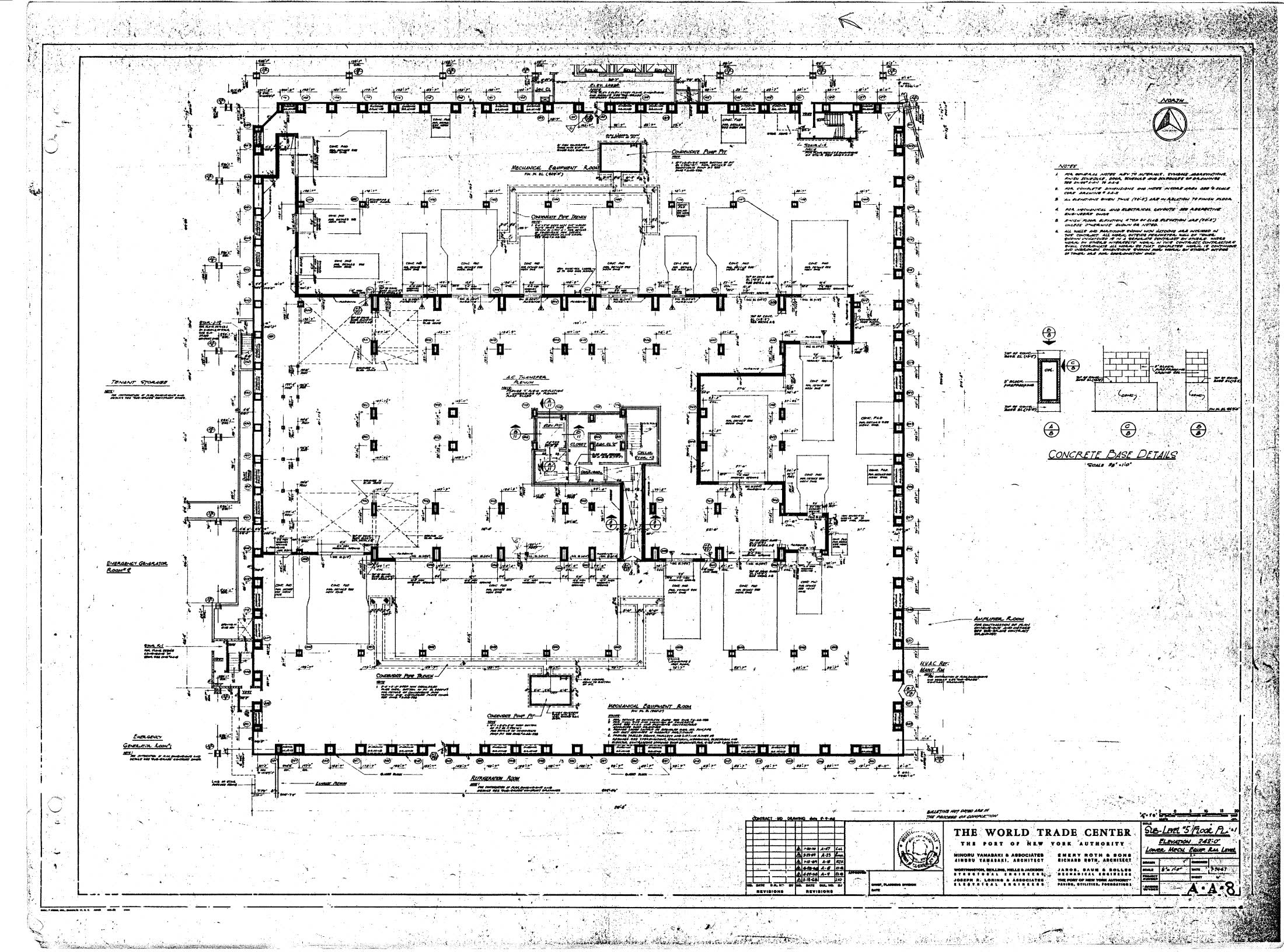
Sheet A-A-8 is Sub-Level 5, the deepest of these floors, where the lower half of the mechanical equipment rooms sat. Around the edges you can make out the labels for the emergency generator rooms, a refrigeration room and tenant storage. Click any sheet to open it full size.
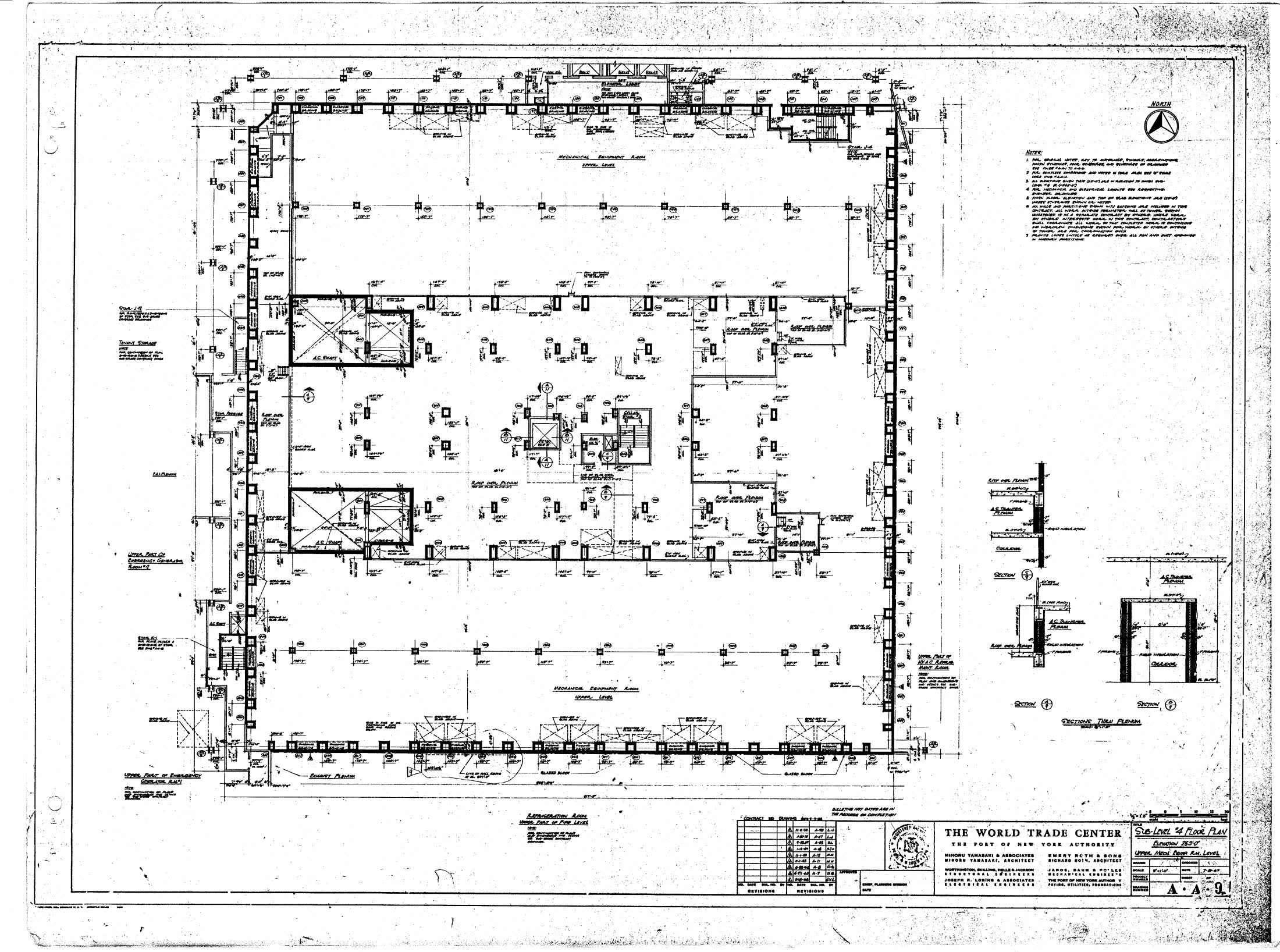
Sheet A-A-9 is one floor up, Sub-Level 4, the upper level of those same equipment rooms. Most of it is open space between columns, crossed by air conditioning shafts and the exhaust plenums that carried air out of the building.
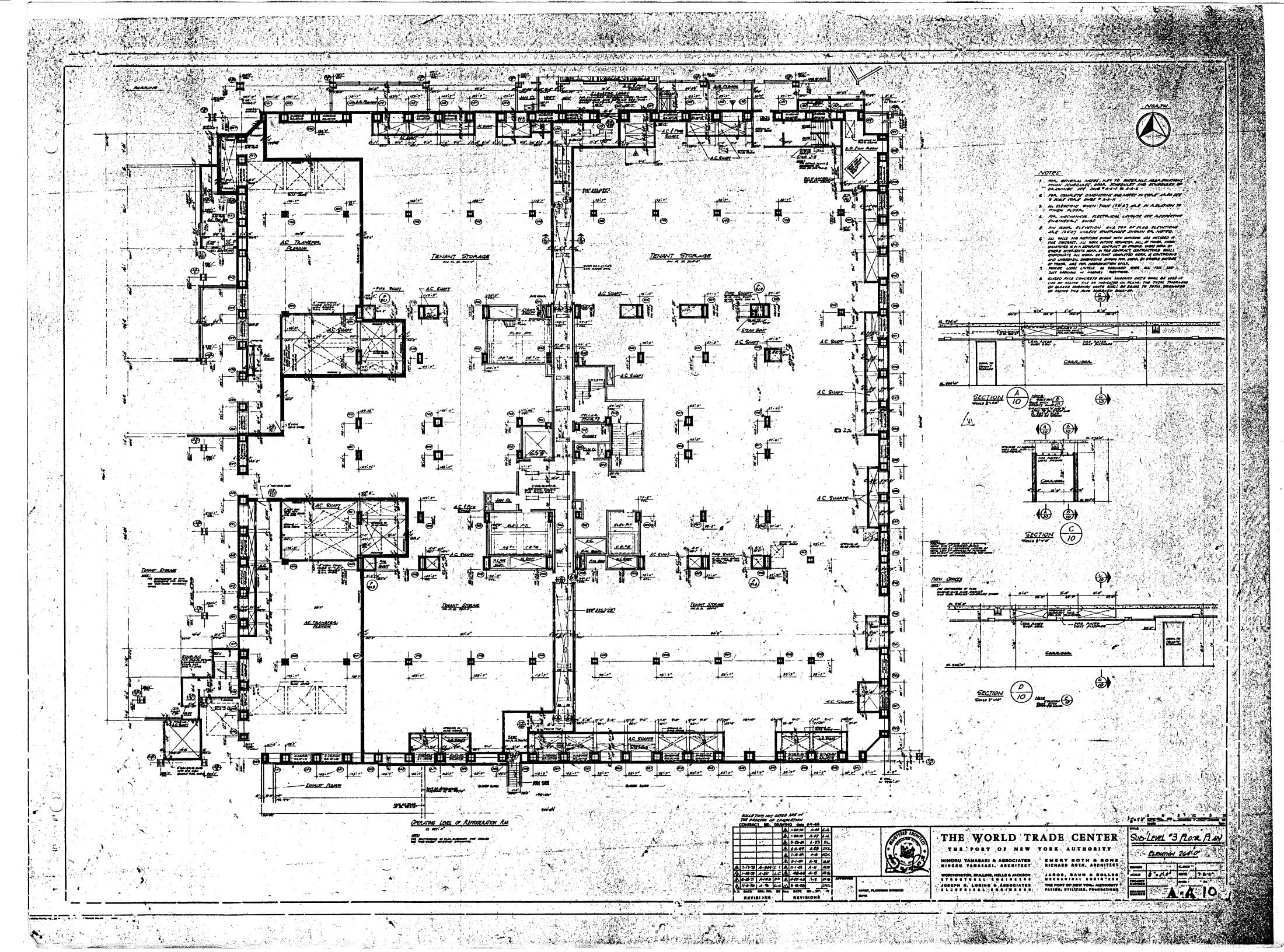
Sheet A-A-10 is Sub-Level 3, which was mostly tenant storage, split down the middle by a long corridor and broken up by more air conditioning shafts and transfer plenums.
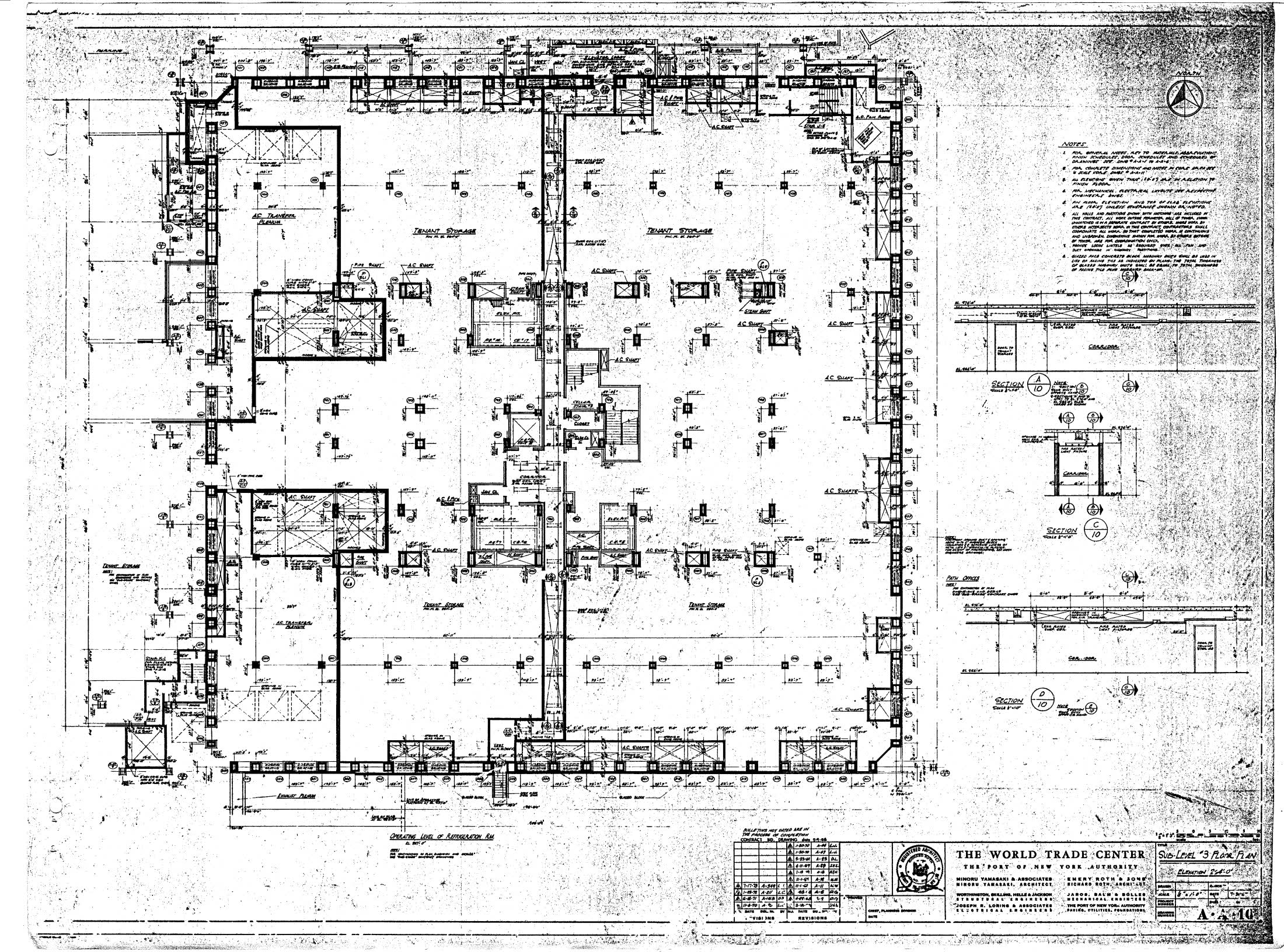
Sheet A-A-10A is the same floor again, a revised version of the Sub-Level 3 plan. Drawings like this got reissued as the design changed, and the storage rooms and shafts move around a little between the two.
Sheet A-A-11 zooms in on the cores of all three levels: the elevator pits, the stairs, the closets and the corridors that tied them together, the same kind of shafts and stairwells that ran all the way up through the building. Somebody drew every one of these lines by hand, a third of a century before the morning they were all buried.
At the World Trade Center, the stairwells in the North Tower above the impact zone had been cut. Nobody above it got out. In the South Tower, one stairwell survived the crash, and a small number of people from above the impact found it and walked down through the damage.
Many people in the South Tower had started evacuating as soon as they saw the North Tower burning, and some had been told over the public address system that their building was secure and they could go back to their offices. Others didn't wait. Rick Rescorla, the head of security for Morgan Stanley, had spent years drilling the firm's employees on evacuation, against plenty of grumbling, because he was convinced the towers would be attacked again after the 1993 bombing. He ignored the announcement and got the company's roughly 2,700 people in the building moving down the stairs. Nearly all of them survived. He went back up to look for stragglers and was killed when the tower fell.
Firefighters climbed into the towers with about a hundred pounds of gear apiece. Radios didn't work well in the high-rises, and many of the firefighters in the North Tower never heard the order to get out. The South Tower, hit second but lower and harder, collapsed first, after 56 minutes. The North Tower came down 29 minutes later. Seven World Trade Center, a 47-story building across the street that burned all day without anyone fighting the fires, collapsed late that afternoon.
Here is what it looked like from the outside. Someone filming out of an apartment window to the north had the camera running when one of the towers came down, and the footage swings wildly as the people in the room start screaming. Over the rooftops you can see the smoke where the tower had been, and then the cloud. A witness at the end of the clip describes it the way a lot of people did that day: it looked like a monster, like something out of a horror movie, a massive dust cloud consuming everything in its path.
The Fire Department of New York lost 343 people, the most it had ever lost in a single event, including its chief of department, its first deputy commissioner, and its chaplain, Father Mychal Judge, who was killed in the lobby of the North Tower. The New York Police Department lost 23 officers and the Port Authority Police Department lost 37. Cantor Fitzgerald, a bond firm with offices high in the North Tower, lost 658 employees, about two thirds of its New York workforce.
Father Judge wasn't the last clergyman at the site. This is a week later, on September 18, an FBI agent at the World Trade Center with two chaplains wearing borrowed FBI jackets, one with "CHAPLAIN" written on tape across his hard hat. Chaplains worked the site for months, and were called over to bless remains as they were found and carried out. Photo by Andrea Booher for FEMA.
In all, 2,977 people were killed that day in New York, at the Pentagon and near Shanksville, not counting the hijackers. They came from more than 90 countries. About 3,000 children lost a parent.
Everyone Else
Across the country, the morning stopped wherever people happened to be.
President George W. Bush was visiting Emma E. Booker Elementary School in Sarasota, Florida, to promote his education plans. He was sitting in front of a class of second graders as they read aloud when his chief of staff, Andrew Card, leaned in and whispered in his ear: "A second plane hit the second tower. America is under attack." Bush stayed in his seat for several more minutes while the children read, a moment that has been argued about ever since. He spent most of the day being flown between air bases in Louisiana and Nebraska before returning to Washington that evening.
This is the moment. Doug Mills of the Associated Press was in the room and caught Card bent down beside the president, a few inches from his ear, with the second graders' reading lesson still going on in front of them. The picture went around the world within hours, and for a lot of people it's the image that comes to mind when they think about where the country's leaders were when it happened. (Photo: Doug Mills/AP)
At the FAA's command center in Virginia, Ben Sliney was on his first day as national operations manager. With reports coming in of other planes that might be hijacked, he did something nobody had ever done. He ordered every civilian aircraft in American airspace to land at the nearest airport, more than 4,000 of them. Planes inbound over the Atlantic were turned away from the United States, and many ended up in Canada. Thirty-eight wide-body airliners landed at the airport in Gander, Newfoundland, a town of about 10,000 people, which took in nearly 7,000 stranded passengers and crew for most of a week. Residents opened up their schools, churches and homes, cooked for them, and lent them clothes. Some of those passengers and the families who took them in still visit each other.
In Lower Manhattan, with the subways shut down and the bridges and tunnels closed, ferries, tugboats, fireboats, dinner cruise boats and private yachts showed up at the seawall without being asked and carried people across the harbor to New Jersey, Staten Island and Brooklyn. It's estimated that close to half a million people were taken off the island by water that day, the largest sea evacuation in history, bigger than Dunkirk.
Thousands of people walked uptown or across the Brooklyn Bridge covered in gray dust. People lined up at blood banks to donate. Very little of the blood was needed, because so few people were pulled from the rubble alive.
The next morning's New York Times ran the biggest headline it had, "U.S. ATTACKED," over the fireball from the South Tower. Up in the corner, in the weather box, it still gave the forecast the way it did every day, and the line for the day before read the way the morning had felt: "Yesterday, high 81, low 63."
The Hamburg Cell
The plan that came to life that morning had started, in large part, in an apartment at Marienstrasse 54 in Harburg, a working-class district across the Elbe River from the center of Hamburg, Germany. In the late 1990s it was home to a rotating group of young Arab men, most of them students, who called it Dar al-Ansar, the house of the followers.
The one who held them together was Mohamed Atta, the son of a lawyer in Cairo, who had come to Hamburg in 1992 to study urban planning at the technical university in Harburg. He was serious, rigid and humorless by most accounts, and he wrote his thesis on the old city of Aleppo. Around him gathered Marwan al-Shehhi, from the United Arab Emirates, who had come to Germany on a scholarship from his country's military; Ziad Jarrah, from a comfortable, secular family in Lebanon, who studied aircraft engineering and had a Turkish girlfriend he kept apart from the others; and Ramzi bin al-Shibh, from Yemen. They prayed together at the al-Quds mosque near the Hamburg train station, where a few of the preachers and regulars were openly radical, and over time their talk turned to jihad.
In late 1999 they decided to go fight. They had wanted to go to Chechnya, to fight the Russians, but they were steered toward Afghanistan instead. That winter Atta, al-Shehhi, Jarrah and bin al-Shibh made their way to the al Qaeda camps around Kandahar and met Osama bin Laden. They were exactly what he was looking for: educated, fluent in Western languages, comfortable living in the West, and already willing to die. They swore loyalty to him, and Atta was chosen to lead the operation in the United States.
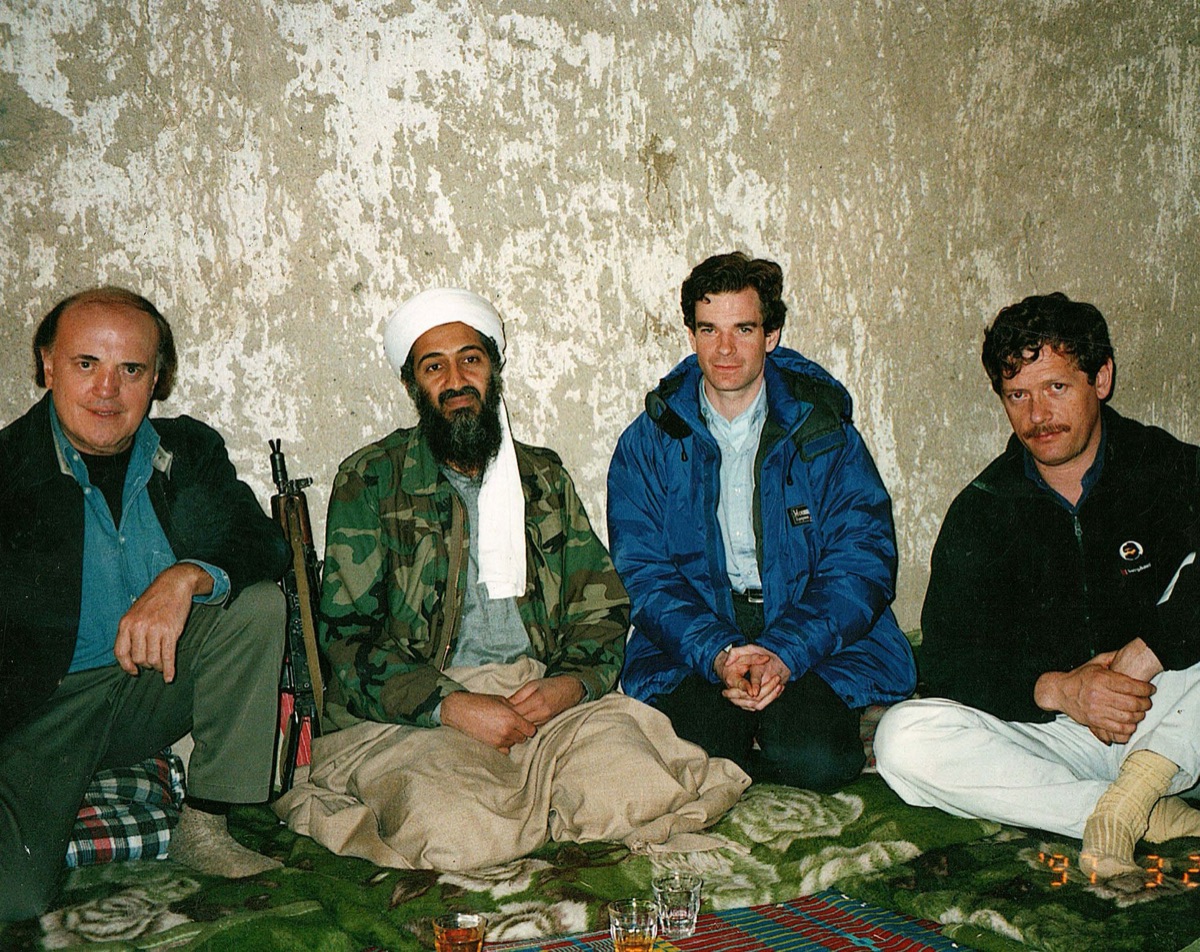
By then bin Laden wasn't hiding what he wanted. This picture is from March 1997, two and a half years earlier, when a CNN team, the reporter Peter Arnett, the producer Peter Bergen and the cameraman Peter Jouvenal, was taken to see him in eastern Afghanistan. In the interview that came out of that trip, his first on television with a Western reporter, he declared holy war on the United States on camera. A year later, in 1998, he called on Muslims to kill Americans, civilians included, anywhere in the world, and that August al Qaeda blew up the American embassies in Kenya and Tanzania.
The idea of using airplanes wasn't bin Laden's. It belonged to Khalid Sheikh Mohammed, a Pakistani engineer raised in Kuwait who had gone to college in North Carolina and whose nephew, Ramzi Yousef, had set off the truck bomb under the World Trade Center in 1993. Mohammed pitched bin Laden on an operation using hijacked planes as weapons in 1996, and in 1999 bin Laden gave him the go-ahead. The 9/11 Commission called him the principal architect of the attacks. He picked the targets with bin Laden, ran the money and the logistics, and fit the Hamburg men into a plan he had been working on for years.
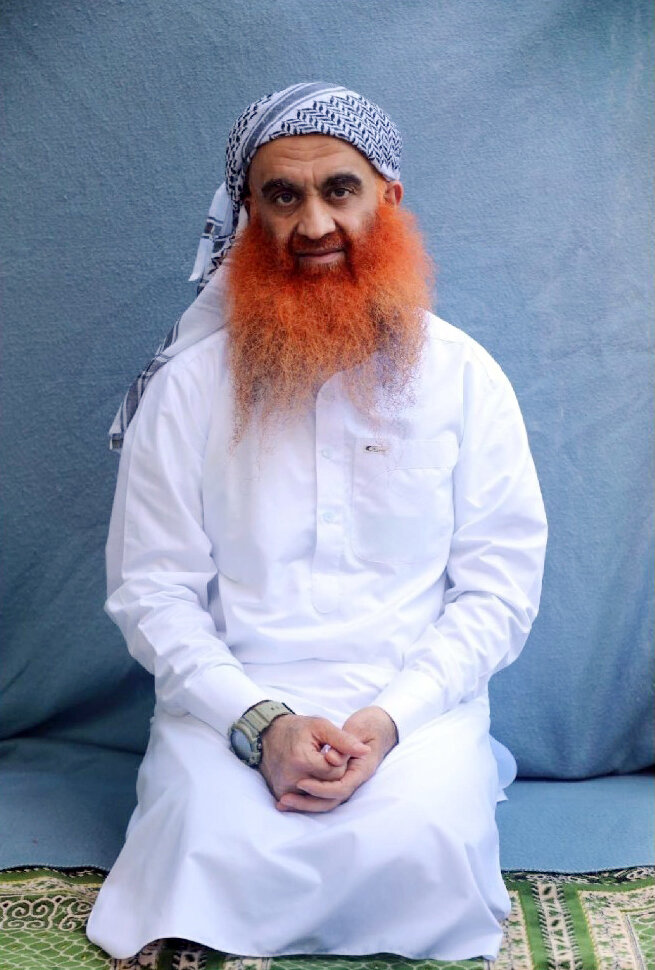
This is Mohammed in 2022, at the American prison at Guantanamo Bay, Cuba. He was captured in Rawalpindi, Pakistan, in March 2003, and held for three years in secret CIA prisons, where he was waterboarded 183 times. He was moved to Guantanamo in 2006. More than twenty years after his capture, he still hasn't been tried. A plea deal that would have spared him the death penalty was announced in 2024 and then revoked by the secretary of defense, and the fight over it went to the courts.
Back in Hamburg in early 2000, the men shaved their beards, stopped going to the radical mosque, and reported their passports lost so they could get clean ones without Pakistani stamps. Atta, al-Shehhi and Jarrah got American visas and started applying to flight schools. Bin al-Shibh was supposed to be the fourth pilot, but the State Department turned down his visa application again and again, and he stayed behind to serve as the go-between for the cell and al Qaeda's leadership. German police had kept an eye on a few men in the cell's circle, but not on the cell itself. After the attacks, investigators went through the Marienstrasse apartment, and Germany later put one of the cell's friends, Mounir el-Motassadeq, on trial for helping them. Bin al-Shibh was captured in Karachi on the first anniversary of the attacks.
What Was Known
The question people asked almost right away was whether anybody saw it coming. The answer, as the 9/11 Commission laid out in its report in July 2004, is that a lot of people saw pieces of it.
The CIA had been warning for years about Osama bin Laden and al Qaeda, which had already bombed two American embassies in East Africa in 1998 and the USS Cole in Yemen in 2000. In the summer of 2001, intelligence officials told the commission, the "system was blinking red." On August 6, the president's daily briefing included an article headed "Bin Ladin Determined To Strike in US." Two of the eventual hijackers had been tracked by the CIA to a meeting in Malaysia in January 2000 and then entered the United States, but the agency didn't put them on the State Department watchlist or tell the FBI in time to matter. An FBI agent in Phoenix had written a memo that July warning that bin Laden might be sending followers to American flight schools. In August, the FBI in Minneapolis arrested Zacarias Moussaoui, a man whose flight instructors had grown suspicious after he paid thousands of dollars in cash to train on a 747 simulator with almost no flying experience, and agents couldn't get headquarters to approve a warrant to search his laptop.
One of those threads ran through a house in Yemen. Since the 1998 embassy bombings, investigators had known about a phone number in Sana'a that belonged to Ahmed al-Hada, whose daughter was married to Khalid al-Mihdhar. Al Qaeda used it like a switchboard. Operatives in different countries called in, and messages got passed along. The NSA was listening. Late in 1999, intercepts on the line mentioned an upcoming trip to Malaysia by men named Khalid, Nawaf and Salem, which is how the CIA came to be photographing the meeting in Kuala Lumpur that January. Later, after al-Mihdhar had settled in San Diego, he called the house in Yemen. Those calls were collected, but according to the congressional joint inquiry and later reporting, nobody worked out that the caller was inside the United States and handed that to the FBI. Years later, defenders of the NSA's warrantless wiretapping program pointed to the San Diego calls as the reason the government needed to listen to calls coming into the country. Critics answered that the agency had already had the calls, and the problem was that it didn't share what it had.
None of those threads got pulled together. The commission's best known judgment was that the most important failure was one of imagination. The government had planned for hijackings, and for bombings, and for terrorists who wanted hostages. It hadn't seriously planned for men who would take over passenger jets and use them as missiles.
There was a second gap, and it ran through the flight schools. The men who flew the planes learned to fly in the United States, at ordinary schools that were happy to take their money, and the training they were after was strangely narrow.
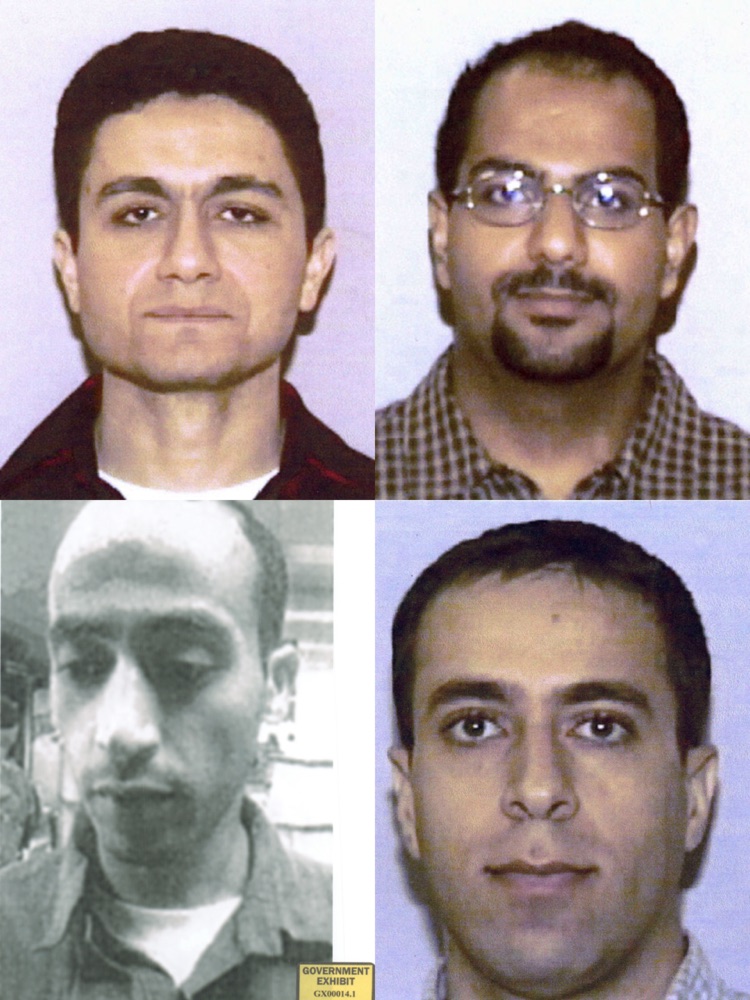
These are the four hijackers who flew the planes, Mohamed Atta, Marwan al-Shehhi, Hani Hanjour and Ziad Jarrah, in photos the government released after the attacks. The black and white one was later entered as an exhibit at the 2006 trial of Zacarias Moussaoui. The four of them had spent much of the year before in American flight schools and jet simulators.
Nobody at those schools could have known what the lessons were for, and some instructors did raise the alarm, one of them loudly enough to get Moussaoui arrested. But the Minneapolis office never heard about the Phoenix memo, the Phoenix agent never heard about Moussaoui, and none of the men who actually flew the planes on September 11 was ever stopped.
After
The changes started almost immediately, and many of them are still with us.
The federal response moved into the city right away. FEMA declared the attack a major disaster, number DR-1391-NY, and set up a Disaster Field Office in Manhattan, where federal, state and military workers ran the recovery out of rows of cubicles. On October 1, they stopped to listen to an address from President Bush.
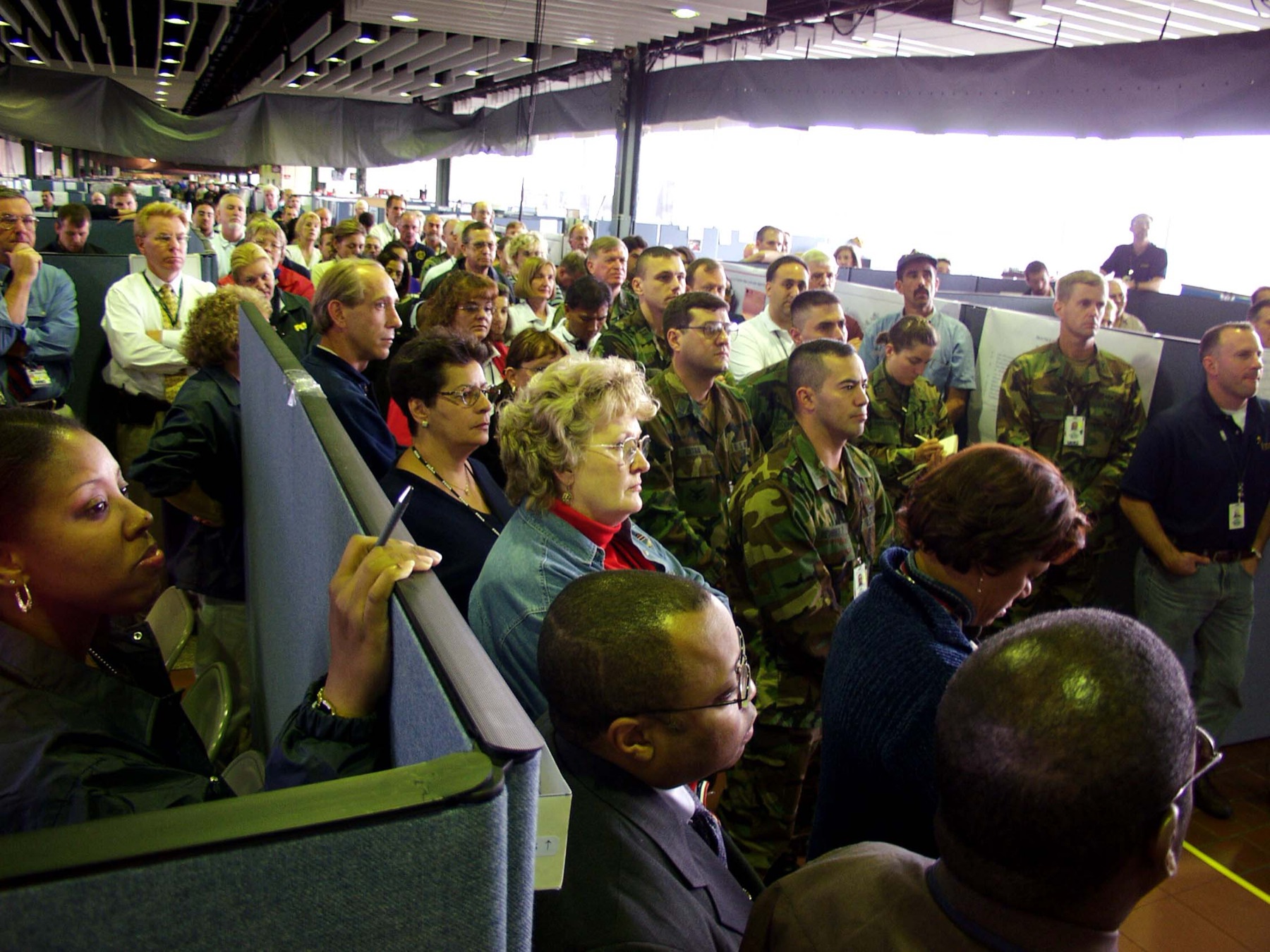
They packed in between the cubicles to hear it, FEMA staff and state workers in badges and lanyards standing shoulder to shoulder with soldiers in camouflage, a few of them taking notes.
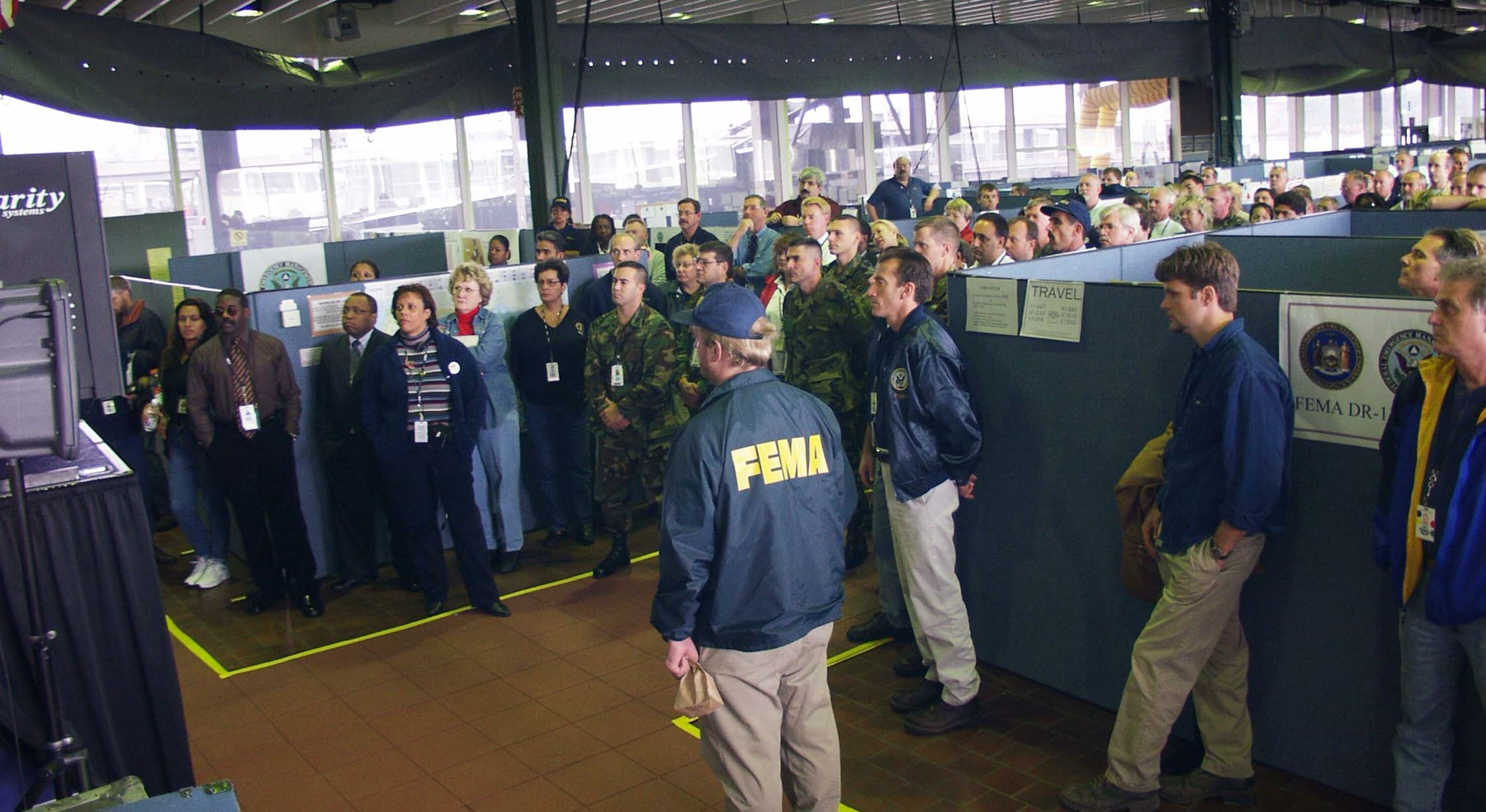
Three weeks after the attacks, the place had the look of an office that meant to be there a long time, with a travel desk and the disaster number posted on the cubicle walls. Photos by Michael Rieger for FEMA.
Congress passed the USA PATRIOT Act in late October, widening the government's surveillance powers. In November it created the Transportation Security Administration and made airport screening a federal job. Cockpit doors were reinforced and locked. When Richard Reid tried to set off explosives in his shoe on a flight from Paris that December, shoes started coming off at checkpoints, and they stayed off until 2025. Liquids got limited in 2006 after a plot involving bombs disguised as drinks. The Department of Homeland Security was created in 2002, the largest reorganization of the federal government since the Second World War.
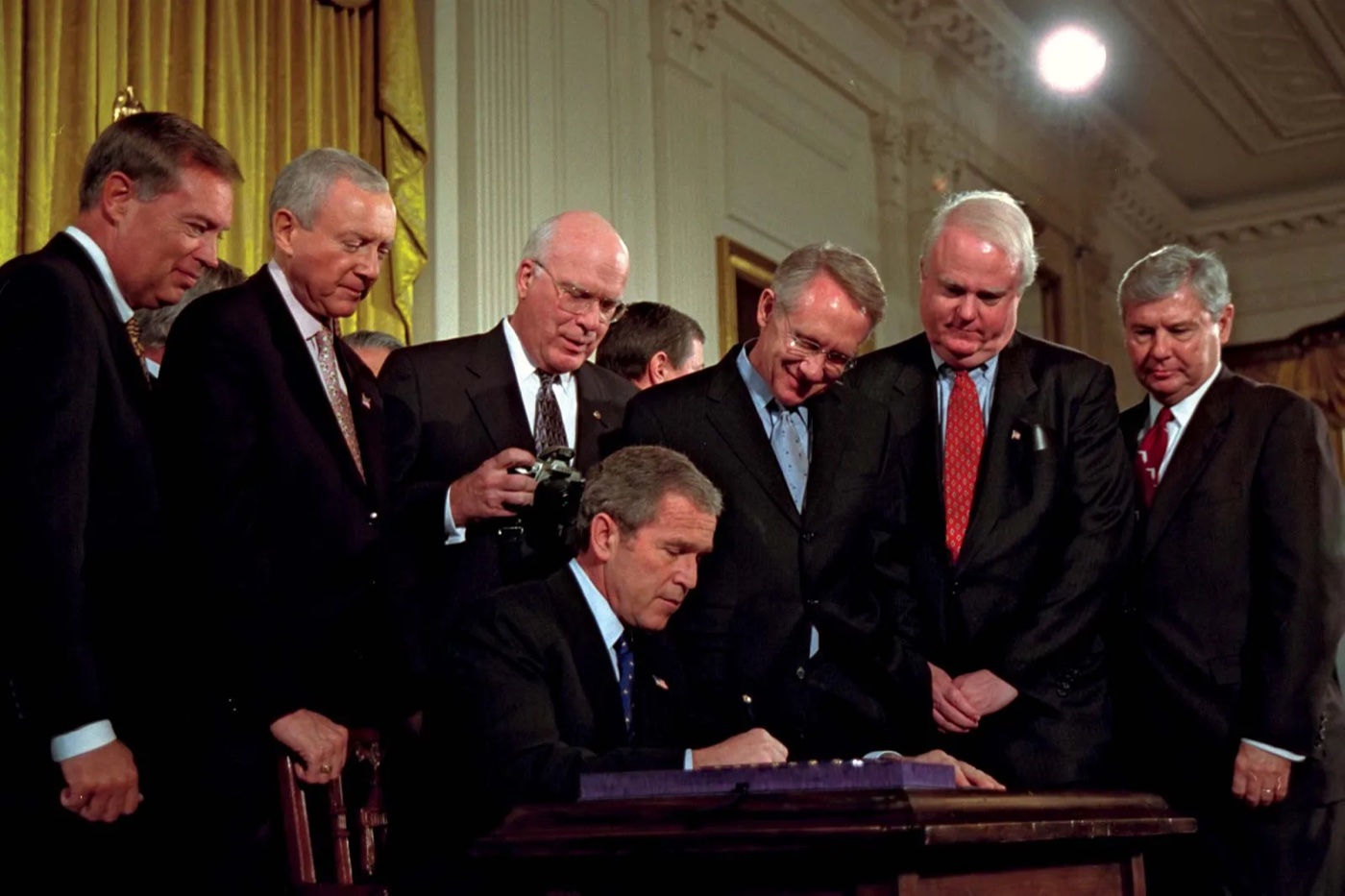
Bush signed the PATRIOT Act in the East Room of the White House on October 26, 2001, six and a half weeks after the attacks, with lawmakers from both parties crowded around the desk. One of them brought his own camera. The bill had passed the Senate 98 to 1 and the House 357 to 66, and it rewrote the rules on wiretaps, business records and information sharing between intelligence and law enforcement, the same wall that had kept the FBI and CIA apart. Some of its provisions were set to expire, and Congress spent the next twenty years fighting over whether to renew them.
The United States went to war in Afghanistan in October 2001 and in Iraq in 2003. The war in Afghanistan lasted almost twenty years, and ended in August 2021 with the Taliban back in power, a few weeks before the twentieth anniversary of the attacks. Bin Laden was killed by Navy SEALs in Abbottabad, Pakistan, in May 2011.
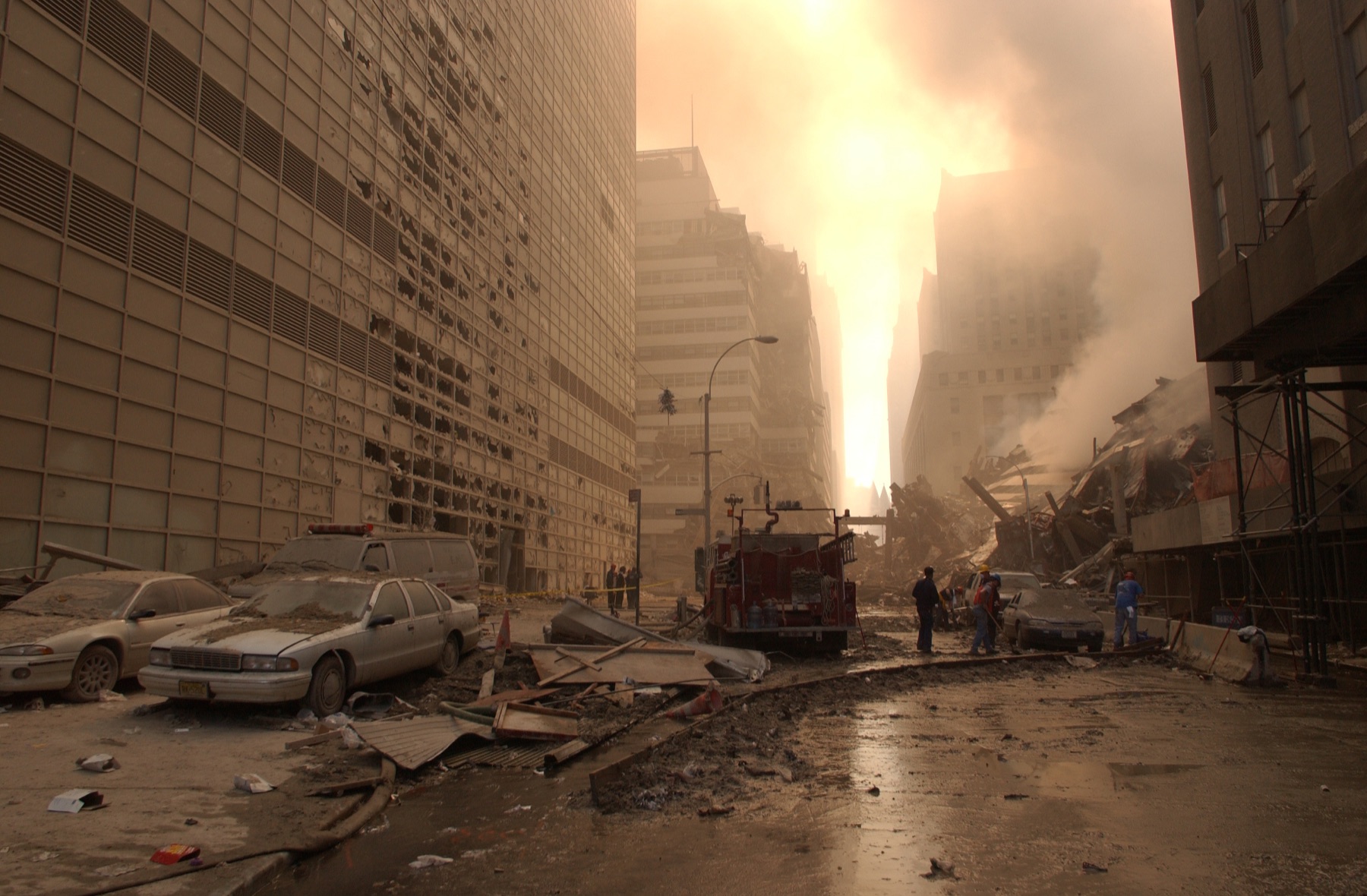
Two days later, on September 13, the streets around the site still looked like this. Cars that had been parked there on Tuesday morning sat where they'd been left, under inches of dust, with the windows of the building above them blown in. A fire truck was still parked in the middle of the street, and at the far end the wreckage was smoking.
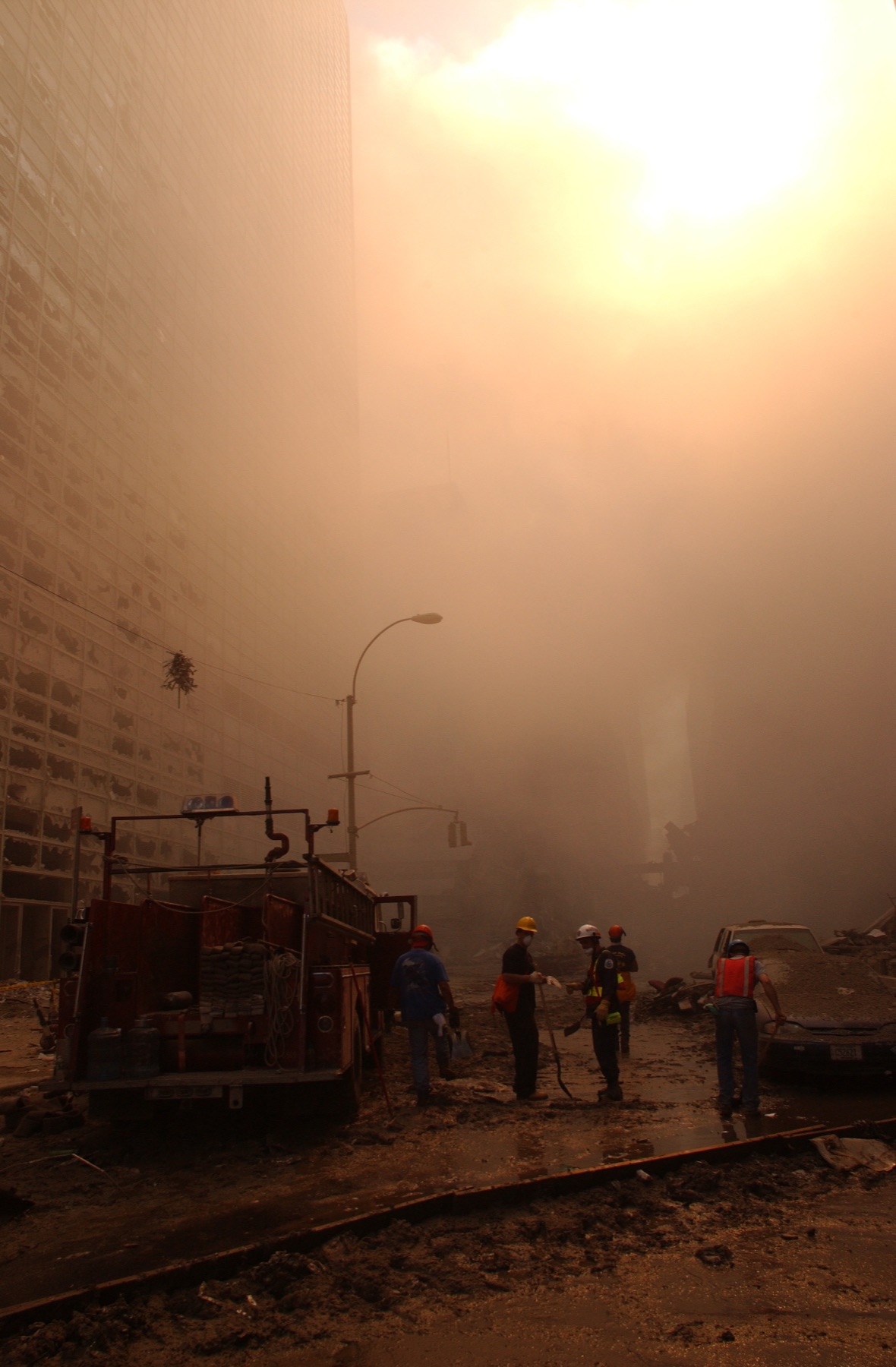
The fires under the pile kept burning for months, and the smoke turned the light orange at midday. Down the same block, workers in hard hats and paper masks stood in the mud with shovels, in air so thick the buildings disappeared a few hundred feet up. Photos by Andrea Booher for FEMA.
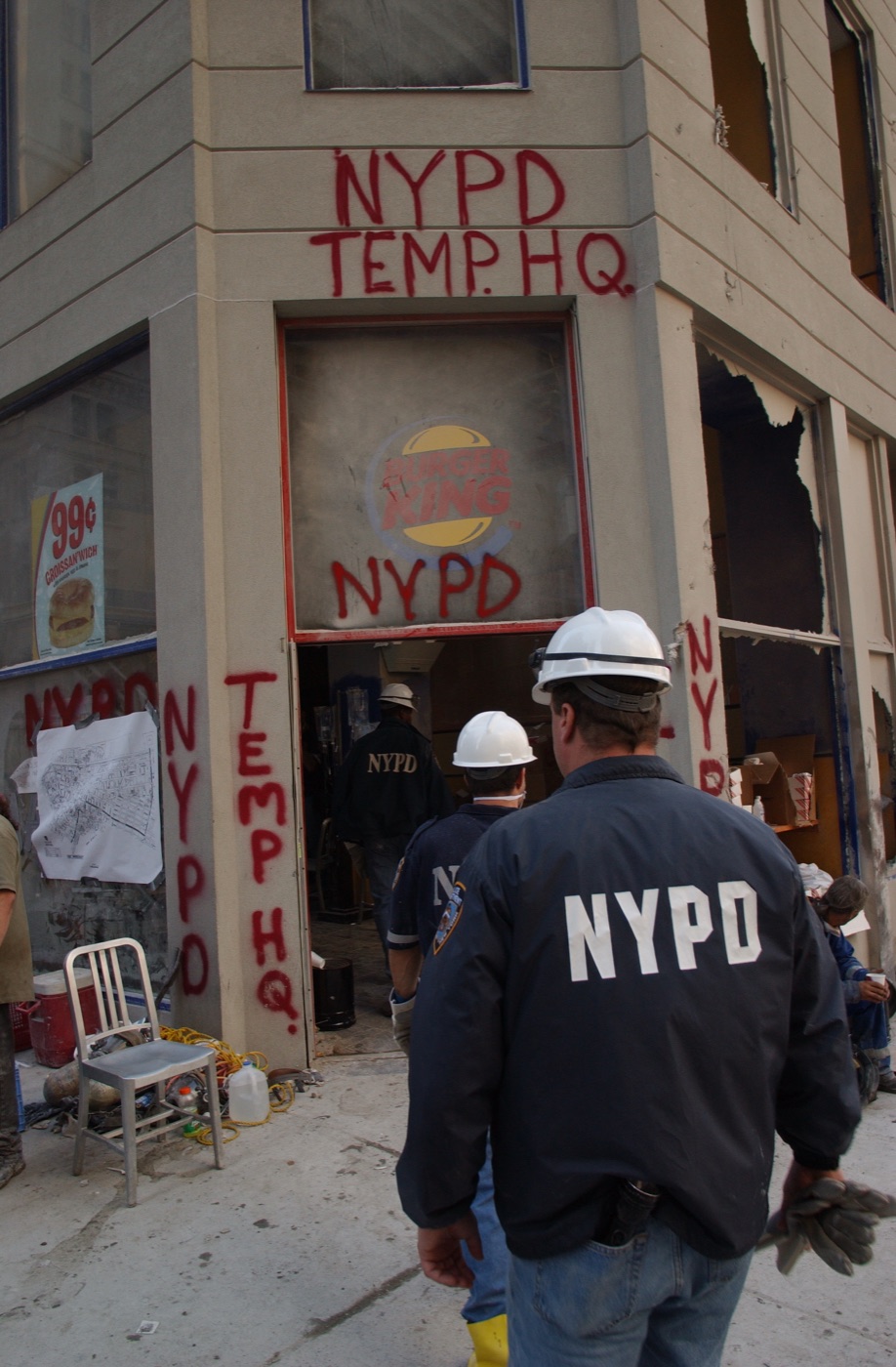
The same day, September 13, the police were running part of their operation out of a Burger King a few blocks from the site. Someone had spray-painted NYPD TEMP. HQ in red across the front, next to a poster still advertising a 99-cent Croissan'wich, and officers in hard hats walked in and out past the shattered windows. The department had lost 23 officers two days before. (Photo: Andrea Booher/FEMA)
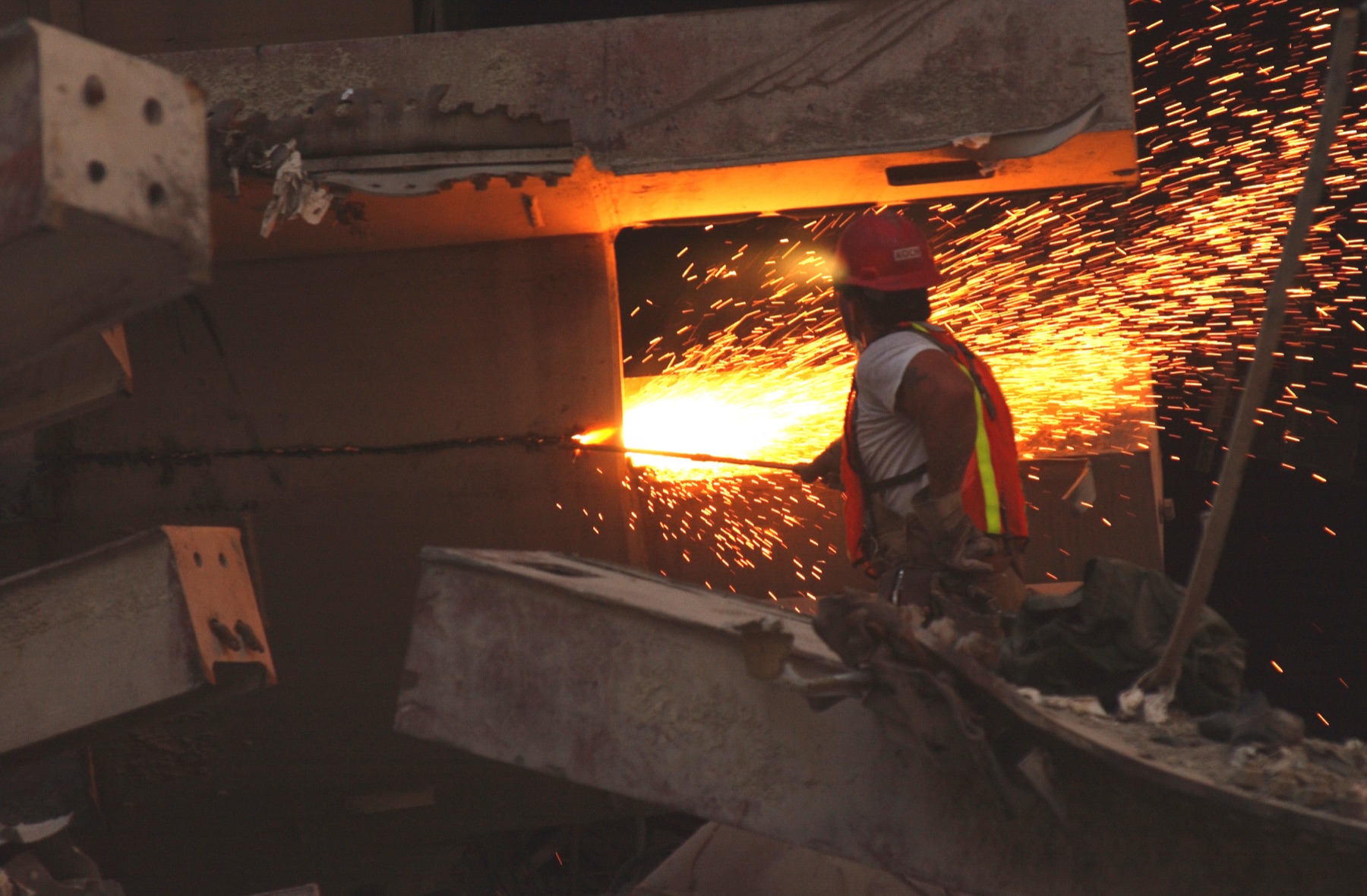
The steel had to come out one piece at a time. Ironworkers and welders, some of them from the same union local whose members had put the towers up thirty years earlier, cut the beams with torches into pieces small enough for the cranes and trucks to carry away. This one was working the wreckage that same day, September 13. Photo by Andrea Booher for FEMA.
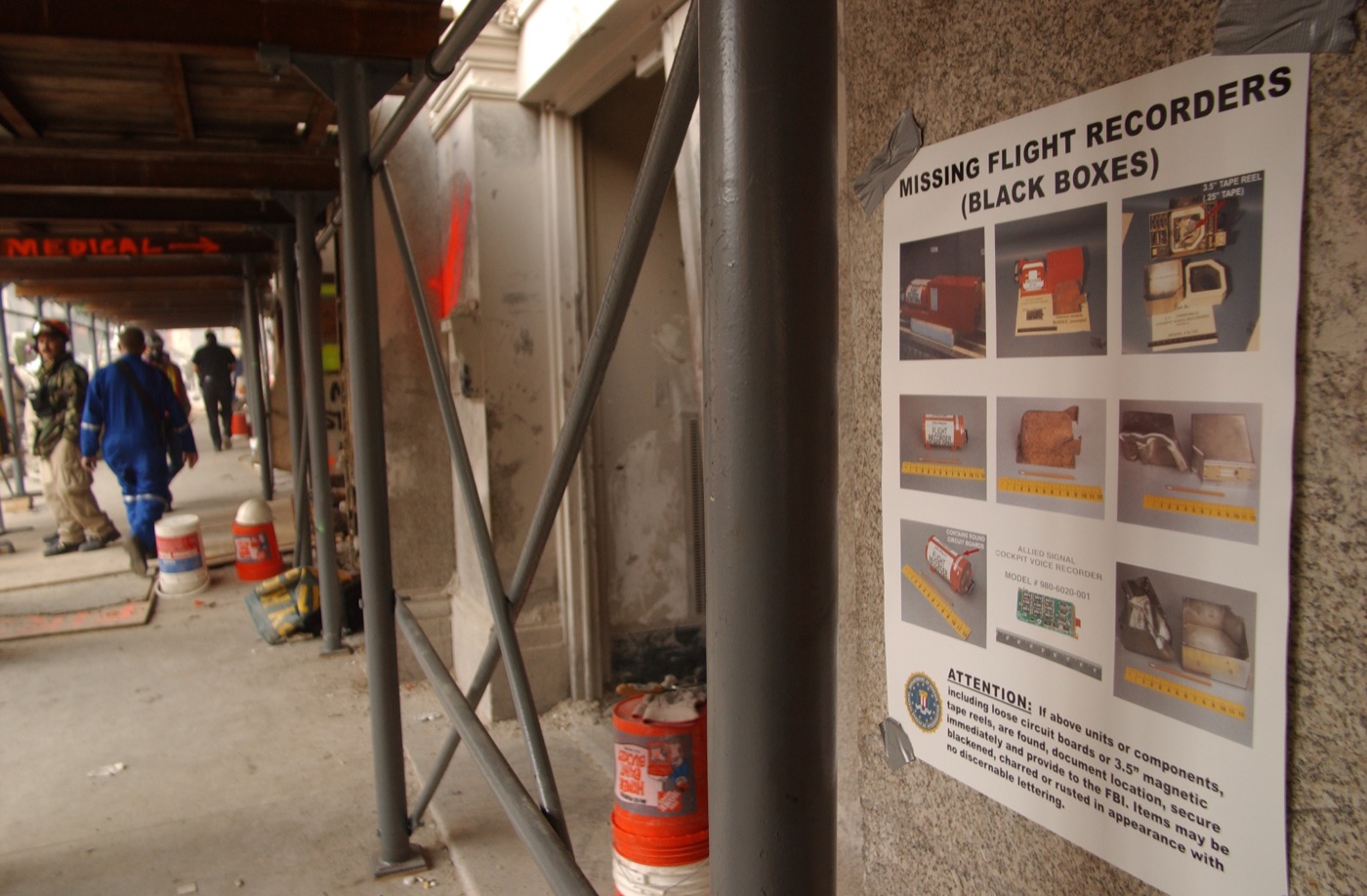
The FBI wanted the black boxes. A week after the attacks, on September 18, posters like this one were taped up around the site, showing workers what a flight recorder looks like intact, and what one looks like burned, crushed and stripped of its paint. They asked anyone who found one, or even a loose circuit board or a reel of magnetic tape, to leave it where it was, note the spot and call the FBI. The recorders from the Pentagon and Shanksville crashes were recovered. In New York, according to the official account, none of the four recorders from the two planes that hit the towers was ever found. A couple of recovery workers later said they had seen recorders pulled from the debris, which the FBI and the government deny, and that disagreement has never been settled. (Photo: Andrea Booher/FEMA)
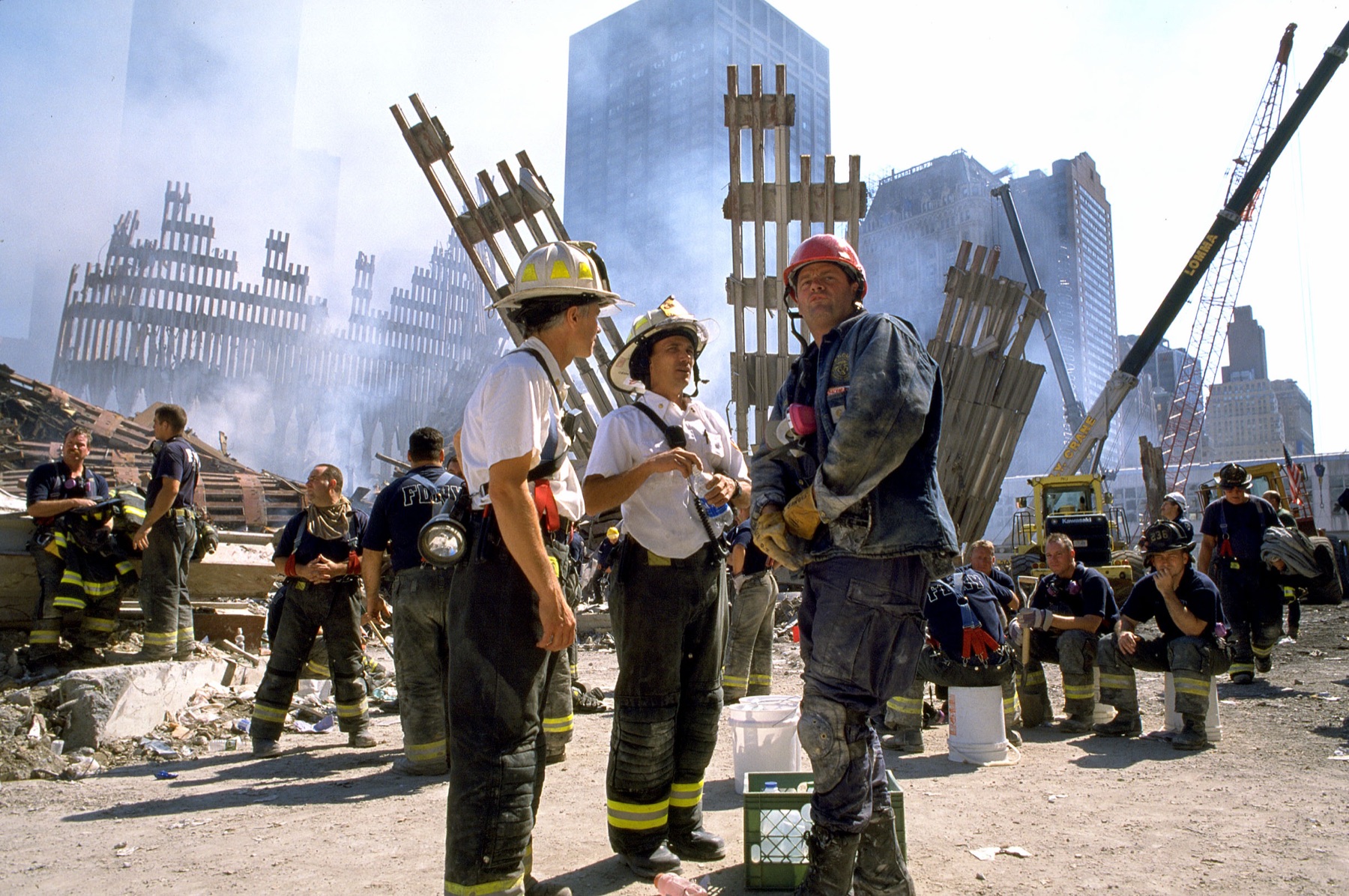
Five days after the attacks, on September 16, firefighters took a break on the edge of the pile with crates of bottled water, under what was left of the towers' steel facade. Many of them had lost friends from their own firehouses, and they kept digging for them. Photo by Michael Rieger for FEMA.
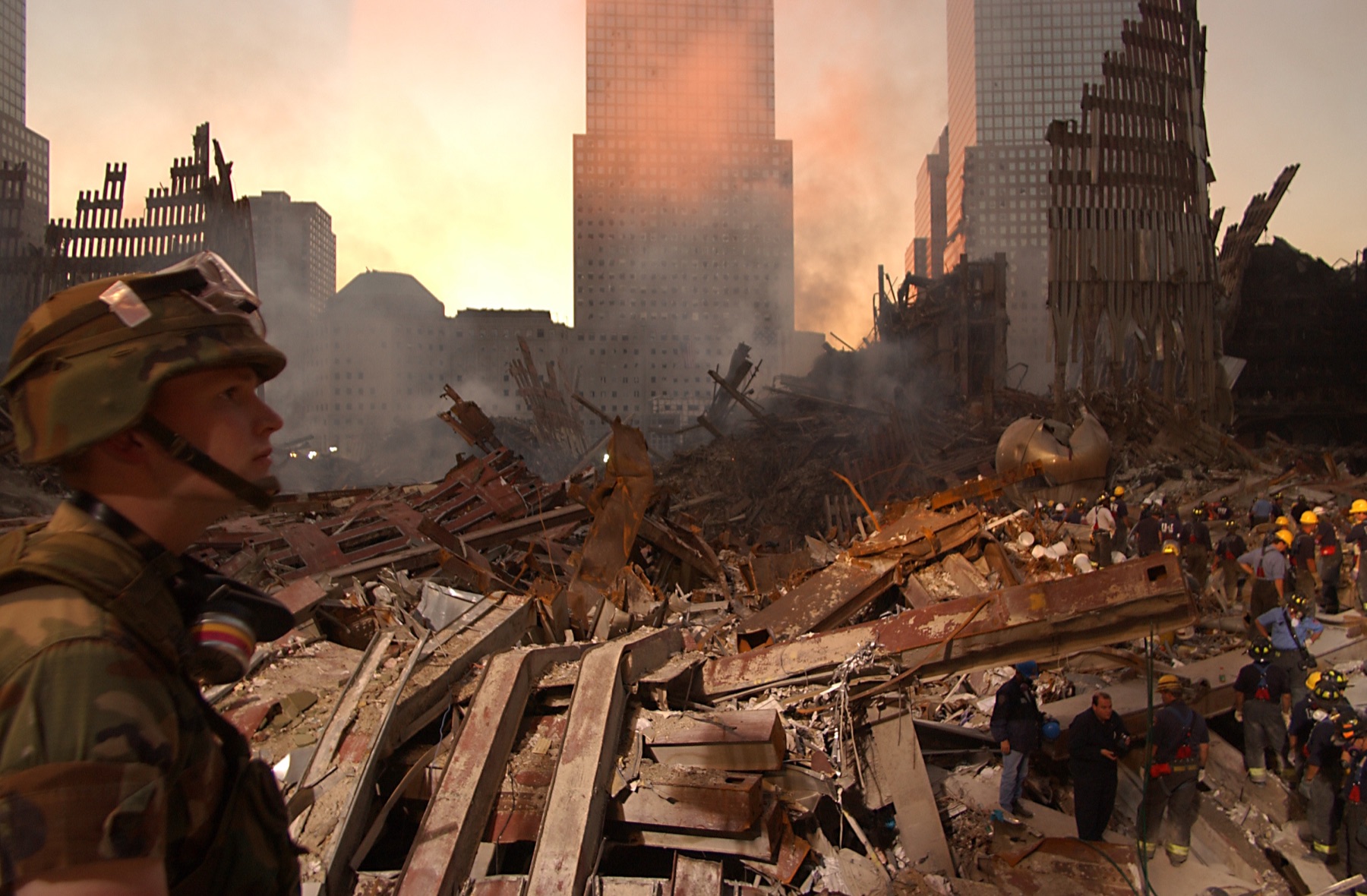
The same day, a young soldier with a respirator slung around his neck stood at the edge of the debris field while firefighters and rescue crews worked the steel below him. Behind them, in the middle of the wreckage, is the bronze sphere that had stood in the center of the plaza between the towers, dented and torn open but still in one piece. Photo by Andrea Booher for FEMA.
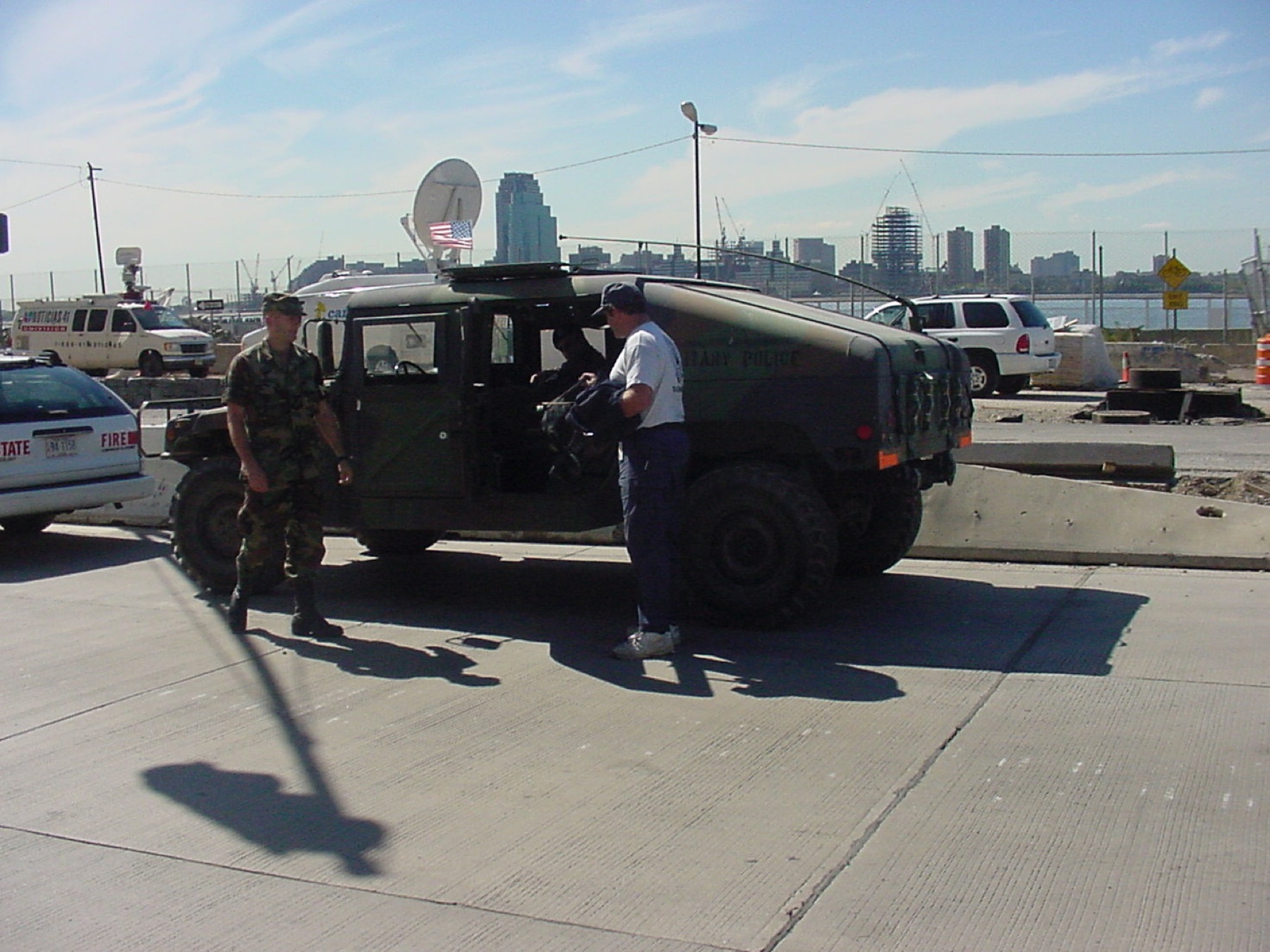
Much of Lower Manhattan was sealed off for weeks, and soldiers stood at the checkpoints alongside the police. This Military Police Humvee was parked by the Hudson on September 17, according to the camera's timestamp, with the TV networks' satellite trucks lined up behind it.
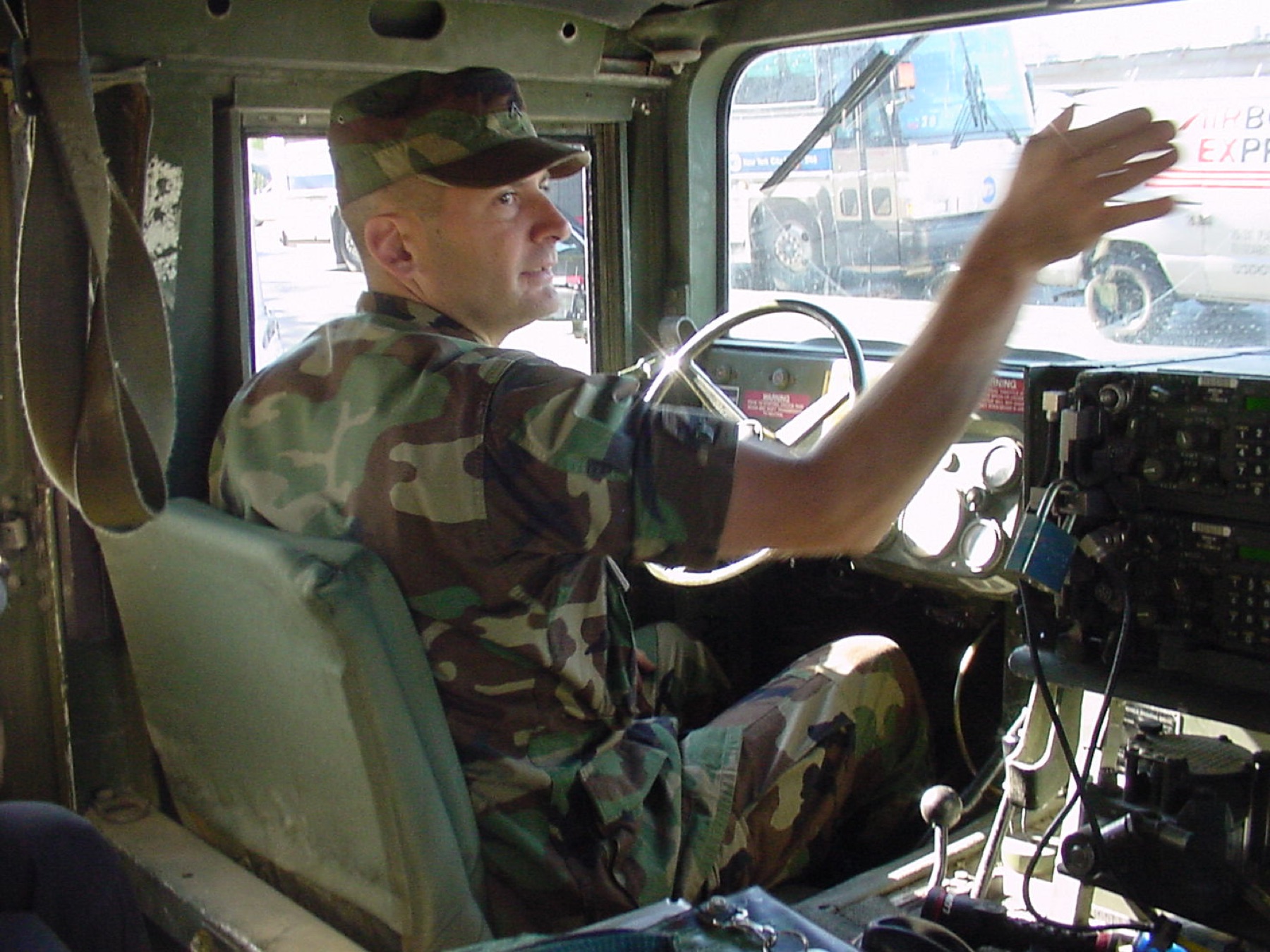
Earlier that day, a soldier behind the wheel of a Humvee waved to somebody outside, with city buses rolling by. A week earlier, a soldier in a Humvee on a Manhattan street would have been a startling sight. By then it was part of the scenery. Both photos are from FEMA's collection, and the photographer isn't credited.
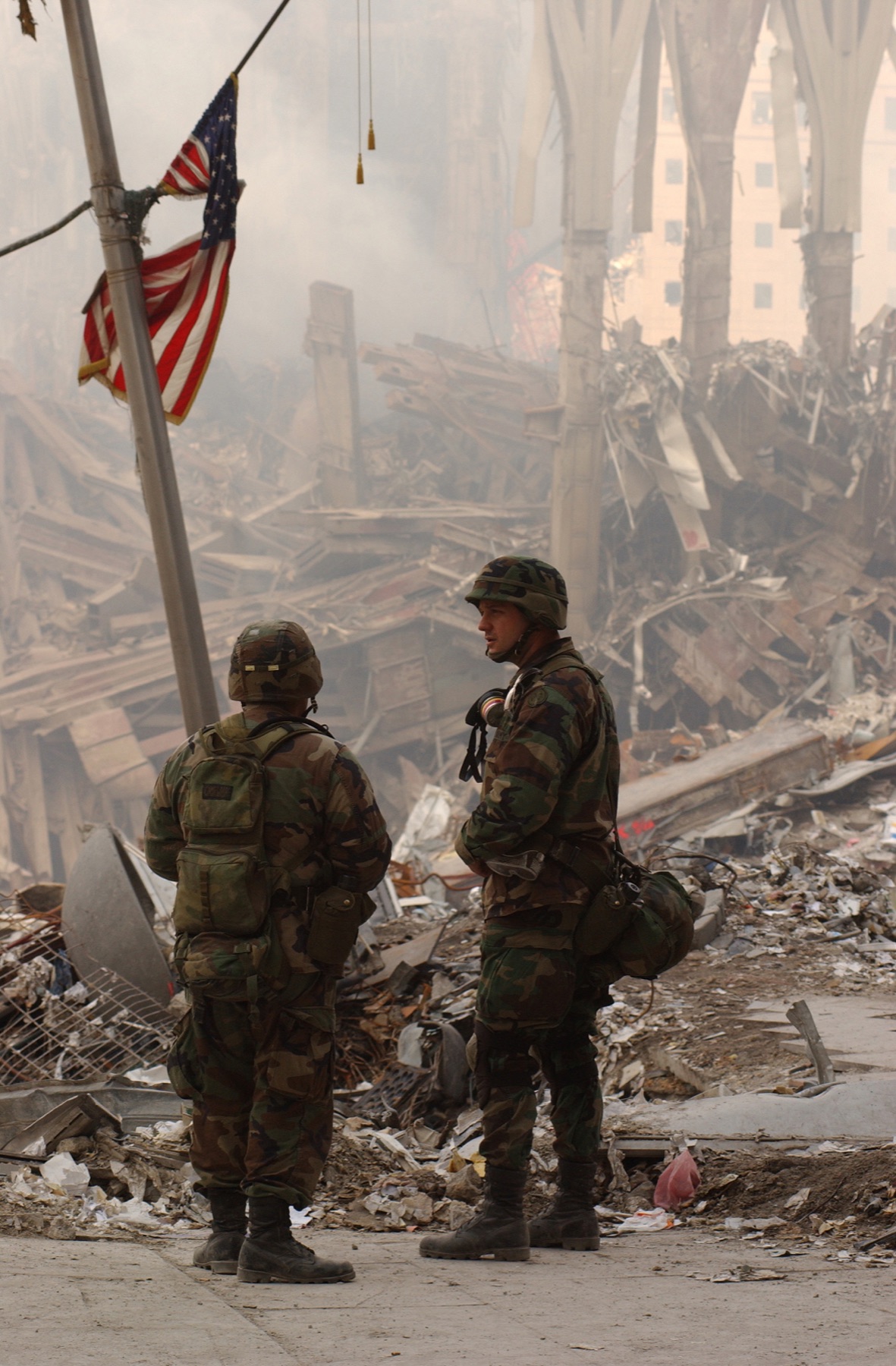
Two more soldiers, filed in FEMA's collection with the National Guard photos, stood talking on the sidewalk at the edge of the site, next to a flag someone had tied to a lamppost. The tall forked columns behind them are what was left of the base of one of the towers' outer walls, the same steel pattern that showed up in almost every picture from the site. The photo isn't dated or credited in FEMA's release.
At Ground Zero, recovery crews worked on the pile for more than eight months, and the dust they breathed turned out to be full of pulverized concrete, glass, asbestos and burning jet fuel. The cancers, lung diseases and other illnesses that followed have killed responders and people who lived and worked downtown for years since, and the toll is still climbing. The federal health program that covers them exists largely because a group of first responders and the comedian Jon Stewart went to Congress over and over to shame lawmakers into paying for it permanently.
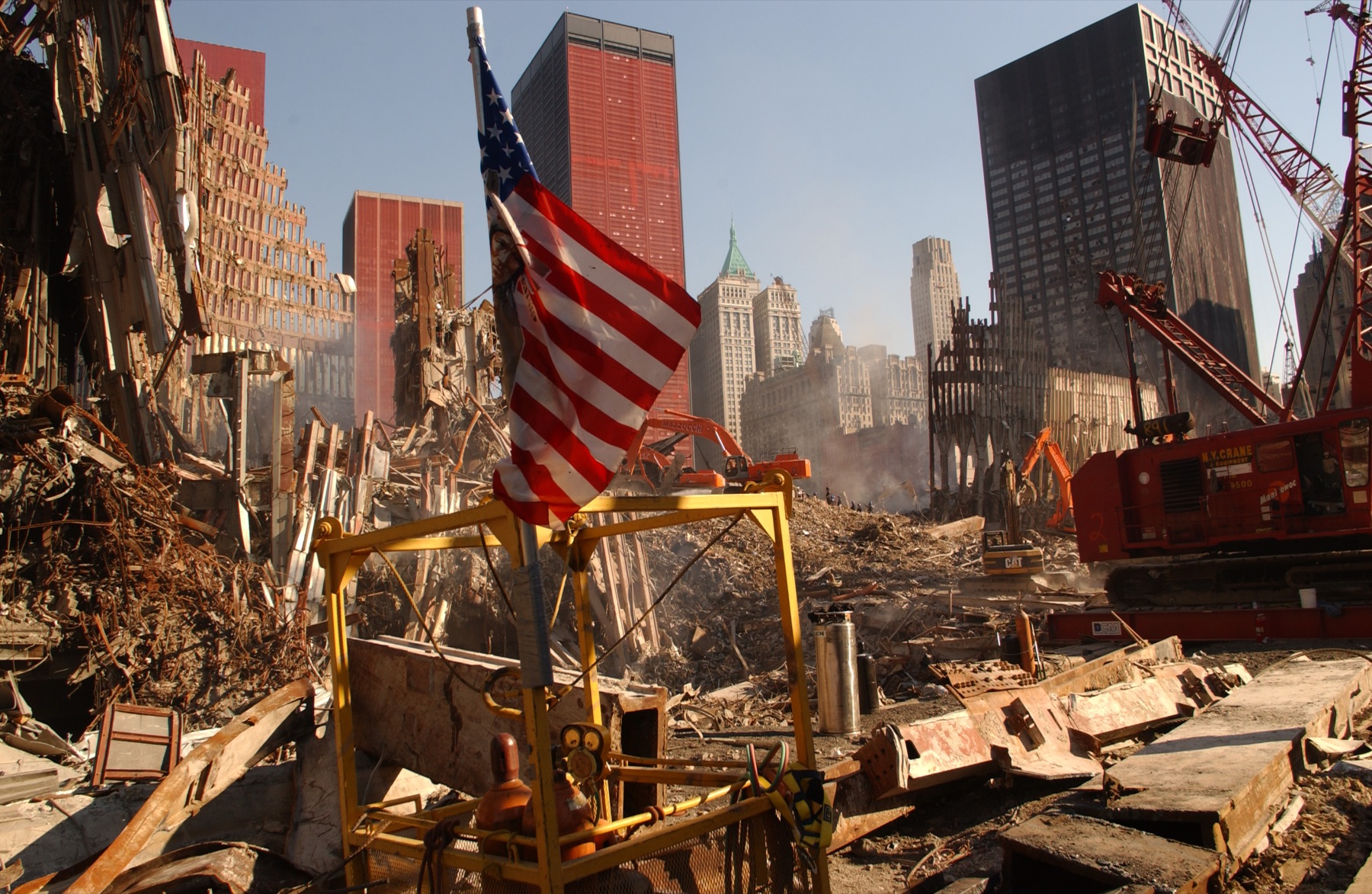
By October 4 the pile had become a work site, with cranes, excavators and the remnants of the towers' outer walls still standing over it. Flags turned up everywhere, on cranes, on steel, on equipment like this welder's basket. Photo by Andrea Booher for FEMA.
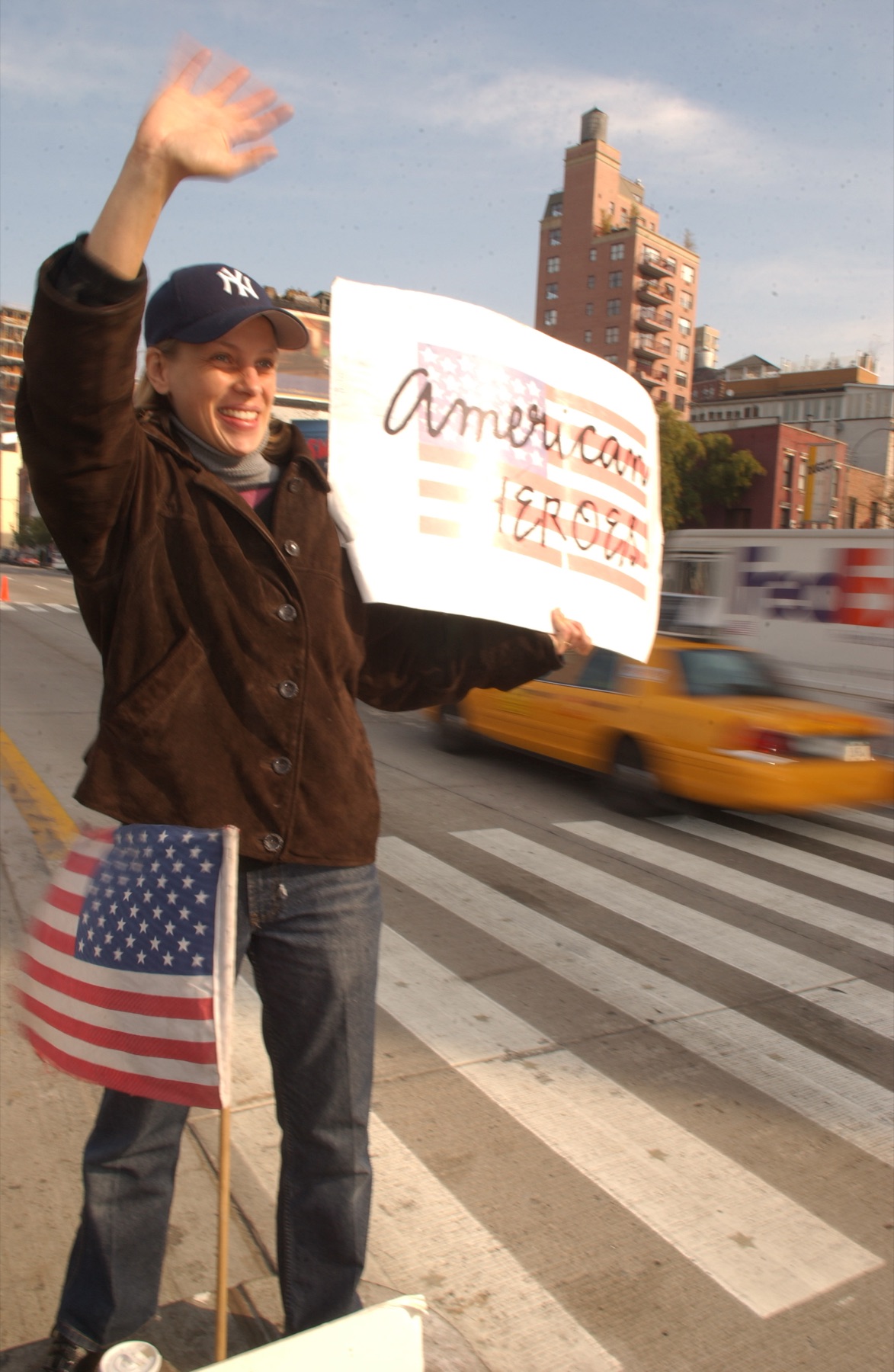
And all fall, people came out to cheer the workers. They stood on corners near the site with flags and homemade signs and waved at every truck, bus and crew that passed on the way in or out. This sign says "American Heroes," written over a flag. Photo from FEMA's collection of well-wishers near the site.
The medical examiner's office in New York is still working to identify remains. More than a thousand of the people killed at the World Trade Center have never been identified, and every so often, as DNA testing gets better, the office announces another name, and a family gets a call more than two decades after the fact.
The memorial pools opened on the tenth anniversary, in the footprints of the two towers, with the victims' names cut into the bronze around the edges. One World Trade Center, built just to the northwest, opened in 2014. Its spire tops out at 1,776 feet.
The Last Normal Morning
Anyone born after that morning, which by now includes a large share of the adults in this country, has never known anything else. To them, taking off your shoes at the airport, a Department of Homeland Security, and a war in Afghanistan were just part of the world, the way the Cold War was for the generation before. Some of them have parents who were in the towers, or who walked out of them. Some of them have parents who served in the wars that came after.
The footage below is from an ordinary workday inside the World Trade Center, a Monday at the end of January 2000, going by the camera's date stamp. Somebody brought a camcorder to the office and walked around with it, catching coworkers at their desks and on the phone, and the view from high up across the harbor to the Statue of Liberty. There is no sound. Nothing happens in it, and that's what makes it hard to watch.
What the people who were alive for it hold on to, more than the images of the planes and the smoke, is the before. The blue sky. The line to vote. The phone call they almost didn't pick up. They remember it so precisely because they had no idea it was going to be the thing they'd remember. It was just a Tuesday, and the weather was perfect, and nobody knew yet that it was the last of something.
Sources: The 9/11 Commission Report (National Commission on Terrorist Attacks Upon the United States, July 2004) and its staff monographs on aviation security and the four flights. National Institute of Standards and Technology investigations of the World Trade Center towers and Building 7. National September 11 Memorial & Museum. Fire Department of the City of New York. Office of Chief Medical Examiner of the City of New York. Federal Aviation Administration. Transport Canada and Gander International Airport Authority. U.S. Coast Guard accounts of the Lower Manhattan boatlift. World Trade Center Health Program.