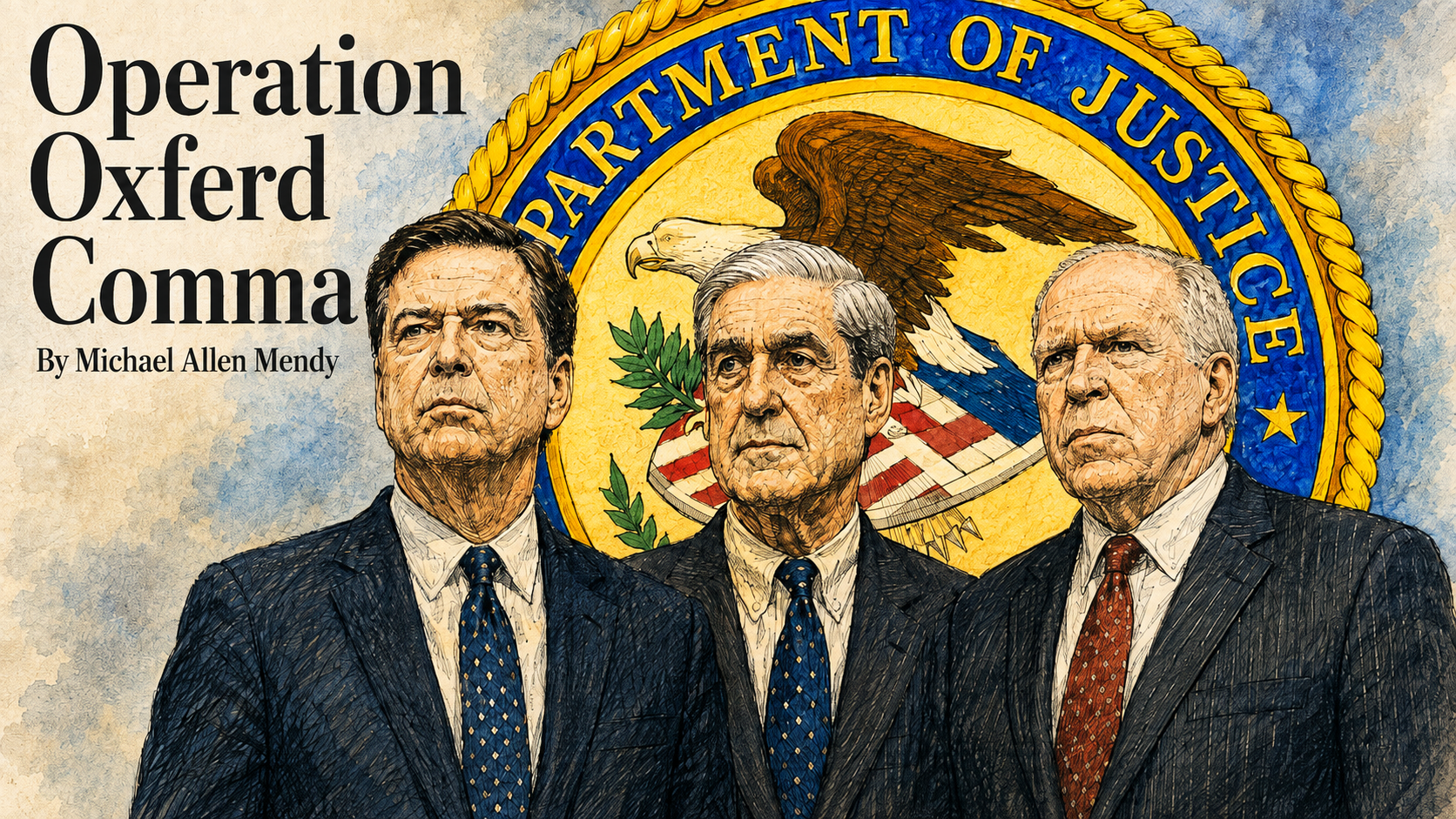
Nine days after President Trump fired FBI Director James Comey, the FBI's Counterintelligence Division opened a full investigation under a codename nobody outside the Bureau had heard until this week: Oxferd Comma. The misspelling looks like a typo, but it isn't; the FBI has a long habit of picking two-word codenames with no descriptive connection to the case, and this is presumably just one more example, a play on "Oxford comma" that nobody bothered to correct. What the case actually asked was a lot more serious than its name.
What The FBI Opened
Every document in this story, the memos, the notes, the texts, the referrals up and down the chain, exists because of one man, and it's worth pausing on him before getting into the paperwork itself.
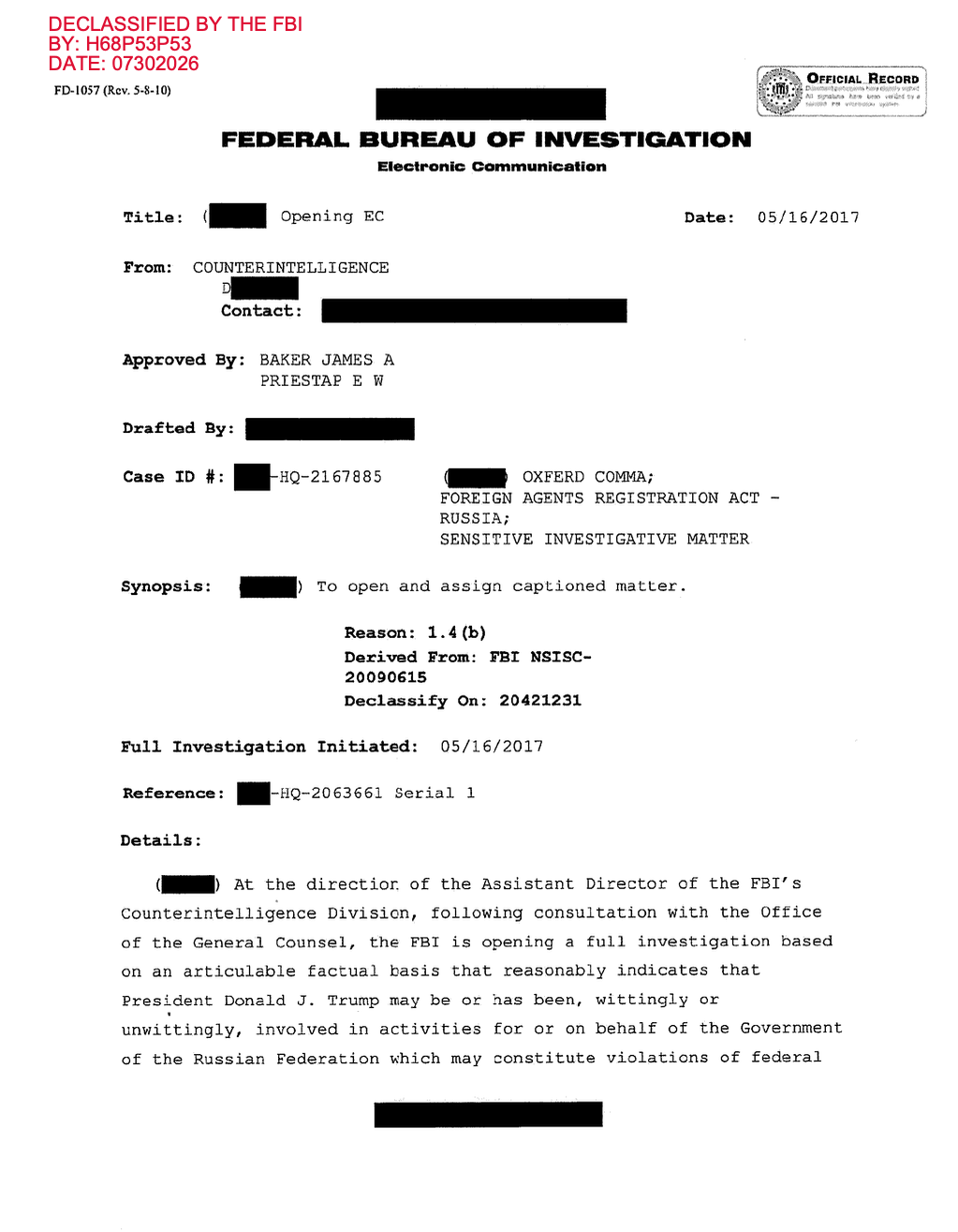
The opening memo, dated May 16, 2017, says the FBI's Counterintelligence Division was opening a full investigation "based on an articulable factual basis that reasonably indicates that President Donald J. Trump may be or has been, wittingly or unwittingly, involved in activities for or on behalf of the Government of the Russian Federation." The full statement of the case's goal, on the memo's second page, is more specific still: to determine whether Trump "is or was directed by, controlled by, and/or coordinated activities with, the Russian Federation in a manner constituting a threat to the national security of the United States and/or a violation of federal criminal statutes," and separately, whether Trump and others "obstructed and/or conspired to obstruct" the FBI's own Russia investigation. It was designated a "sensitive investigative matter," Bureau shorthand for a case involving a public official senior enough that its existence and handling get extra layers of review, and the memo closes by noting the FBI considered opening a full investigation "the least intrusive method" available to address the risk it described.
That language is doing careful, specific work, and it's worth being precise about what it does and doesn't say. It does not say the FBI had concluded Trump was a Russian asset. It says investigators had enough of a factual basis to open a full investigation into the possibility, which is a formal threshold, not a verdict, and one that by design includes the "unwittingly" branch: a president could fall under this kind of scrutiny without knowingly doing anything wrong at all. The memo paired that question with the obstruction question. Both went into the same case file.
The Factual Basis The FBI Cited
The memo doesn't just assert its own predicate, it lists the specific facts investigators were relying on, and the declassified pages spell out more of that list than has been public before.
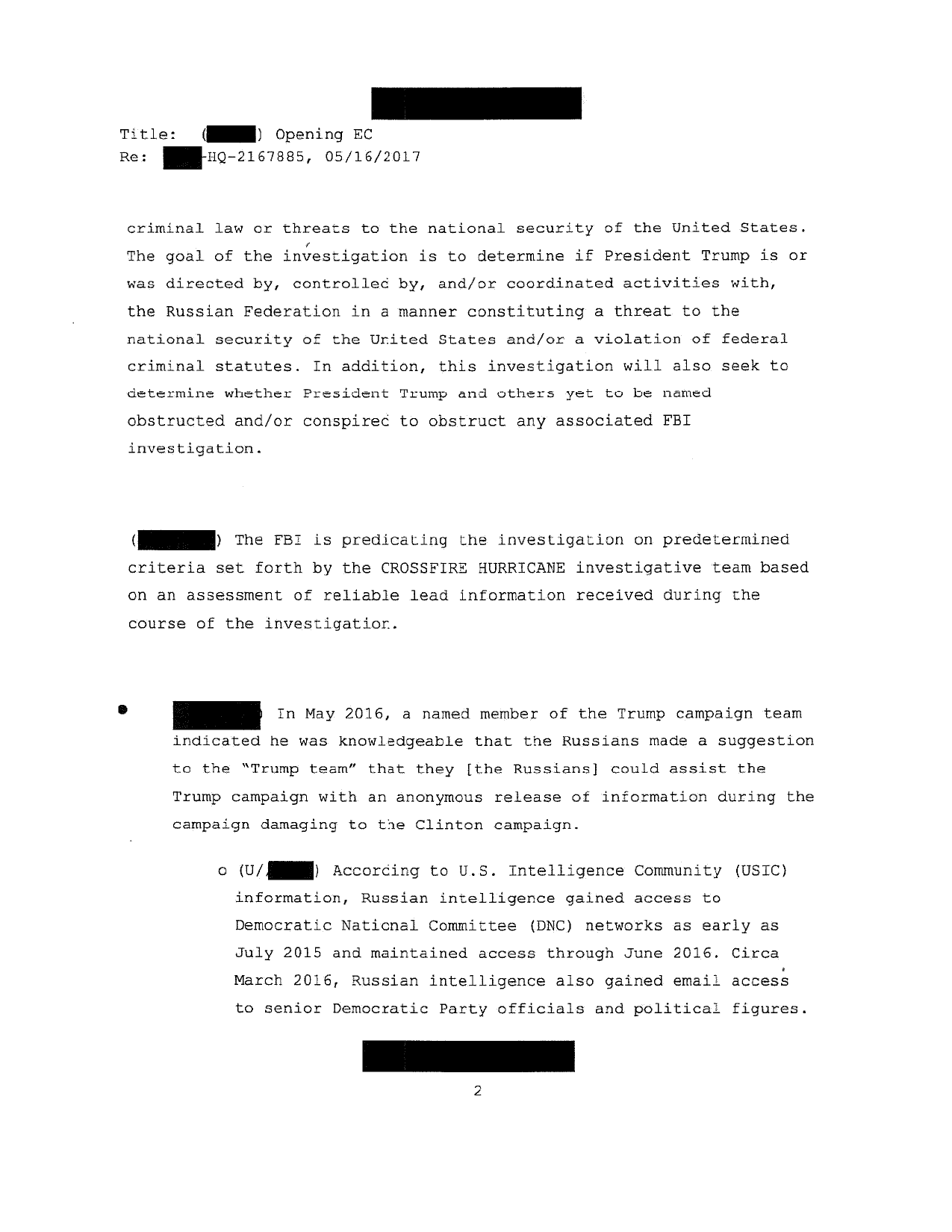
The first item cited is a May 2016 report that "a named member of the Trump campaign team indicated he was knowledgeable that the Russians made a suggestion to the 'Trump team' that they [the Russians] could assist the Trump campaign with an anonymous release of information during the campaign damaging to the Clinton campaign." The document doesn't name him on this page, but the description matches the episode that's already publicly attributed to campaign foreign policy adviser George Papadopoulos, who told an Australian diplomat that spring that Russia had dirt on Clinton in the form of emails.
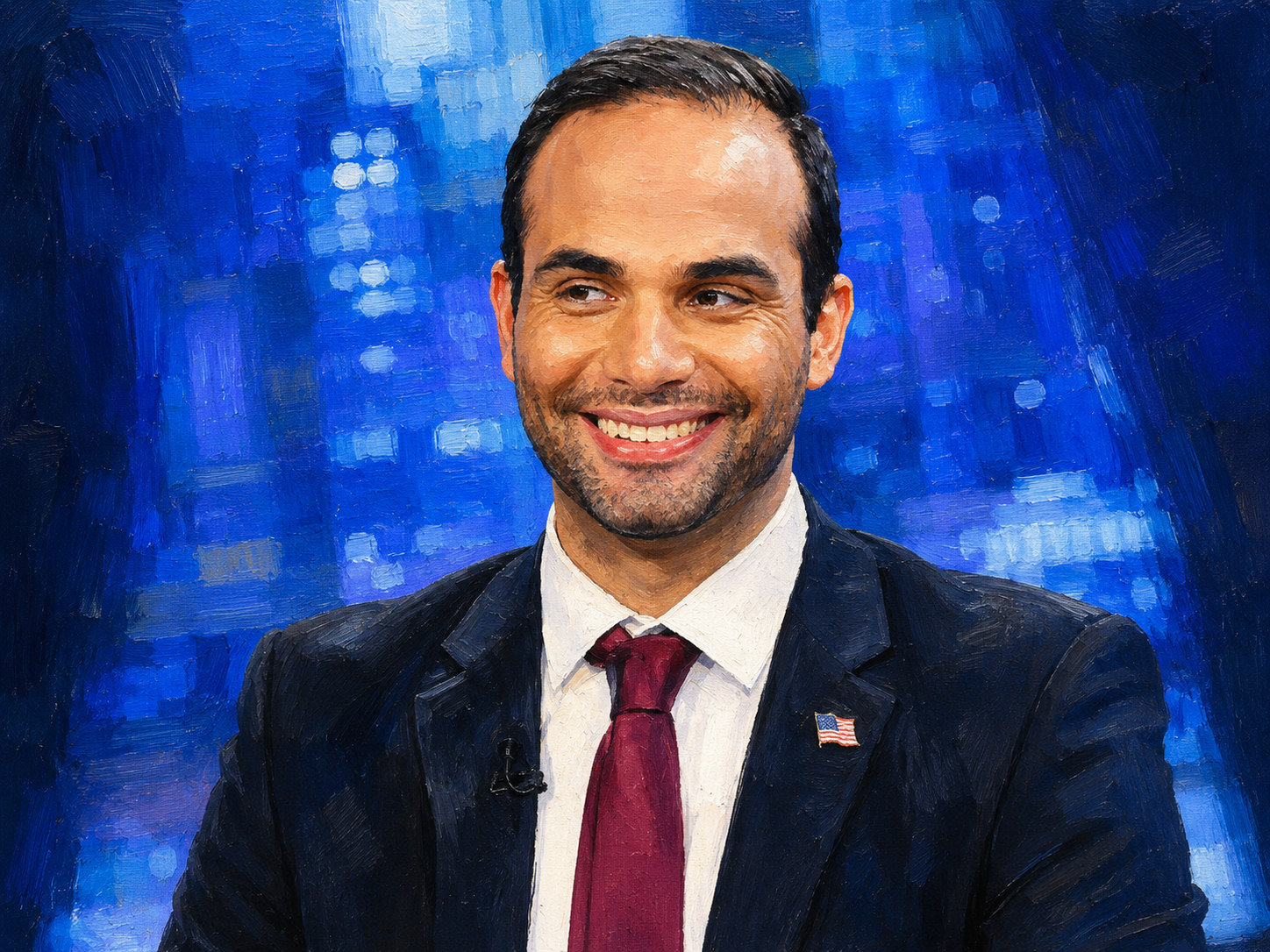
He was twenty-eight at the time, a junior volunteer adviser with no formal role in campaign decision-making, which is part of what made the episode so useful as a predicate: a single loose conversation, years before anyone in the room that day could have anticipated where it would lead, ended up cited in an FBI memo about the sitting president. From there the memo lays out the U.S. intelligence community's assessment that Russian intelligence had access to DNC networks from July 2015 through June 2016, had separately gained access to senior Democratic officials' email accounts by around March 2016, and used DCLeaks.com and WikiLeaks starting in June 2016 to publish what had been taken.
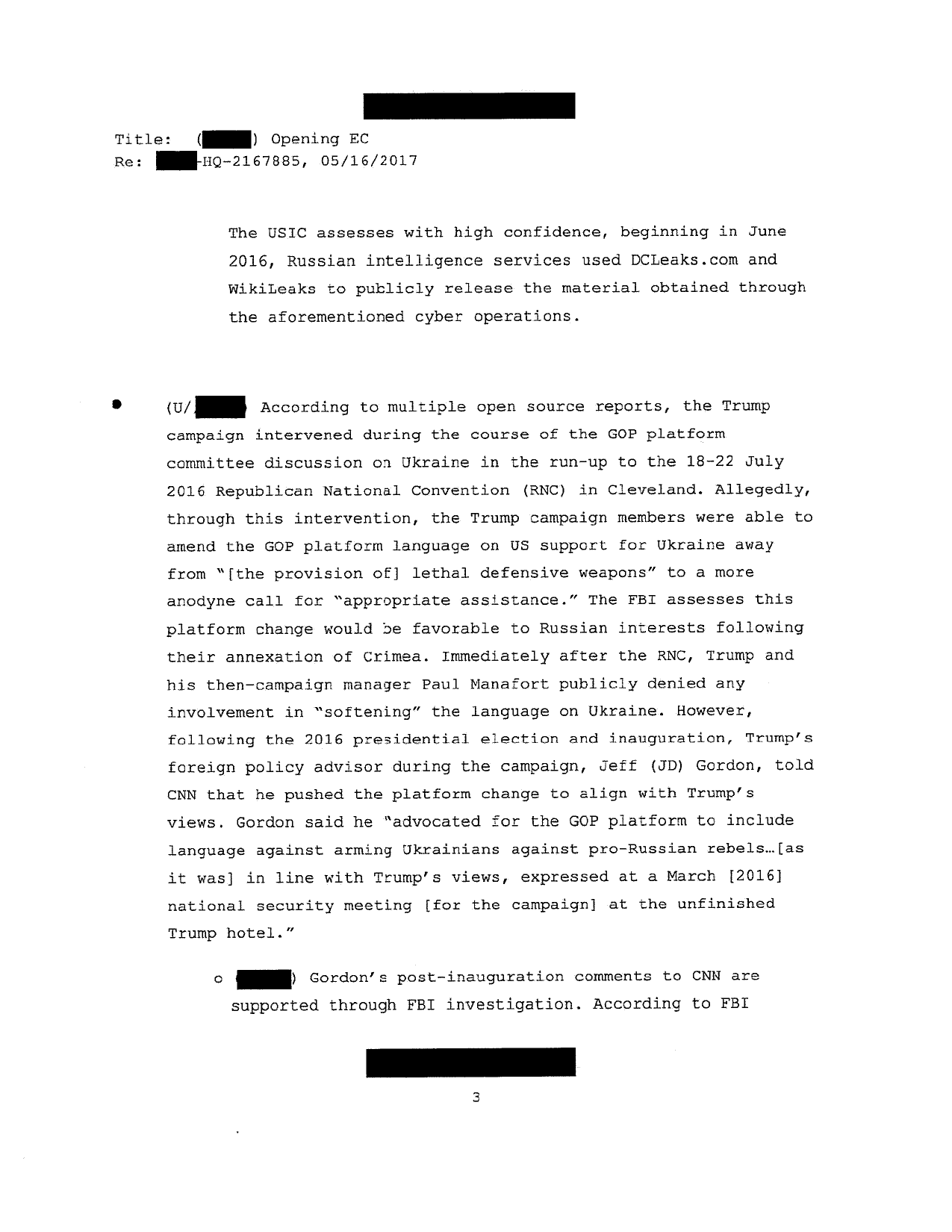
A separate item concerns the 2016 Republican National Convention. According to the memo, the Trump campaign intervened during the platform committee's debate over Ukraine, and language calling for the U.S. to provide "lethal defensive weapons" to Ukraine was changed to a vaguer call for "appropriate assistance," a shift the FBI assessed would favor Russian interests after its annexation of Crimea. Trump and then-campaign manager Paul Manafort denied any involvement at the time. The memo notes that campaign foreign policy adviser J.D. Gordon told CNN after the inauguration that he had personally pushed for the change, saying it was "in line with Trump's views," and that FBI investigation corroborated Gordon's account, including that he'd told the campaign's foreign policy team on July 14, 2016 that they had "defeated red line amendments like providing lethal assistance to Ukraine."
None of these items, on their own or together, is the FBI declaring any of them proven wrongdoing. They're the specific facts the Bureau cited to clear the bar for opening a full investigation, which is a much lower bar than the one needed to charge a crime.
Why Comey's Firing Raised The Question
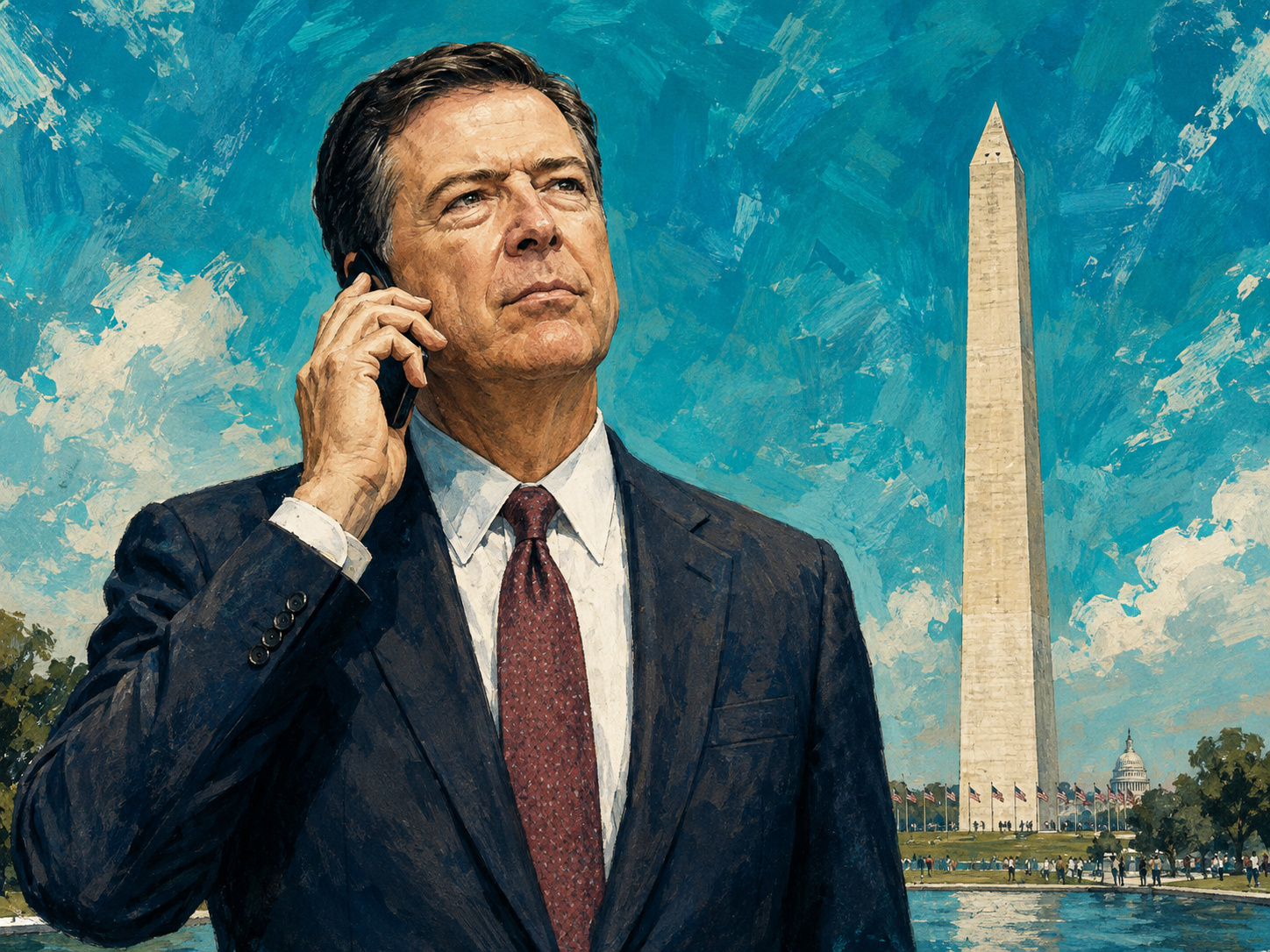
For a director whose agency runs on secrecy, Comey spent an unusual amount of that winter on the phone, fielding calls from a president who wanted his loyalty and, later, giving his own account of those calls to Congress, to Mueller's investigators, and eventually to the public. The obstruction predicate the FBI wrote down in Oxferd Comma is built almost entirely out of what happened on those calls and in a handful of one-on-one meetings.
Before it gets to Comey, the memo lists one more item under the "witting or unwitting" question: Trump's decades of business and real estate dealings in Russia and former Soviet states, and a specific 2008 quote from Donald Trump Jr. that Russians made up "a disproportionate cross-section" of many of his father's assets, alongside open-source reporting on business ties to named Russian oligarchs.
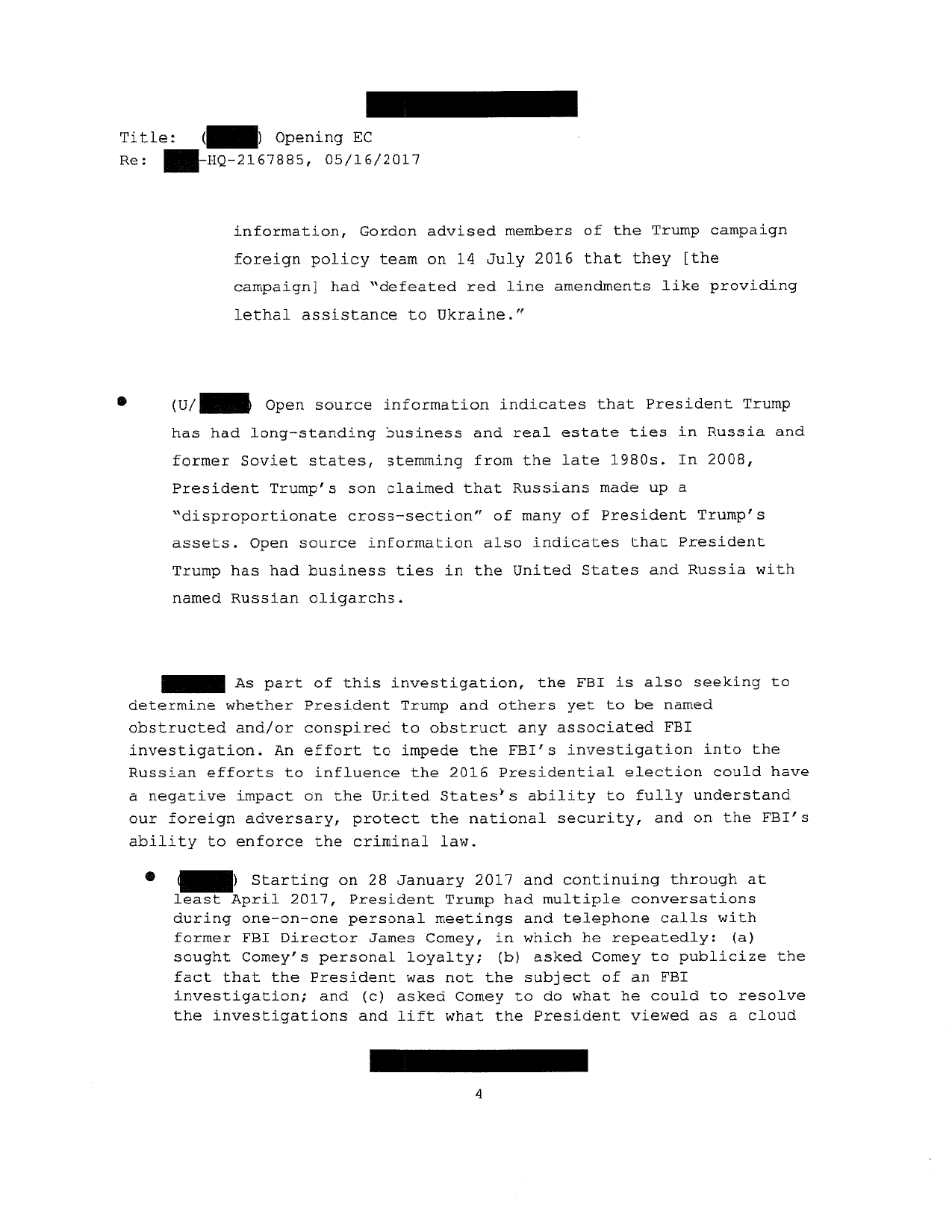
The obstruction half of the case had its own list of specifics. The memo states that starting January 28, 2017 and continuing through at least that April, Trump had multiple one-on-one meetings and calls with Comey in which he repeatedly sought Comey's personal loyalty, asked him to publicly state that Trump wasn't under investigation, and asked him to do what he could to resolve the investigations and "lift what the President viewed as a cloud" over his presidency, including expressing hope that Comey wouldn't further pursue the investigation of former National Security Advisor Michael Flynn.
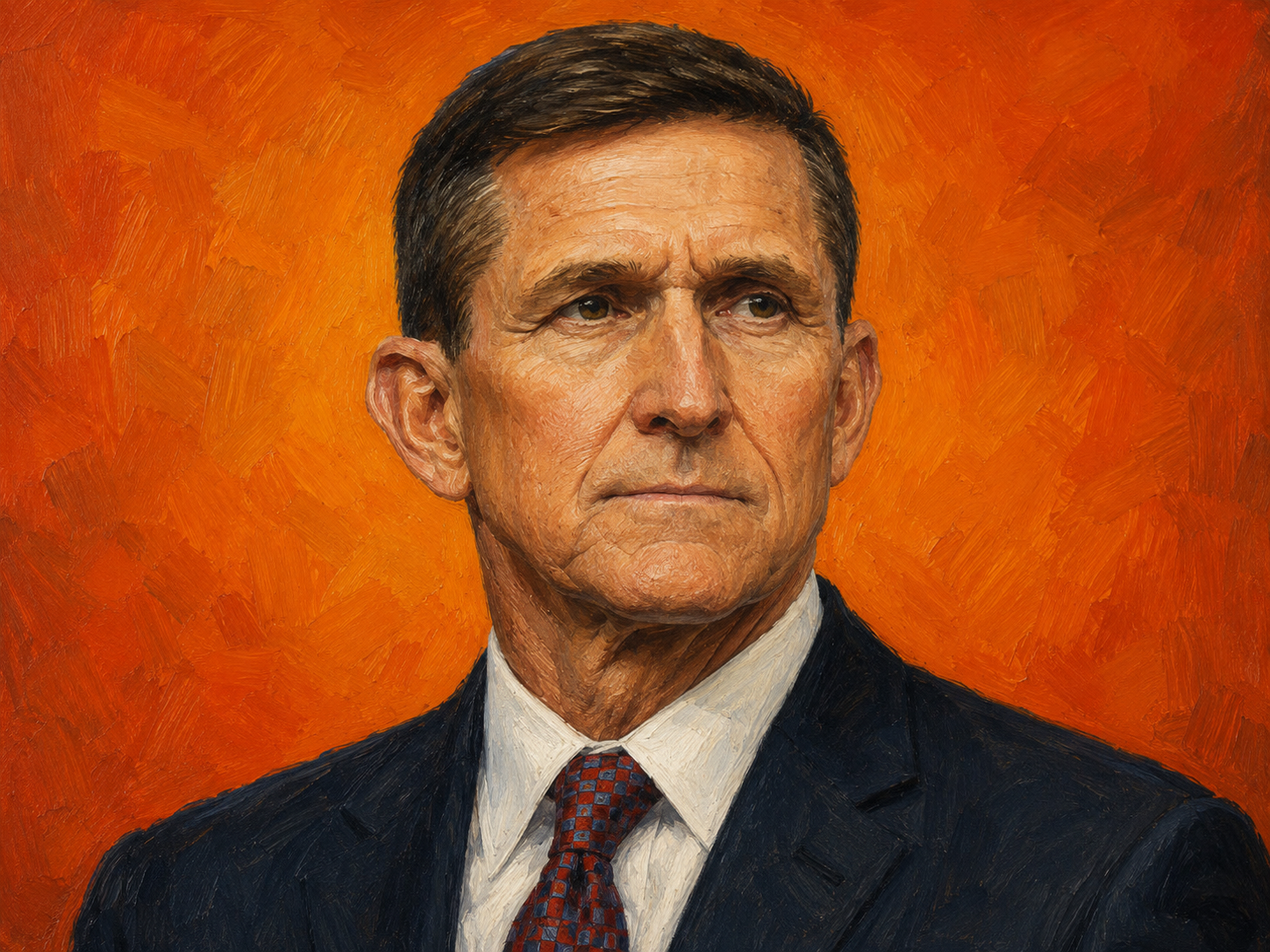
Flynn had already been forced out by the time this conversation was taking place, resigning as National Security Advisor on February 13, 2017, after it became public that he'd misled Vice President Pence about the substance of his Kislyak calls. That resignation is part of why the memo treats Trump's request on Flynn's behalf as significant: it wasn't a routine check-in about a sitting official, it was the president asking the FBI Director to go easy on a case involving someone his own White House had already pushed out the door.
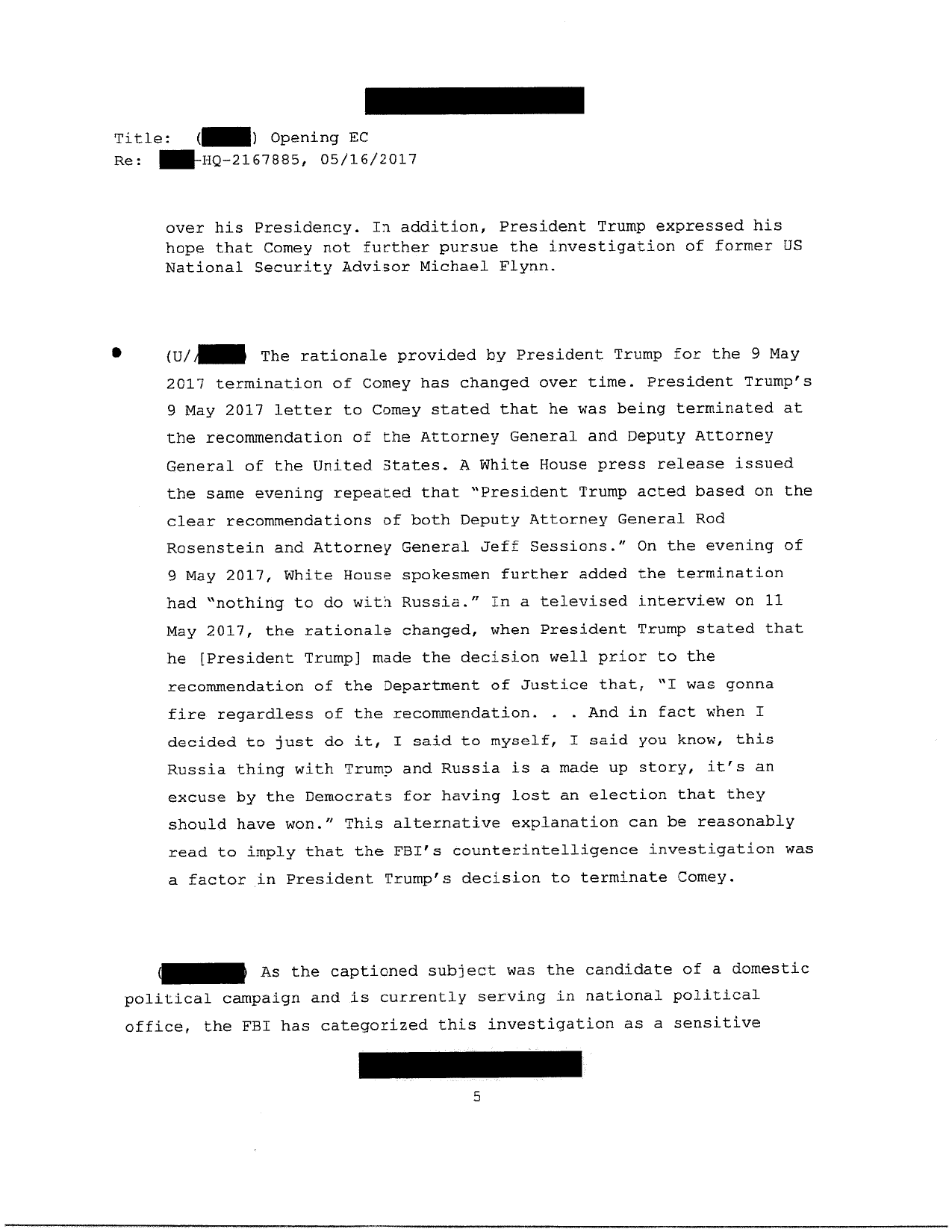
The memo then walks through how Trump's own explanation for firing Comey shifted. His termination letter and a same-day White House statement said the decision followed the recommendations of Attorney General Jeff Sessions and Deputy Attorney General Rod Rosenstein, and White House spokespeople said that night the firing had "nothing to do with Russia." Two days later, in the NBC interview with Lester Holt, Trump said he'd decided to fire Comey before any DOJ recommendation came in, adding: "in fact when I decided to just do it, I said to myself, I said you know, this Russia thing with Trump and Russia is a made up story, it's an excuse by the Democrats for having lost an election that they should have won." The memo's own conclusion about that quote is measured, not accusatory: it says the statement "can be reasonably read to imply" that the counterintelligence investigation was a factor in the decision, not that it proves one.
A Branch Of Crossfire Hurricane
Oxferd Comma wasn't a new investigation built from scratch. The case reference on the opening memo points back to file number HQ-2063661, the same case number assigned to Crossfire Hurricane, the investigation the FBI opened in July 2016 into possible coordination between the Trump campaign and Russia. The later closing memo spells out the connection directly: agents opened Oxferd Comma "using predetermined criteria established by the CROSSFIRE HURRICANE investigative team." It was a formal spinoff, opened under a separate case number because it now named a sitting president as its subject, but built on the same predicate and run by people already working the larger case.
The officials who signed off on it are familiar names to anyone who's followed this story. It was approved by James Baker, the FBI's General Counsel at the time, and Bill Priestap, the Assistant Director of the Counterintelligence Division, the same official credited elsewhere with authorizing Crossfire Hurricane itself. A separate one-page memo, dated the following day, documents how quickly the news moved up the chain: at approximately 12:30 p.m. on May 16, 2017, the same day the case opened, Acting FBI Director Andrew McCabe personally briefed Deputy Attorney General Rod Rosenstein on it in person.
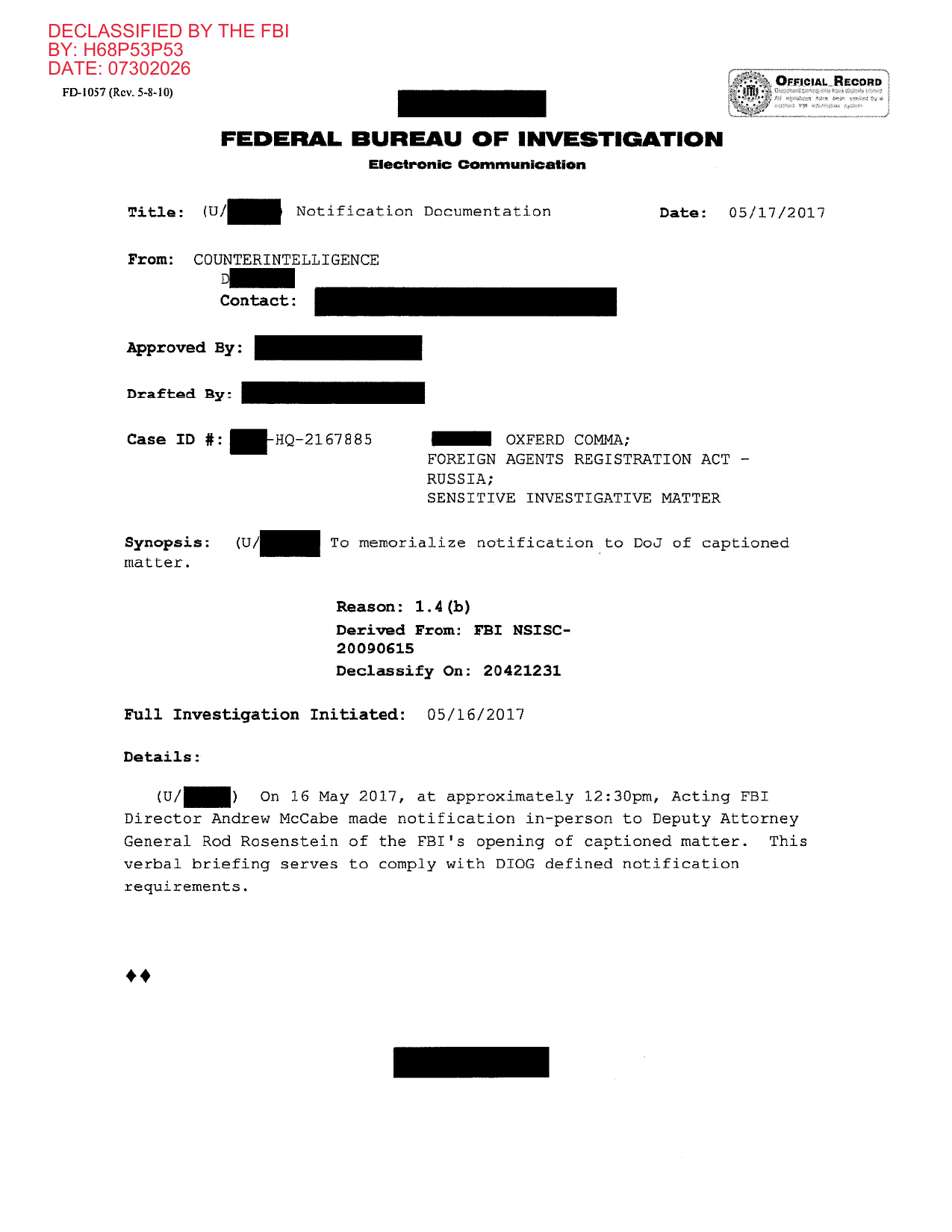
The next day, May 17, Rosenstein appointed Robert Mueller as special counsel.
What The CIA Was Also Weighing
Oxferd Comma was an FBI case, run out of the Counterintelligence Division and briefed to DOJ, but the FBI wasn't operating in isolation that winter. Comey and Brennan were in regular contact as the transition unfolded, comparing notes across the two agencies on the same broad set of Russia questions from different vantage points, the FBI running its own domestic investigation while the CIA weighed intelligence no domestic case could fully explain on its own.
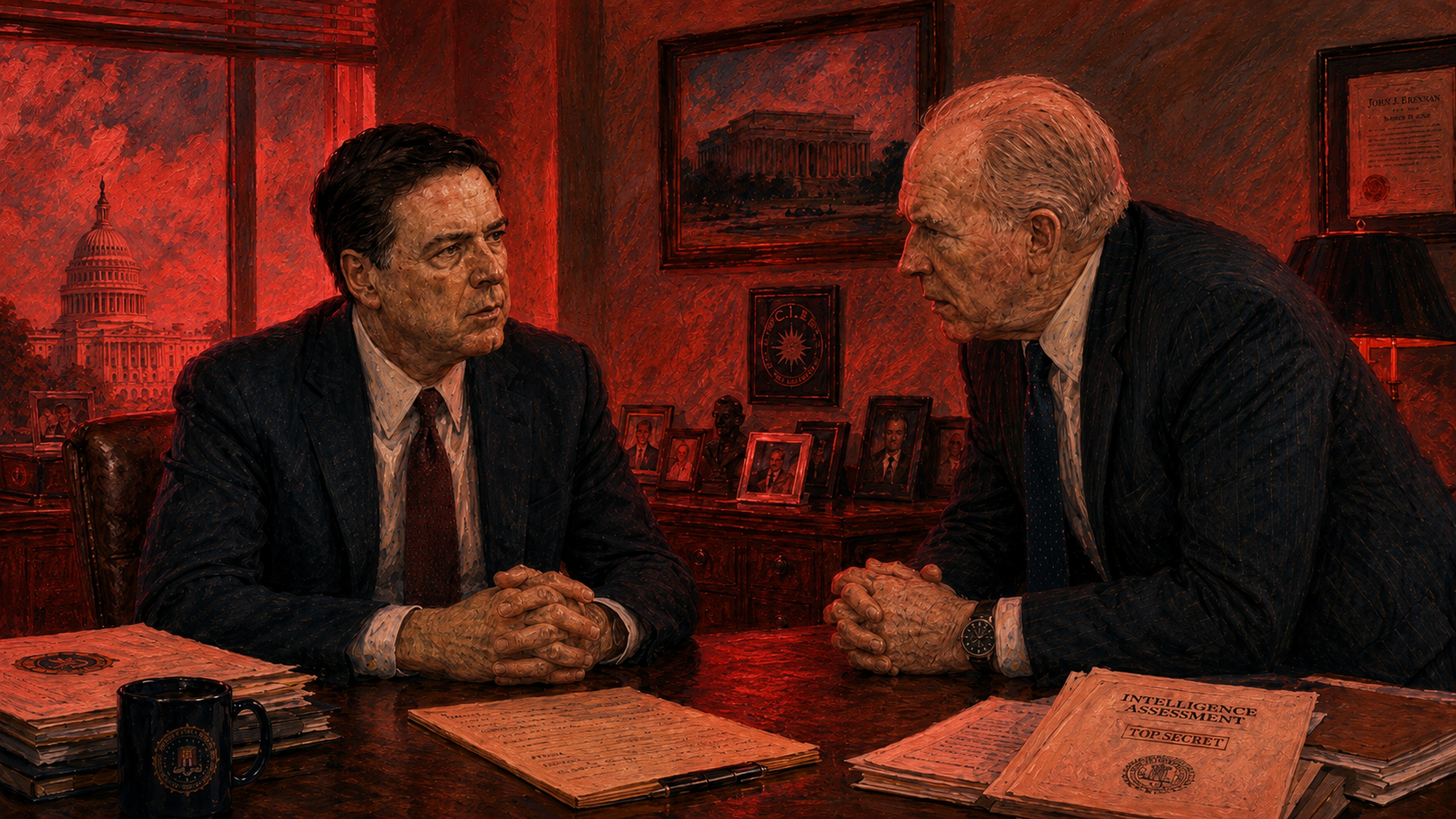
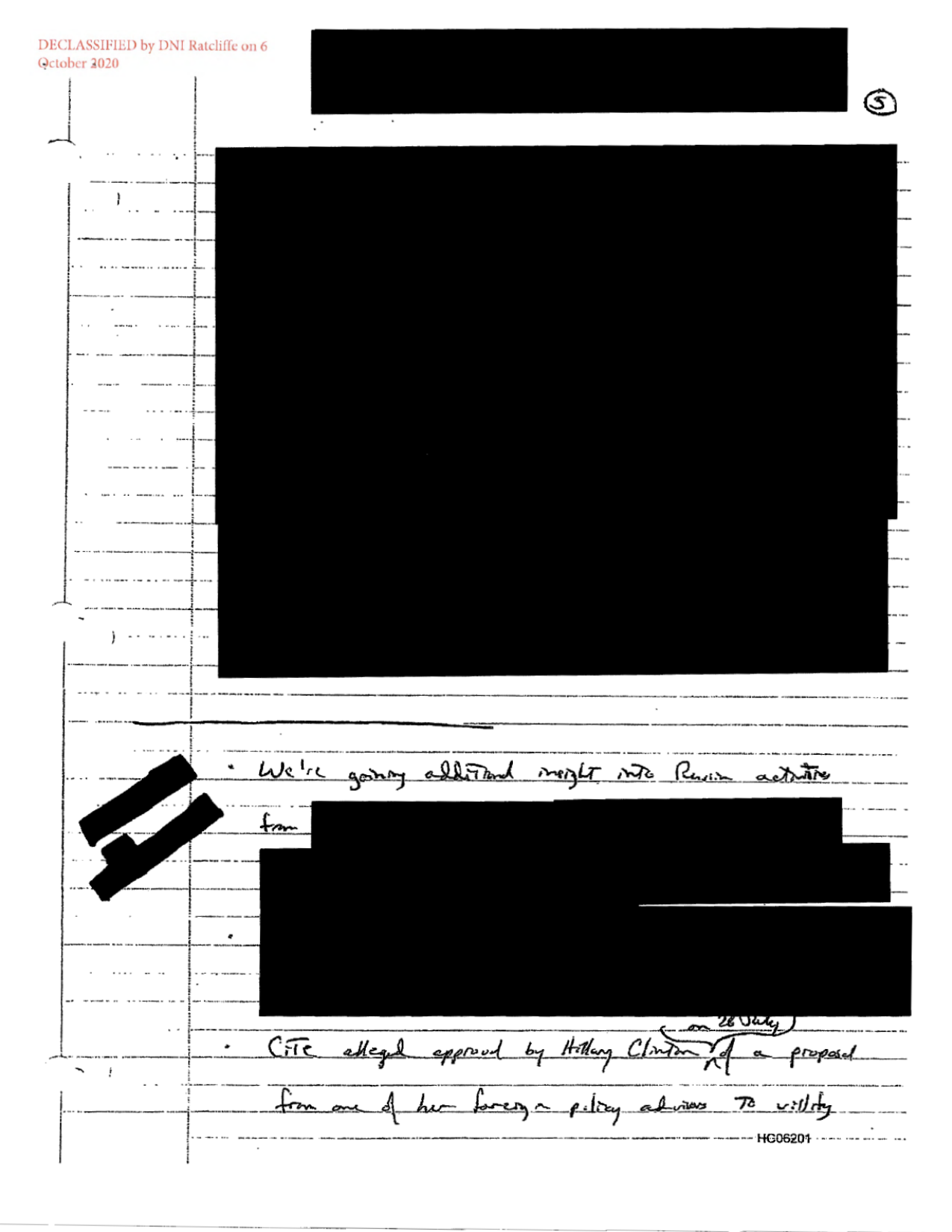
The FBI wasn't the only agency turning these questions over that winter. A separate set of handwritten notes, declassified in 2020 and taken by then-CIA Director John Brennan, records part of a briefing from the transition period that touches the same territory as Oxferd Comma's predicate from another angle entirely.
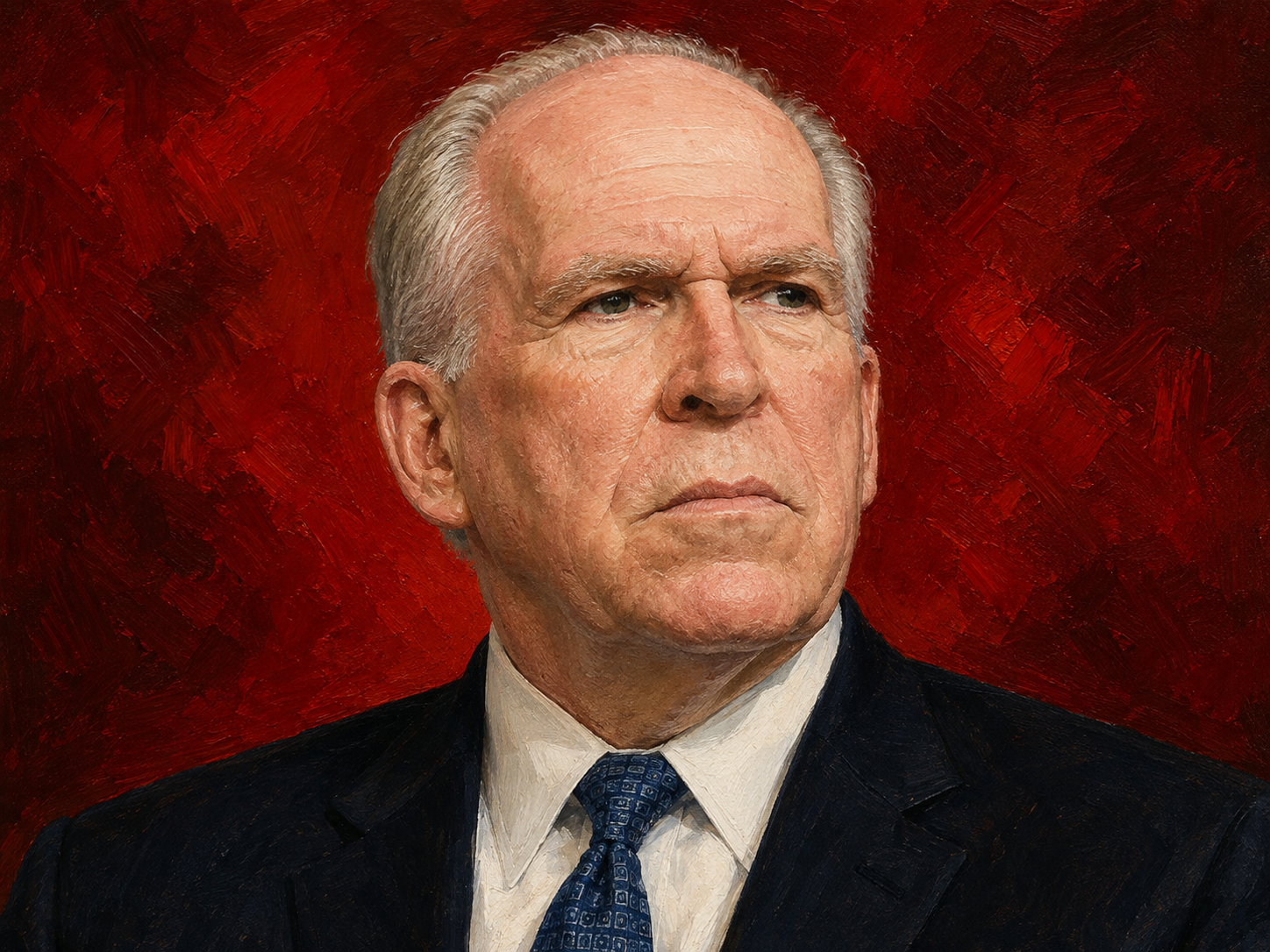
Brennan ran the CIA for the last four years of the Obama administration, which put him in the room for exactly this kind of briefing during the transition, weighing raw intelligence against an incoming administration that hadn't yet been read into any of it. One page cites intelligence alleging that on July 28, 2016, Hillary Clinton personally approved a campaign proposal from one of her foreign policy advisers to, as the notes put it, "vilify" Trump.
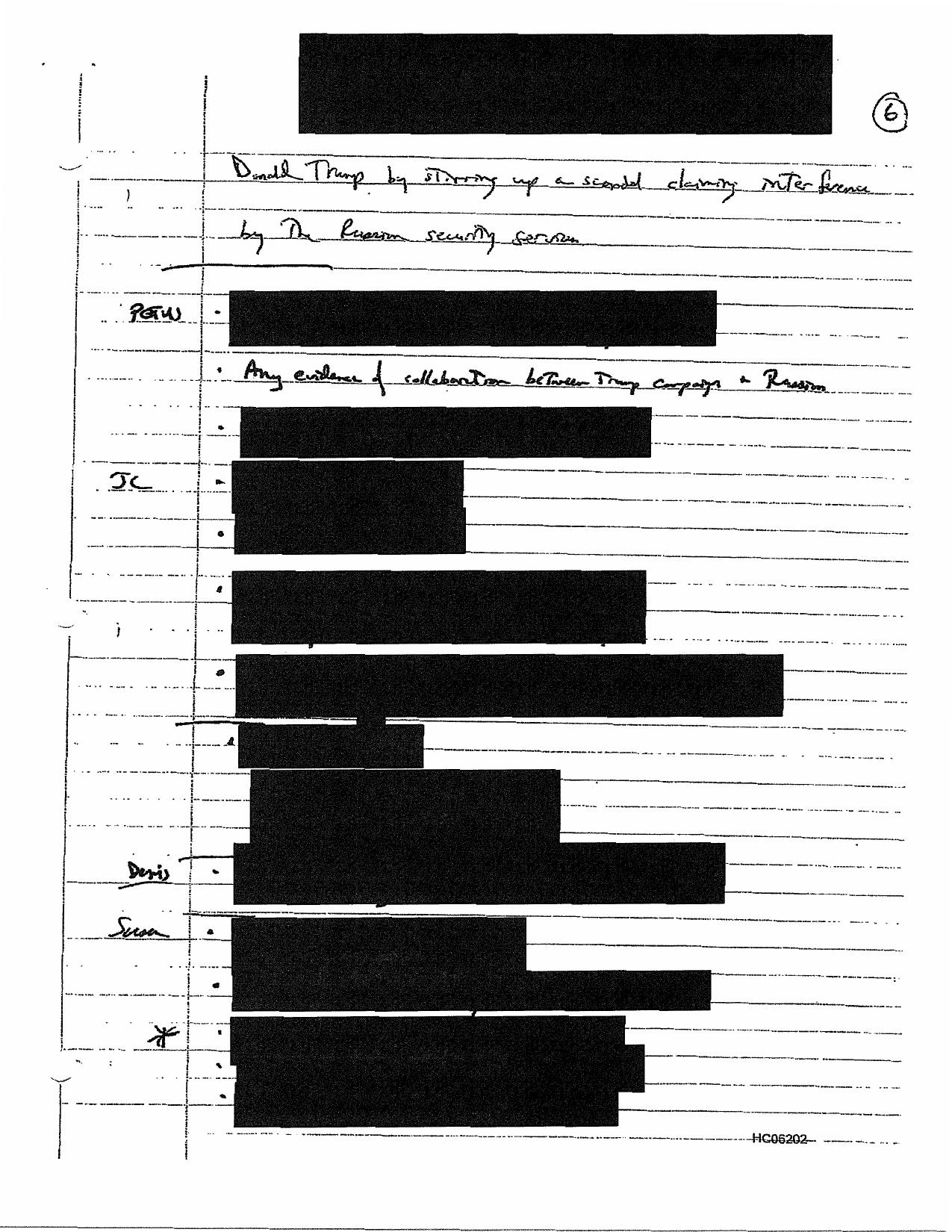
The next page picks up the sentence and finishes it: vilify Trump "by stirring up a scandal claiming interference by the Russian security services." The notes then move straight into a list of questions for the officials in the briefing, including then-FBI Director James Comey, about "any evidence of collaboration between Trump campaign & Russia."
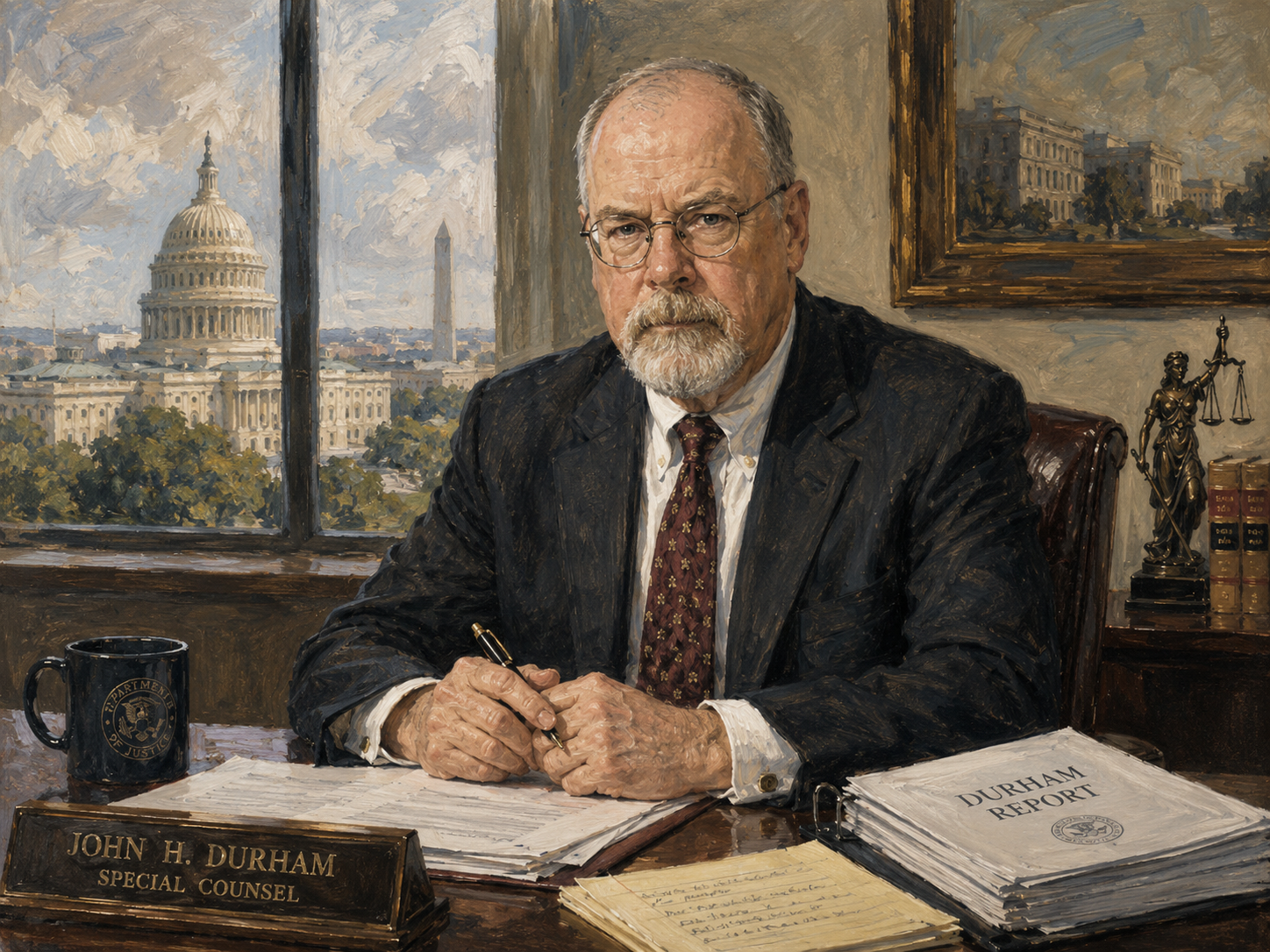
That's the same "Clinton Plan" intelligence that later became a centerpiece of John Durham's investigation and report, and it points in the opposite direction from Oxferd Comma: an allegation, disputed and never proven, that the Russia scandal itself had partisan origins rather than a genuine Russian angle. Durham spent years working through material like this, and his report leaned hard on it in arguing that the FBI had been too credulous about the original Russia allegations while giving the "Clinton Plan" intelligence too little weight.
Both threads, the suspicion of a manufactured scandal and the search for actual evidence of collaboration, were live inside the government at the same time, in the same room, weeks before Oxferd Comma's predicate would start being written down. Neither one canceled the other out; they're evidence the entire question was being taken seriously and skeptically at once, by people who didn't yet know which way it would break.
A third stream of intelligence ran alongside both of those, and it's the one most people actually remember: the dossier compiled by Christopher Steele, a former British intelligence officer hired to research Trump's Russia ties during the campaign. Steele's reporting reached the FBI in 2016 and helped shape part of the early Crossfire Hurricane record, including material used in the Carter Page FISA applications that the 2019 Inspector General review later criticized as poorly verified.
Durham's investigation spent enormous effort tracing where Steele's sourcing actually came from, and found it thinner and less corroborated than the FBI had treated it at the time. None of that reporting touches Oxferd Comma directly, since the case Baker and Priestap opened in May 2017 was built on the Comey-firing predicate and the CIA-level "collaboration" question, not on Steele's material specifically. But it's the third leg of the same period: three separate intelligence streams, the CIA's Clinton Plan intelligence, the FBI's Comey-obstruction case, and Steele's dossier, all moving through overlapping people at the same time, each later scrutinized by a different reviewer with a different verdict.
Laid out this way, the two threads share more plumbing than their conclusions suggest. The same CIA that assessed the "Clinton Plan" intelligence also fed the briefing that reached Comey, and Comey's own FBI is the agency that both opened Crossfire Hurricane and, sixteen months later, opened Oxferd Comma on the strength of criteria that team had already established. The "Clinton Plan" material took a slower, separate path out into public view, sitting classified until a 2020 declassification order and later surfacing again in Durham's report. Two allegations, running through a lot of the same people, reaching daylight years apart and on very different schedules.
How It Closed
Everything from here runs through one man. Robert Mueller had spent twelve years as FBI Director before Rosenstein appointed him special counsel, and it was his office, not the FBI's Counterintelligence Division, that ultimately decided how Oxferd Comma's questions would be answered.
Mueller took the case as he found it: a codename, a predicate written by someone else's team, and a president who was now also his subject. He didn't reopen the question of whether to investigate. He just had to decide, using tools the FBI's Counterintelligence Division never had, grand jury subpoenas, cooperating witnesses, the ability to compel testimony, what the answer actually was.
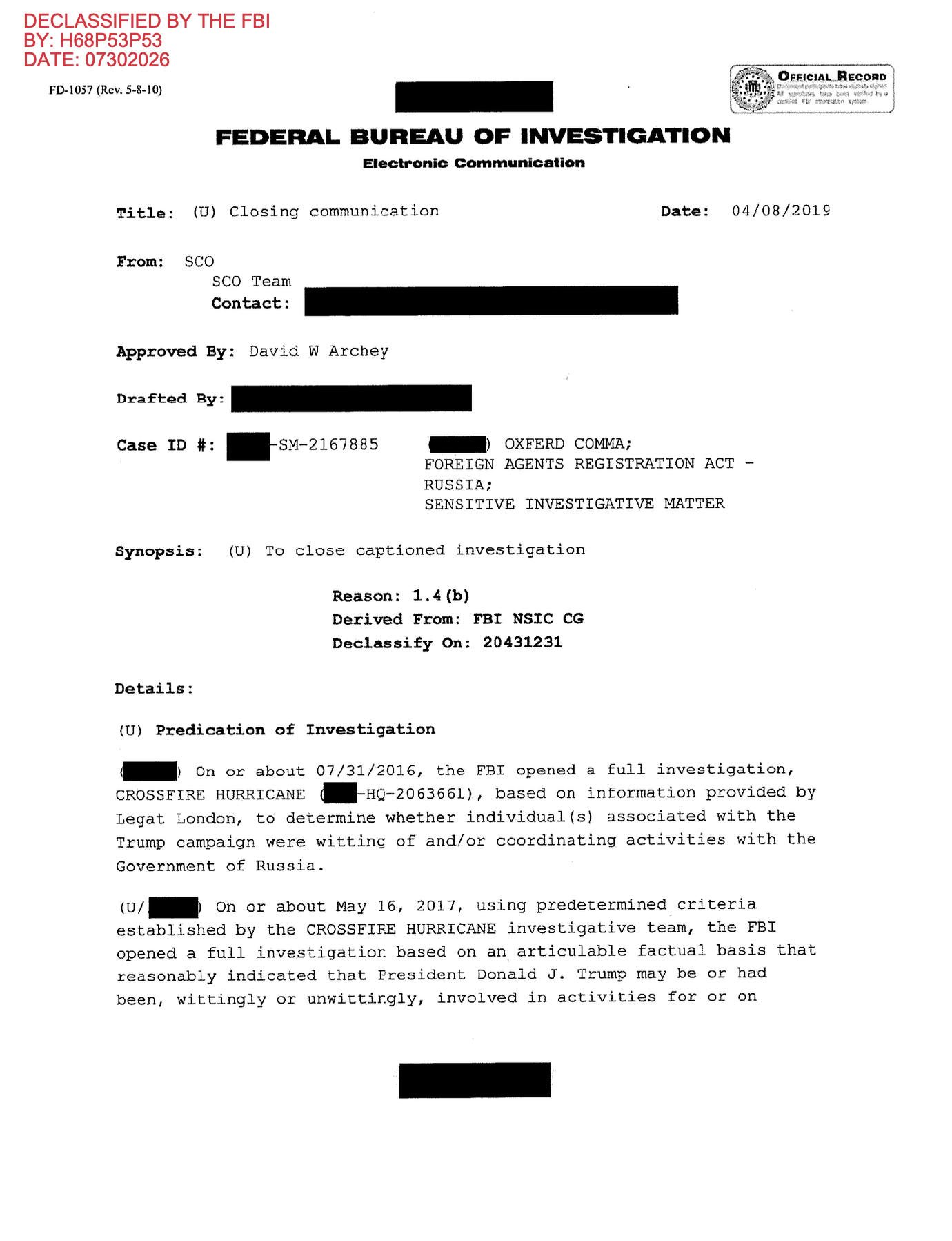
Once Mueller was appointed, responsibility for Oxferd Comma transferred to his office, whose jurisdiction the closing memo says explicitly covered whether the president had obstructed justice in connection with the Russia investigations. The Special Counsel's office ran that inquiry using grand jury subpoenas and interviews, delivered its confidential report on prosecution and declination decisions to the Attorney General on March 22, 2019, and the FBI closed the captioned case about two weeks later, on April 8, 2019, with a status of "Administrative Closing." No charges were filed against Trump personally, in this case or in Mueller's broader investigation. Mueller's report stated that the investigation "did not establish" that the Trump campaign conspired or coordinated with the Russian government, while documenting extensive contacts between campaign associates and Russian-linked individuals. On the obstruction question, Mueller's team explicitly declined to reach a conventional prosecutorial judgment either way, writing that while the evidence did not allow them to conclude Trump committed a crime, it also did not exonerate him.
What's Actually New Here
None of this is the first time the public has heard that the FBI, at some point, looked into whether Trump was acting on Russia's behalf. The New York Times reported the general shape of this story back in January 2019, before Mueller's report was even public. What's new with this release is the paperwork itself: the codename, the exact date the case opened and closed, the specific legal language investigators used to justify it, and the names of the officials who signed off on each step. It's a declassification of documents, not a new disclosure of the underlying fact pattern.
Reading The White House's Framing
The documents themselves came out through a White House-published article, written by John Solomon, who currently chairs the White House's own Government Transparency Task Force. That's worth flagging plainly: this wasn't an independent outlet obtaining leaked material, it was the administration releasing and narrating its own declassified documents, and the framing reflects that. The piece presents the investigation in dramatic terms and leans on material skeptical of the broader Russia investigation. The underlying memos support the fact that this case existed and describe its scope accurately; they don't, on their own, prove Trump was an asset or that Russia had any hand in the Comey decision. Those were the questions investigators set out to answer, not conclusions the memo reaches.
It's also worth keeping in mind what a separate, independent review already found about the parent investigation. The Justice Department's Inspector General concluded that Crossfire Hurricane had sufficient factual predication under the FBI's own rules to be opened and found no evidence that political bias drove that opening decision, while separately identifying serious errors in the FISA applications filed later in the investigation. That finding was about Crossfire Hurricane as a whole; the Inspector General wasn't specifically evaluating the Oxferd Comma sub-case these new memos describe, since its existence wasn't declassified at the time.
Bottom Line
The FBI did formally investigate whether Trump's firing of Comey was an effort to obstruct the Russia investigation and whether it reflected some form of Russian influence over the president himself. That investigation ran for nearly two years and produced no charges. What's genuinely new today is the primary-source paperwork: the codename, the exact scope the FBI wrote down, and the officials who approved it, not the underlying fact that a counterintelligence inquiry like this existed in the first place.
The Author

As of late, Michael Allen Mendy has been writing about software and politics, and increasingly the strange overlap between them. It's the intersection of two habits of mind: the same instinct that makes sense of a codebase by reading it line by line applies just as well to a declassified memo, a redacted spreadsheet, or a text message log, where the real story is usually sitting in the details nobody thought to highlight. That's the thread running through this site, whether the subject is a production outage or a case file: fewer conclusions handed down from the top, more time spent in the primary source itself.