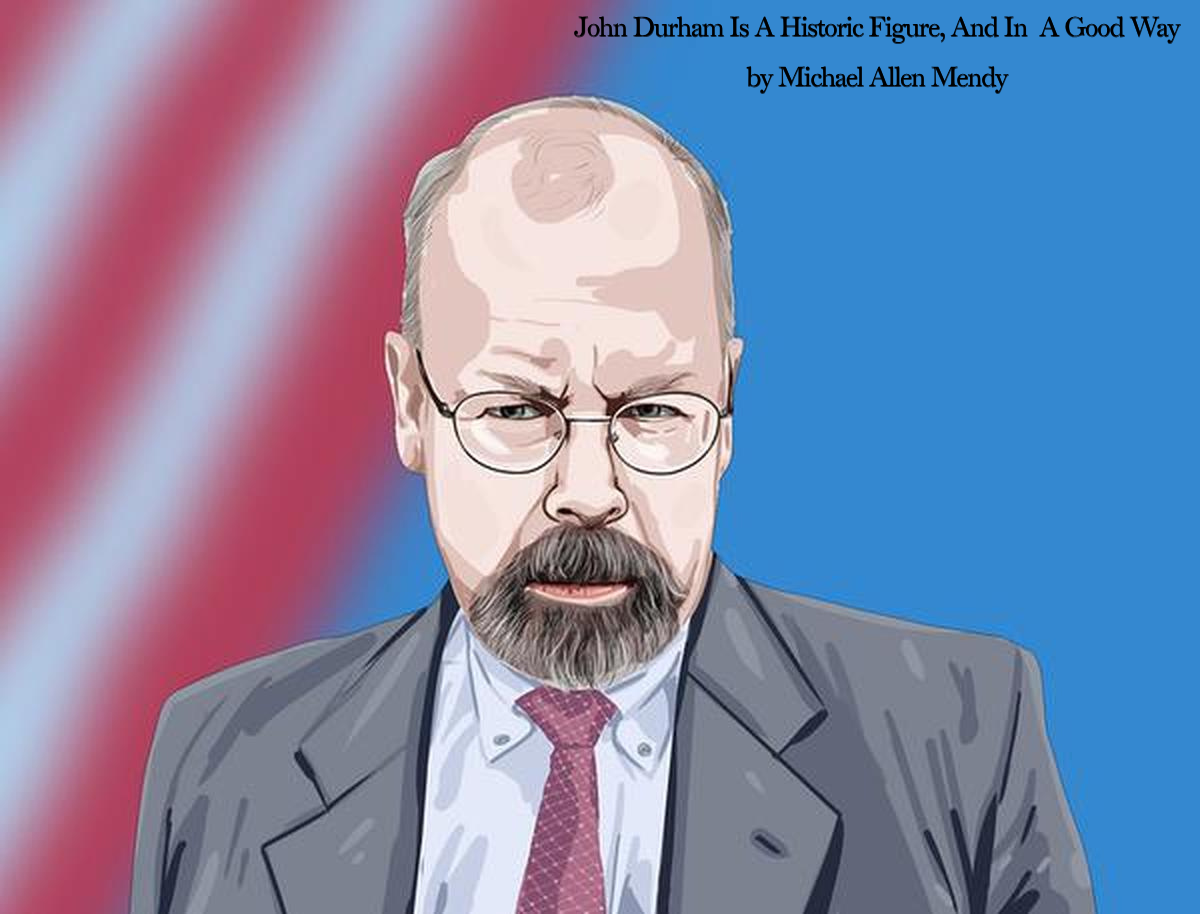
Long before "Durham" meant a special counsel report on the origins of the Trump-Russia investigation, it meant a career federal prosecutor in Connecticut who had spent decades doing something unusual in Washington: going after powerful people regardless of which side of the aisle they sat on. By the time anyone in national politics had heard his name, John Henry Durham had already convicted an FBI agent, taken down a sitting governor from his own party's opposite, and been trusted twice to investigate the CIA. That track record is the actual reason his name carries weight. Everything that came after just tested whether it still would.
He Made His Name Prosecuting The FBI, Not Defending It
In 1999, Attorney General Janet Reno assigned Durham, then a veteran Assistant U.S. Attorney, to investigate something almost nobody wanted looked at too closely: whether FBI agents in Boston had been corrupted by their own informants, the mob bosses James "Whitey" Bulger and Stephen "The Rifleman" Flemmi. Durham's investigation found that FBI Agent John Connolly had been protecting Bulger and Flemmi for years, and in the process helped surface evidence that four men had been framed for a 1960s murder they didn't commit. Two of them died in prison before anyone corrected the record.
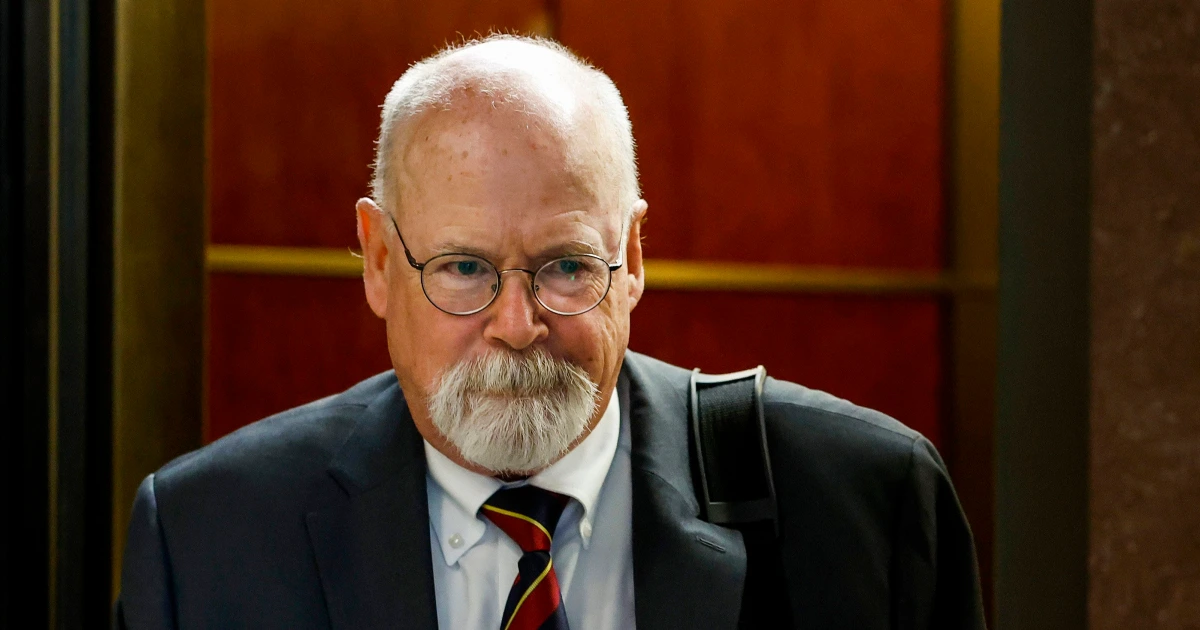
Connolly was convicted on racketeering charges in 2002. All four wrongly convicted men eventually shared in a roughly $100 million civil judgment against the federal government, the two survivors directly and the estates of the two who had already died in prison standing in for them. Whatever comes later in this story, it starts with a prosecutor who spent years building a case against his own government's law enforcement agency because the facts led there, not because it was easy or popular inside the Justice Department to do it.
He Also Took Down A Republican Governor
The Boston case wasn't an outlier. A few years later Durham supervised the corruption investigation into Connecticut Governor John Rowland, a Republican, over gifts and favors he'd taken while in office, with Assistant U.S. Attorney Nora Dannehy leading the case day to day. Rowland resigned in 2004 and pleaded guilty, serving a year in prison. A prosecutor who had just spent years exposing FBI misconduct signed off on building a case against a governor from the party more likely to have appointed him. Nobody could credibly call that a partisan pattern, because the pattern didn't point in one direction.
Then Bush's DOJ Sent Him After The CIA
In 2008, Attorney General Michael Mukasey handed Durham one of the most sensitive assignments in the government: figure out who destroyed CIA videotapes of detainee interrogations, and whether that destruction was itself a crime. The following year, incoming Attorney General Eric Holder expanded his mandate to examine whether the "enhanced interrogation" methods used on detainees had crossed into unlawful territory.
Both investigations closed without charges, in 2010 and 2012, and the findings remain classified. Critics of Durham point to those closures as evidence he pulls punches against intelligence agencies. It's a fair data point to hold onto, because it's the same standard worth applying to what came next. By 2018 he was sworn in as the U.S. Attorney for Connecticut, a job he'd already spent decades preparing for in every way except the title.
George Papadopoulos And The Meeting That Started All Of This
Before any of the acronyms, there was a twenty-eight-year-old campaign volunteer nobody outside politics had heard of. George Papadopoulos was a junior foreign policy adviser to the Trump campaign in 2016, and in late April of that year a London-based professor named Joseph Mifsud, who claimed Kremlin connections, told him that Russia had "dirt" on Hillary Clinton in the form of thousands of emails.
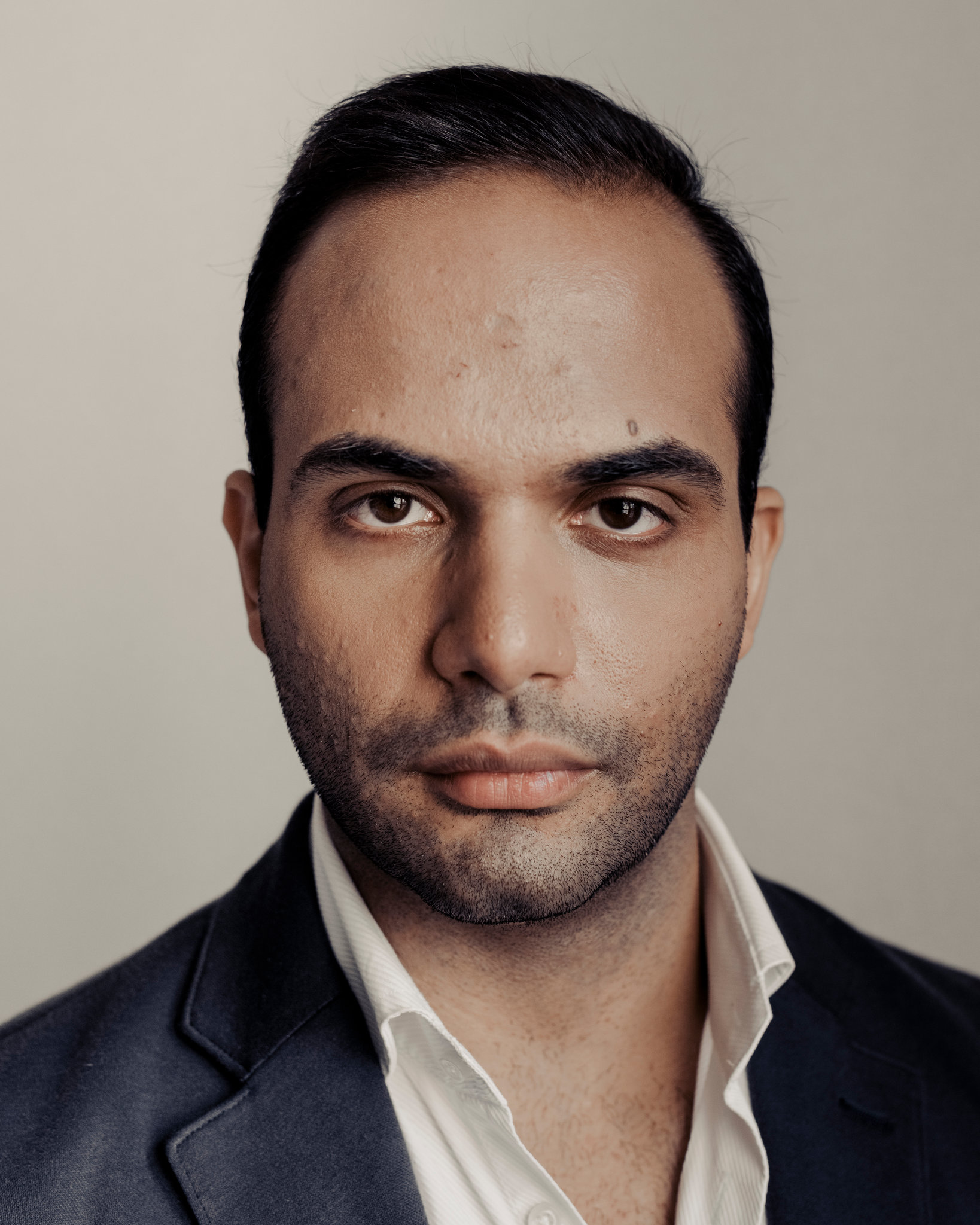
A few weeks later, over drinks at a London bar, Papadopoulos mentioned that conversation to Alexander Downer, Australia's top diplomat in the U.K. Downer relayed it to his own government, and after the DNC hack became public that summer, Australian officials passed the tip to the FBI through diplomatic channels. That single secondhand conversation is what the bureau has always said opened Crossfire Hurricane on July 31, 2016, and it's the same account Durham's own report ended up confirming rather than debunking. Papadopoulos later pleaded guilty in October 2017 to lying to the FBI about the timing of his contacts with Mifsud, becoming the first person convicted in Robert Mueller's investigation. He served twelve days in prison, spent years afterward calling himself a setup target rather than a witness, and was pardoned by Trump in December 2020.
Papadopoulos has also made a claim that never made it into any indictment: that in September 2016, he was introduced in London to a woman going by the name Azra Turk, presented to him as a research assistant working alongside Stefan Halper, an American academic the FBI used as a confidential source to approach both Papadopoulos and Carter Page that year. Papadopoulos has said her credentials didn't add up and that he came to believe she was an intelligence operative sent to draw information out of him rather than an academic at all. The New York Times reported in 2019 that an FBI investigator had indeed posed as Halper's assistant during that outreach, which lines up with the outline of what Papadopoulos described, though her real name and the full scope of her role have never been made public. It's worth mentioning here for the same reason the confidential-source questions above are worth mentioning: whatever actually happened, it's one more example of how much of this entire saga still rests on accounts that took years, if ever, to get independently corroborated.
Fusion GPS, Christopher Steele, And The Dossier's Real Origin Story
The other document that shaped this entire saga started on the opposite side of the aisle. Fusion GPS, an opposition-research firm founded by former Wall Street Journal reporter Glenn Simpson, was originally hired during the 2016 Republican primary by the conservative Washington Free Beacon to dig into Trump's business history. Once Trump won the nomination, Perkins Coie, the law firm representing the Clinton campaign and the Democratic National Committee, picked up Fusion GPS's retainer and kept the research going.

Perkins Coie is a large, Seattle-founded firm with a long history of representing Democratic campaigns and committees, and the specific arrangement here mattered more than the firm's size. Marc Elias, the partner overseeing the Clinton campaign's legal work, was the one who authorized the Fusion GPS retainer, which meant the payments moved through a law firm's invoices rather than showing up directly on campaign finance disclosures. The Clinton campaign and the DNC both later paid fines to the Federal Election Commission, settled in 2022, over how those payments had been categorized as legal expenses rather than disclosed as opposition research. Elias left Perkins Coie in 2021 to start his own firm. One of his former partners at Perkins Coie, working the same general period, was Michael Sussmann, the same lawyer whose trial over the Alfa Bank allegations shows up later in this piece. Both men passed through the same firm, on the same side of the same story, years before either name meant anything to people outside Washington.

The firm behind that logo was small, but it was run by a name that kept resurfacing years after most people had forgotten the original assignment.
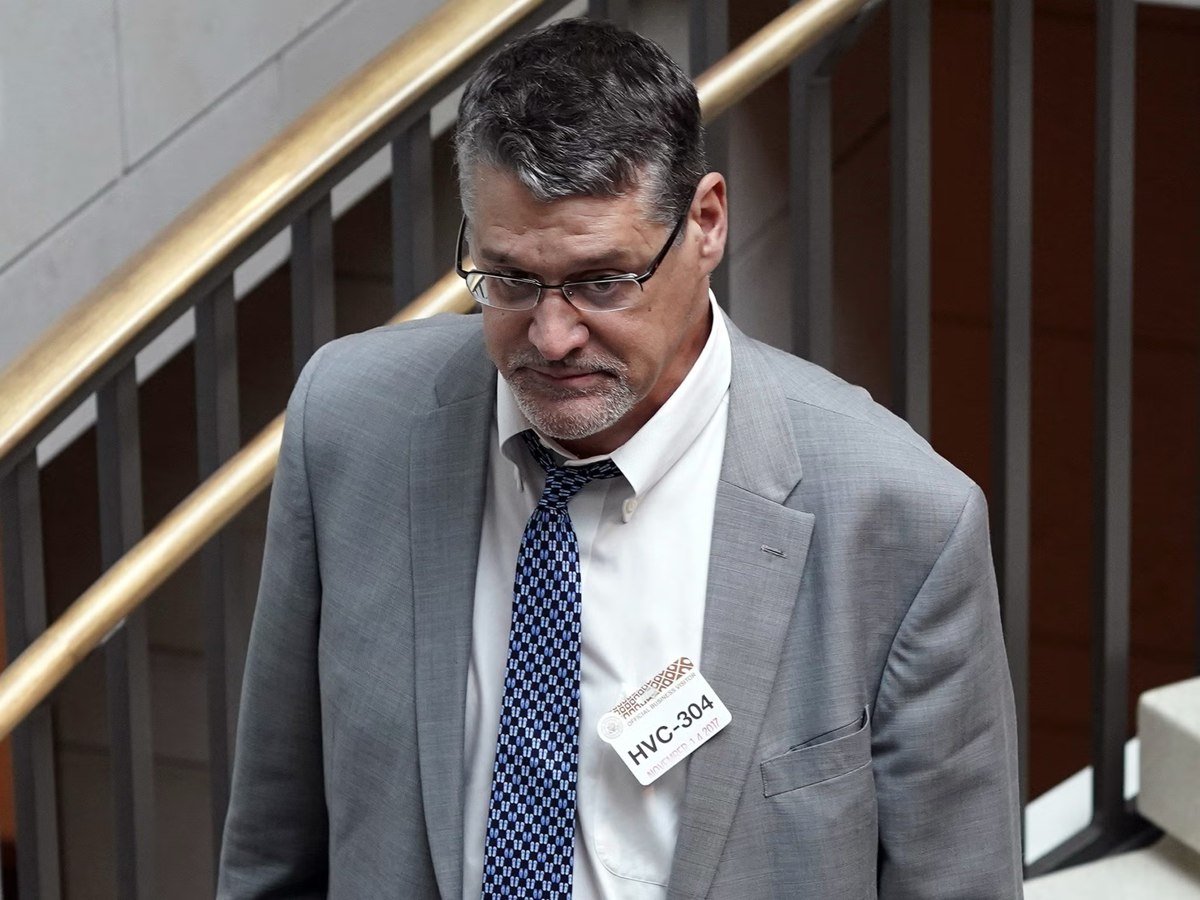
That's Simpson himself, years later, on his way into a closed-door congressional interview about exactly this. Fusion GPS then subcontracted Christopher Steele, a former British intelligence officer, who compiled a series of memos alleging coordination between the Trump campaign and Russia, some of it salacious and never corroborated. Those memos, later known simply as the Steele dossier, made their way to the FBI in 2016 and were cited inside the FISA applications used to keep surveilling Carter Page, the same applications the Durham findings above describe as continuing even after doubts about probable cause were raised internally. An opposition research shop funded through a Democratic campaign's own law firm ended up, several steps removed, feeding raw material into a federal surveillance court. That is precisely the kind of chain Durham's report spent four years trying to trace back to its source.
Robert Mueller Took Over First
Durham wasn't the first serious, institutionally respected prosecutor to run this case. Robert Mueller, a former Marine and the second-longest-serving FBI Director in the bureau's history, had spent over a decade at the helm of the FBI, first appointed by a Republican president in 2001 and kept on by a Democratic one, who sought and won a two-year extension to his term in 2011, earning a reputation across both parties as a strict institutionalist. After Trump fired FBI Director James Comey in May 2017, Deputy Attorney General Rod Rosenstein appointed Mueller as Special Counsel to take over the entire Russia investigation, absorbing Crossfire Hurricane into a much larger inquiry.
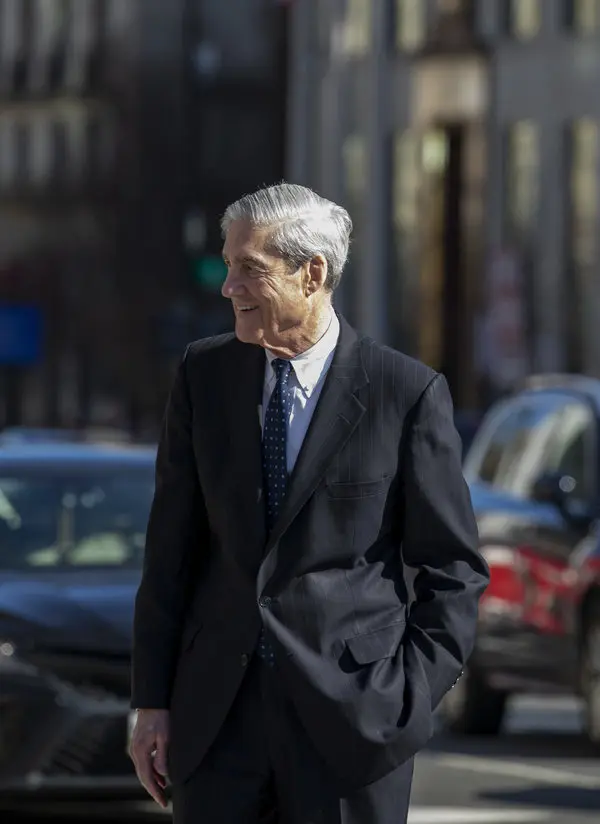
Over the next twenty-two months, Mueller's team secured indictments and convictions against several Trump associates, including Paul Manafort, Michael Flynn, Michael Cohen, Roger Stone, and Papadopoulos himself, mostly on financial crimes and false-statement charges rather than anything charging a Trump-Russia conspiracy outright. Mueller also indicted Russian intelligence officers and Russian entities directly for the hacking and social media interference operations.
Not everyone who mattered to the investigation got charged with anything. Hope Hicks, Trump's longtime communications director, was never indicted, but she sat for three separate interviews with Mueller's team and turns up more than 180 times across the final report, including in the episode where Corey Lewandowski asked her to help type up the president's message to Jeff Sessions.
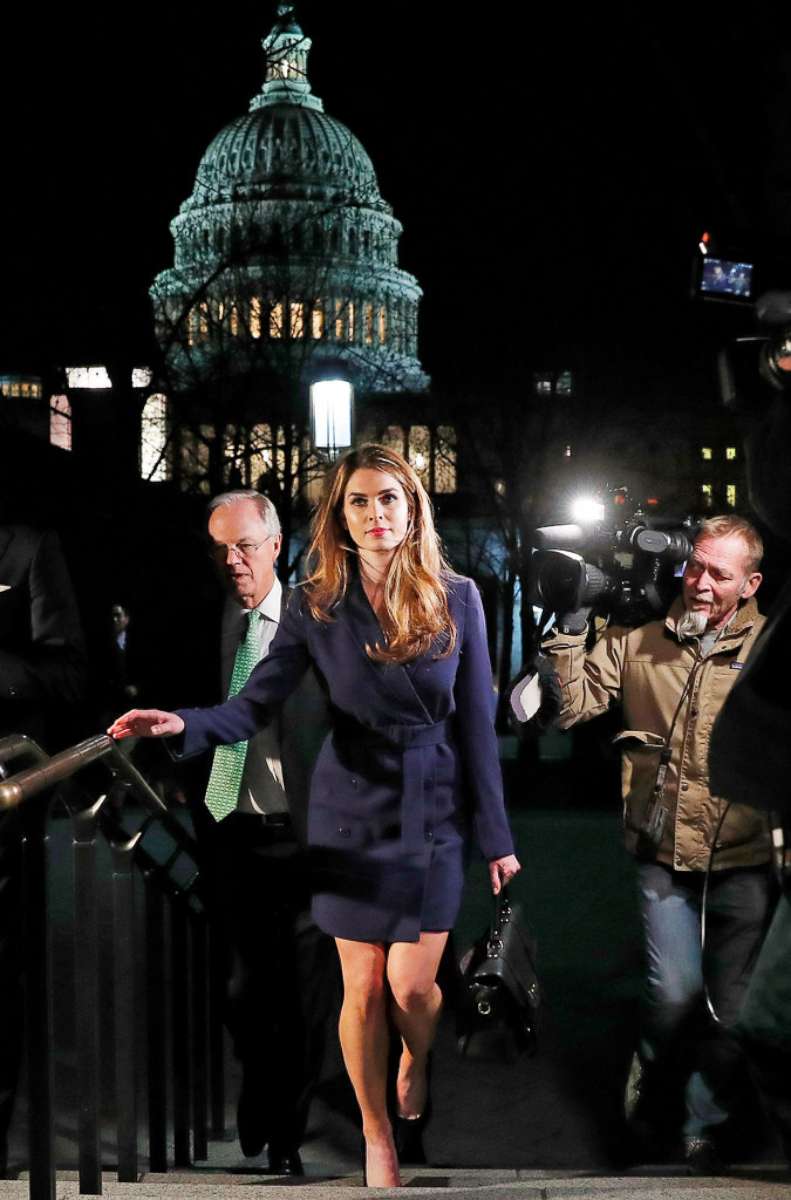
She testified for roughly nine hours before the House Intelligence Committee in early 2018, where she acknowledged telling occasional "white lies" on Trump's behalf while maintaining she'd never lied about anything relevant to the Russia investigation itself.
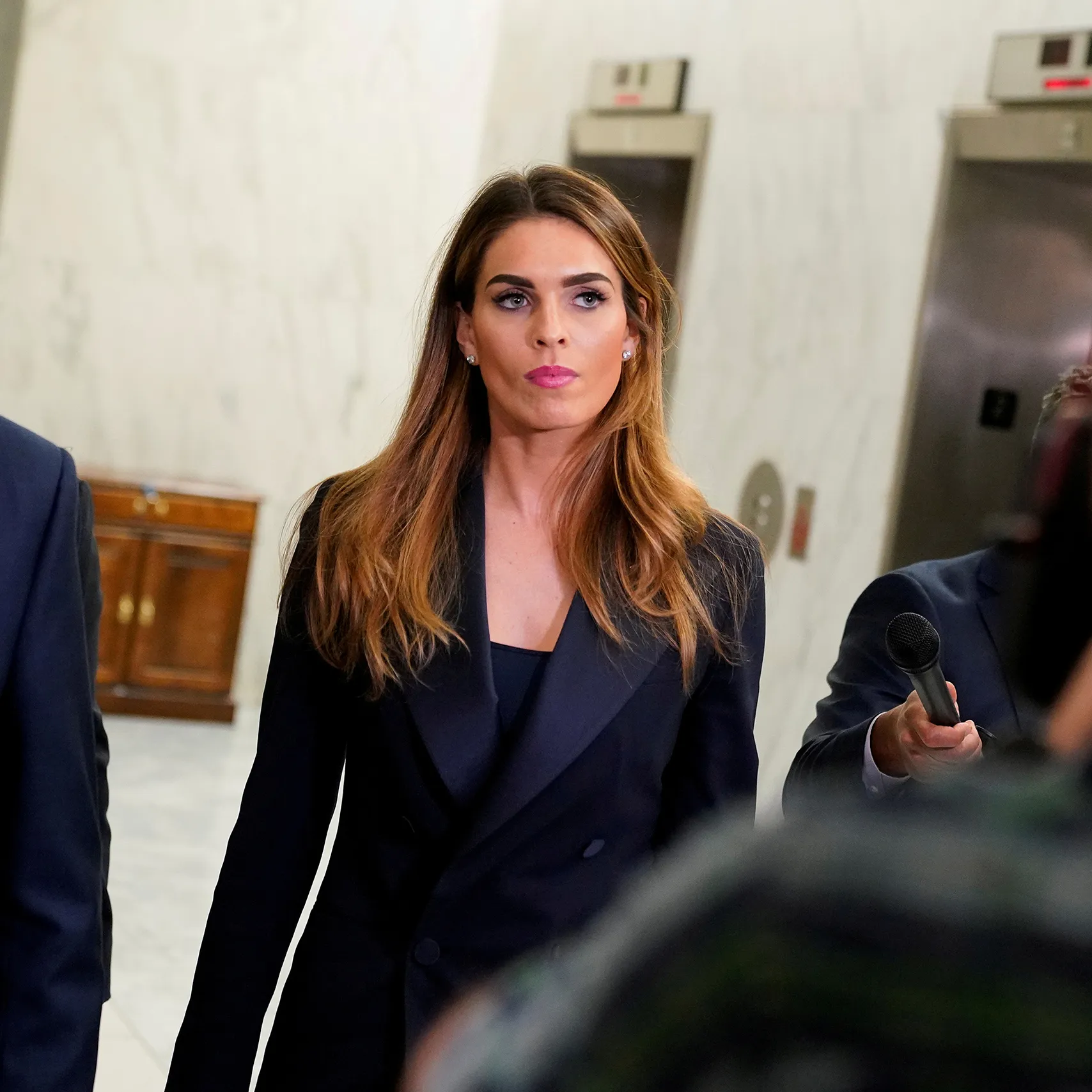
By the time she came back for the House Judiciary Committee in June 2019, for another seven hours, White House lawyers had her declining to answer well over a hundred separate questions. Nobody ever charged Hope Hicks with anything. The sheer number of hours Congress spent with her anyway is its own small measure of how deep this went into the campaign's inner circle, years before Durham was ever assigned to look at how any of it started.
Part of what made the whole saga land as hard as it did was the sheer volume of contact reporters found sitting inside the material Mueller's team had gathered. Outside tallies, most famously one compiled by BuzzFeed News, counted well over a hundred separate contacts between Trump, eighteen of his associates, and Russian nationals or people connected to WikiLeaks across the campaign and transition.
Volume alone was never the same thing as proof of coordination, and Mueller's own report said so directly. But that density of contact is exactly why the origins question Durham was assigned to chase mattered so much to so many people on every side of it. A hundred-plus contacts is enough to explain why investigators felt the tip was worth chasing down in the first place, and it's also enough to explain why, years later, both camps could look at the same catalogue and walk away with completely opposite conclusions about what it proved.
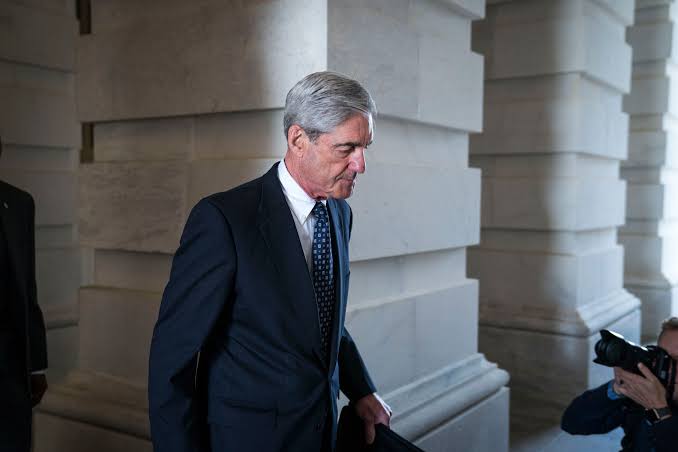
When Mueller's report landed in March 2019, it concluded the investigation did not establish that Trump campaign members had conspired or coordinated with the Russian government's election interference, while pointedly declining to exonerate the president on obstruction of justice and leaving that question for others to weigh. Barr's decision to release his own summary letter days before the public saw the actual report became its own controversy. Mueller testified before Congress that July, and by May 2019, right as his work was wrapping up, Barr had already turned to Durham to go back and examine how the investigation Mueller had just spent two years running was ever opened in the first place. One prosecutor closed the book moving forward. The other was about to open it moving backward.
The Comey's FBI Factor
No single person sits at more points in this timeline than James Comey. He was the FBI Director whose bureau opened Crossfire Hurricane in July 2016. He was the same director who, days earlier that summer, announced the FBI would not recommend charges over Hillary Clinton's private email server, then reopened that same question just eleven days before the election, a decision both parties have spent years blaming for different reasons. He was the director whose firing by Trump in May 2017 is the specific event that led Rod Rosenstein to appoint Mueller as Special Counsel in the first place. Take Comey out of the story at almost any point, and the rest of this piece runs on a different timeline entirely.
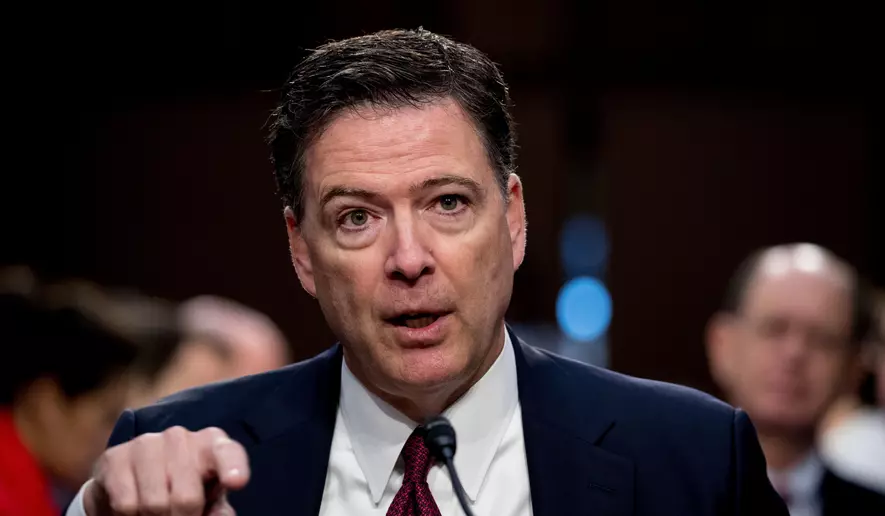
That makes what happened in August 2025 land differently than it otherwise would. The bureau Comey ran is the one whose conduct Durham spent four years picking apart, section by section, in the report and the annex covered above. Years after that report was finished, federal prosecutors built a case against Comey himself, and it was Durham, of all people, who told them the conduct in question didn't support the charges. The prosecutor whose entire career had been defined by scrutinizing the FBI's judgment ended up being the one voice inside the government arguing for restraint when the FBI's own former director was the target. Whatever else gets said about Durham's four years chasing the origins of Crossfire Hurricane, it's worth remembering that the story it's a part of only exists because of decisions James Comey made, and it only came full circle because Durham was still willing to say a case was weak even when the person facing it was the man who started all of it.
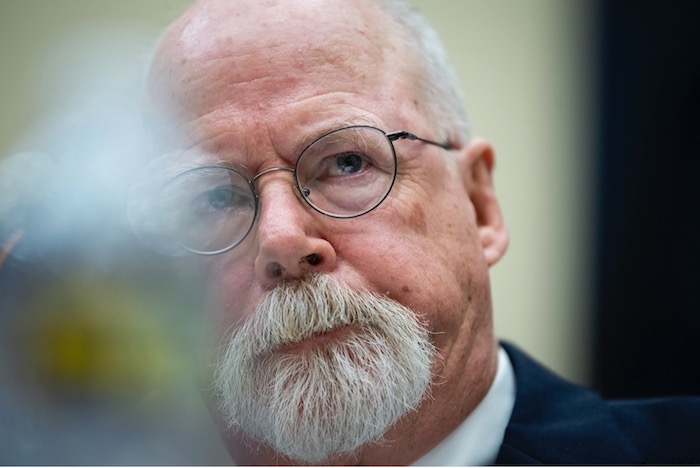
That's the same face that sat through years of closed-door interviews and public hearings on the other side of this story, the man who spent four years asking the FBI to explain itself and then, years later, found himself the one voice telling prosecutors to slow down on Comey. Two directors, one prosecutor, and a single office connecting all of it.
By The Time He Got Called On Russia, He'd Already Investigated Everyone
Mueller's report closed one chapter. Durham was about to open a very different one, and it started with a phone call rather than a headline.
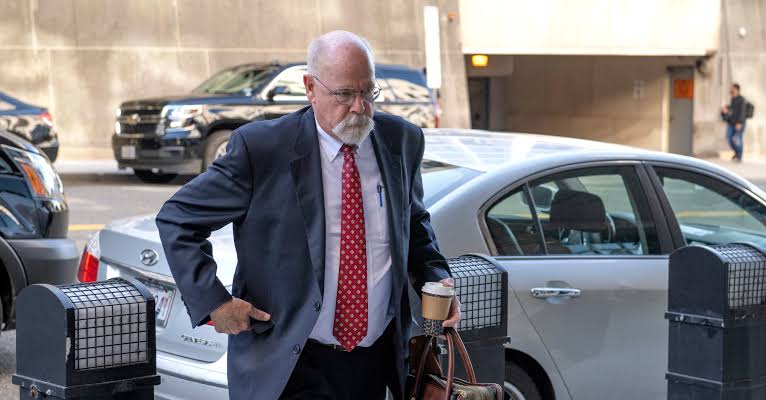
In May 2019, Attorney General Bill Barr assigned Durham to investigate the origins of Crossfire Hurricane, the FBI's counterintelligence investigation into the Trump campaign's ties to Russia. In October 2020, more than a year later and just weeks before that November's election, Barr quietly elevated him to Special Counsel status, a move disclosed publicly in December 2020, which meant the investigation would survive past a change in administration regardless of who won that year's election.
Over the next four years, Durham's team conducted more than 480 interviews, reviewed over a million documents totaling more than six million pages, and issued 190 grand jury subpoenas. The final report landed on Attorney General Merrick Garland's desk in May 2023.
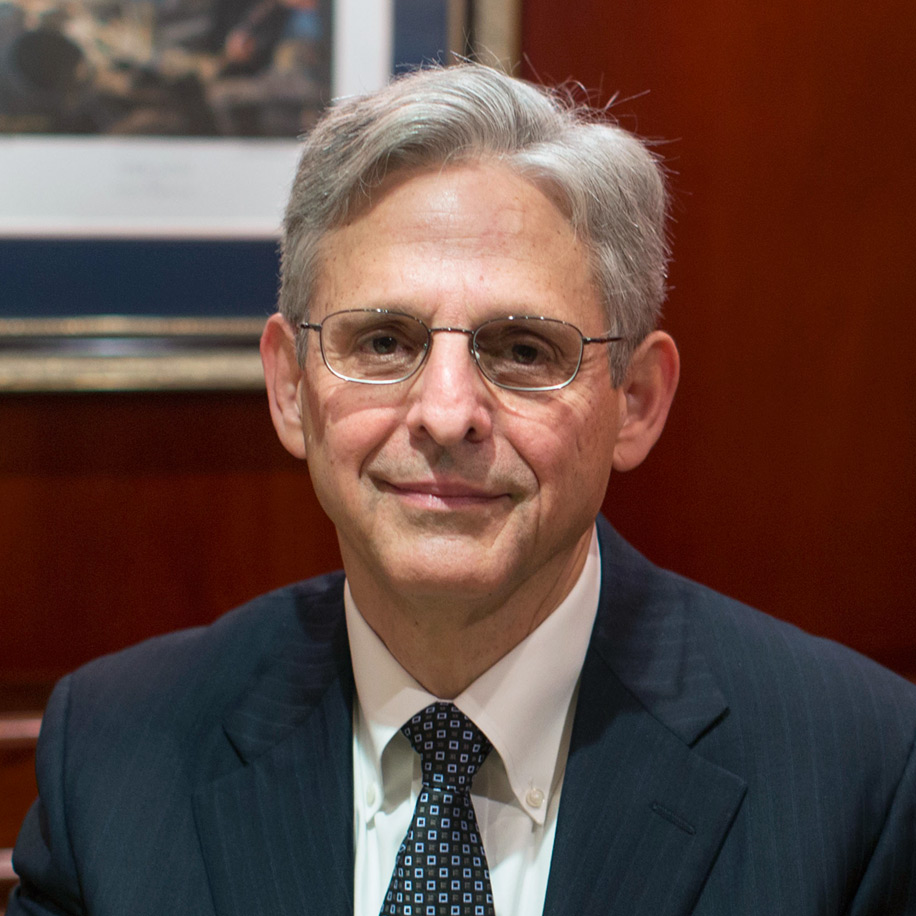
Garland is the one who ultimately decided how much of the finished report the public would ever see, and he's the recipient the actual cover memo is addressed to.
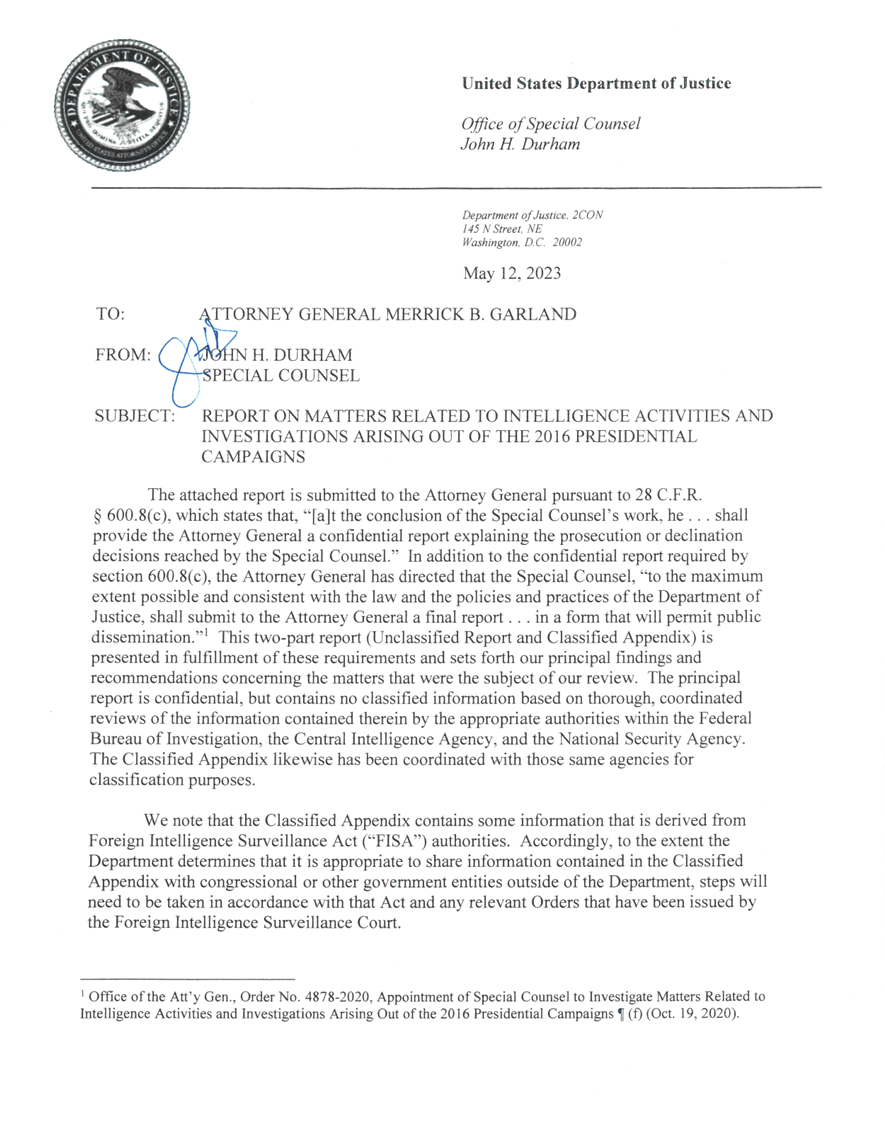
That's the actual cover memo, dated May 12, 2023, three days before the report went public. It's worth reading closely, because the bureaucratic language is doing real work. Durham notes that the report was reviewed and coordinated for classification purposes by the FBI, the CIA, and the NSA themselves, the same agencies whose conduct the report criticizes, before a single page of it reached the public. He also flags that the classified appendix contains material derived from FISA authorities, meaning even the parts Congress and the public never saw were still bound by the same surveillance law the report found the FBI had bent past its limits. A four year investigation into how the government polices itself ends, fittingly, with a two paragraph memo about exactly how much of its own findings the government would be allowed to keep from view.
The IG Report And The Deputy Who Walked Away
Durham's wasn't the only government review of Crossfire Hurricane running during those years. In December 2019, DOJ Inspector General Michael Horowitz released his own report on the FBI's handling of the investigation and the FISA process behind it. Horowitz concluded the FBI had an adequate factual basis to open the investigation in the first place, a finding that disappointed a lot of people rooting for Durham to prove the opposite, but he also identified seventeen significant errors and omissions in the FISA applications used to surveil Carter Page, and issued forty recommendations for reform. Durham took the unusual step of publicly disputing part of Horowitz's conclusion the same day the report came out, saying the evidence his own team had gathered to that point didn't support the finding that the investigation's opening was adequately predicated.
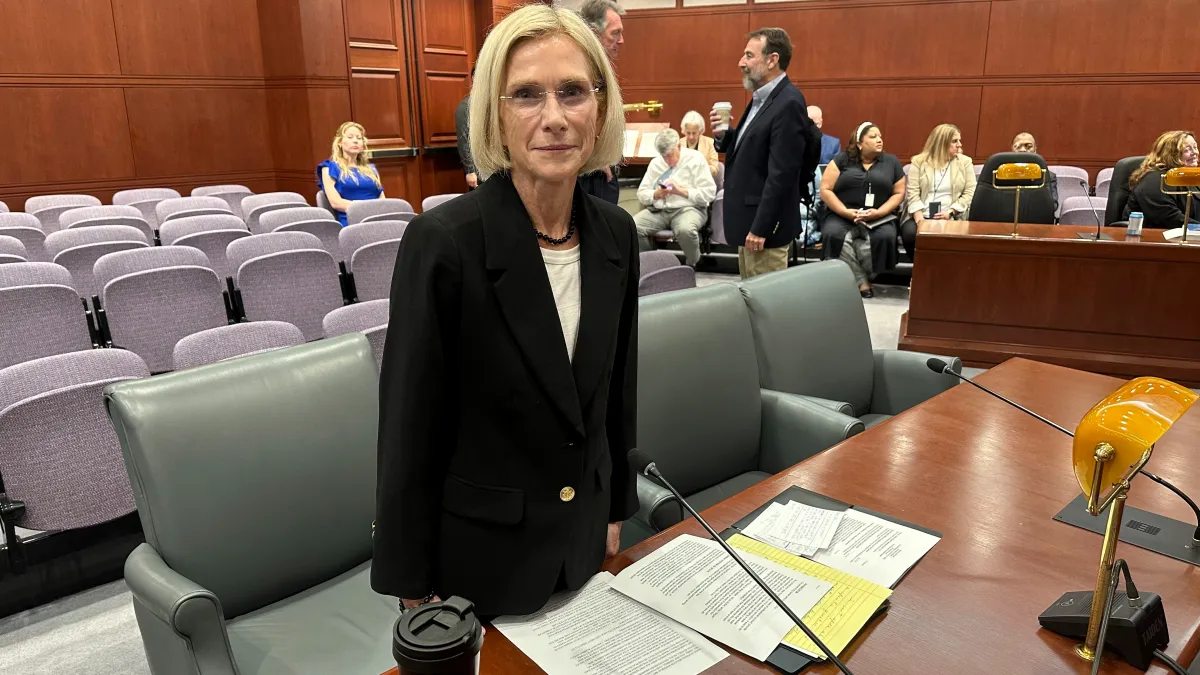
That disagreement is worth sitting with next to what happened eight months later. Nora Dannehy, the same prosecutor who had led the Rowland case for Durham back in the 2000s and had joined his Crossfire Hurricane team as a senior deputy, resigned from the investigation in August 2020, a departure first reported that September. The reporting at the time said she left over concern that Barr was pushing to release an interim report or findings before the November 2020 election that the evidence didn't yet fully support. Nobody on Durham's team disputed that a break happened. What people disagreed about was why.
Dannehy is not a minor character in this story. She is the person Durham trusted enough to run his highest profile political corruption case two decades earlier, someone with as much firsthand knowledge of how he actually works as almost anyone alive. When someone with that history steps away from an investigation specifically over concerns about being rushed for political reasons, it doesn't erase everything documented elsewhere in this piece, but it deserves to sit right alongside it rather than get left out.
What The Report Actually Found
Stripped of the politics on both sides, the report's central finding was a comparison. The FBI opened a full counterintelligence investigation into a presidential campaign based on raw, unanalyzed, and largely uncorroborated information, while comparable information involving the Clinton campaign around the same period was handled with far more caution. The report described this gap plainly, calling out what it labeled a serious lack of analytical rigor toward material from politically affiliated sources.
One detail tends to get lost in the noise around the report: it also confirmed the FBI's own long-standing account of how the investigation actually began, a tip from an Australian diplomat about a Trump campaign aide's comments in a London bar, not the Steele dossier. A report commissioned specifically to find fault with the FBI ended up validating the one part of the bureau's story its harshest critics were most eager to disprove. That's not the behavior of an investigation built to reach a predetermined conclusion. That's what it looks like when the facts get to talk first.
The Part Congress Had To Fight To See
The report the public got in May 2023 wasn't the whole thing. A classified appendix went with it, walking through the same three matters in more detail, and most of it stayed sealed for years. In 2025, Senate Judiciary Chairman Chuck Grassley pushed to get it declassified and released the annex to the public, black bars and all.
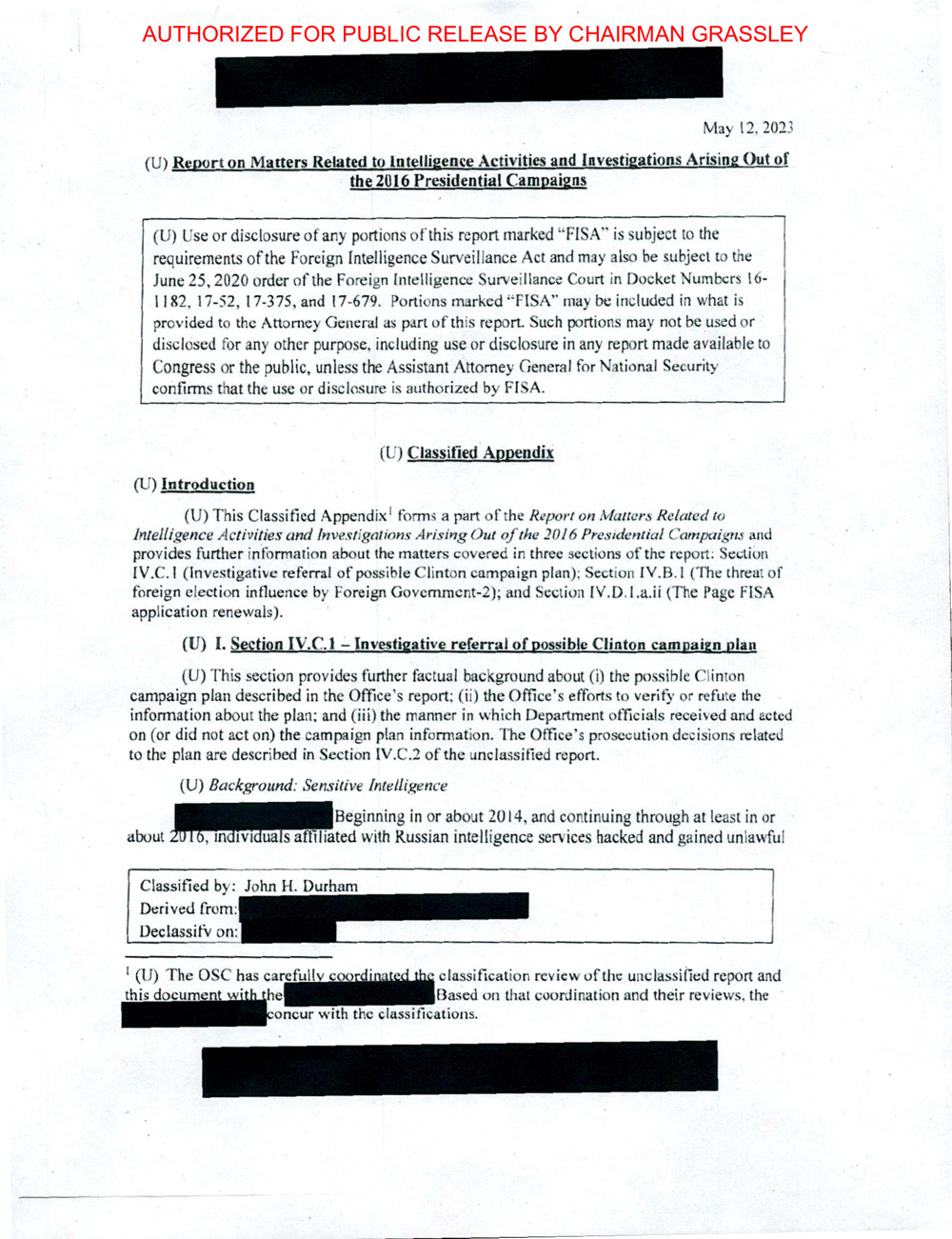
The appendix covers three things the public report only summarized. First, the full background on a piece of raw intelligence describing a purported Clinton campaign plan to tie Trump to Russia and distract from the email server controversy, including memos that claim to quote DNC Chair Debbie Wasserman Schultz describing that strategy directly to Democratic operatives. Second, more detail on a separate foreign influence threat tracked under the codename Foreign Government-2. Third, additional material on how the FBI assessed Carter Page's July 2016 Moscow trip inside the FISA renewal applications used to keep surveilling him.
What's notable is how carefully hedged the annex is about its own centerpiece. After walking through years of effort to authenticate the purported Clinton campaign plan memos, cross-checking them against hacked think tank records and interviewing the people named in them, Durham's team landed here:
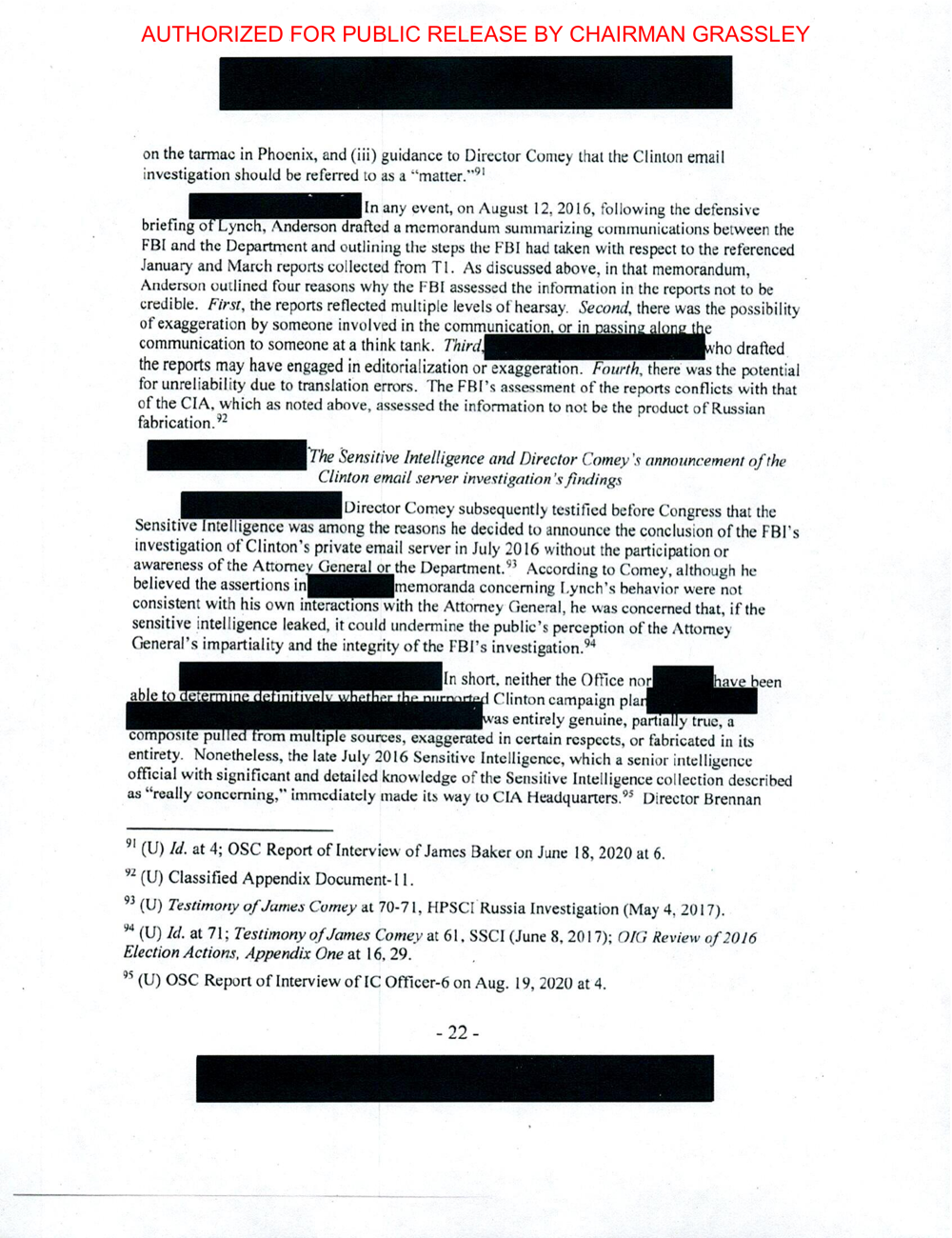
Neither the Office nor the intelligence agencies that reviewed it could determine whether the material was entirely genuine, partially true, a composite pulled from multiple sources, exaggerated, or fabricated outright. Everyone named in it, including Hillary Clinton herself, denied it under oath. A team with every institutional incentive to declare that intelligence credible instead told Congress, on the record, that it couldn't prove it either way. That's the same restraint running through the whole investigation, applied to the one piece of evidence that would have made the loudest headline if he'd simply asserted it was real.
The annex's middle section gets far less attention than the Clinton Plan material, and it's arguably more damning on its own terms. In November 2014, more than a year and a half before Crossfire Hurricane even opened, the FBI received information from a longtime confidential human source about a plan by a separate foreign government, referred to in the annex only as Foreign Government-2, to influence the U.S. election. Two independently authorized FISA surveillances corroborated it.
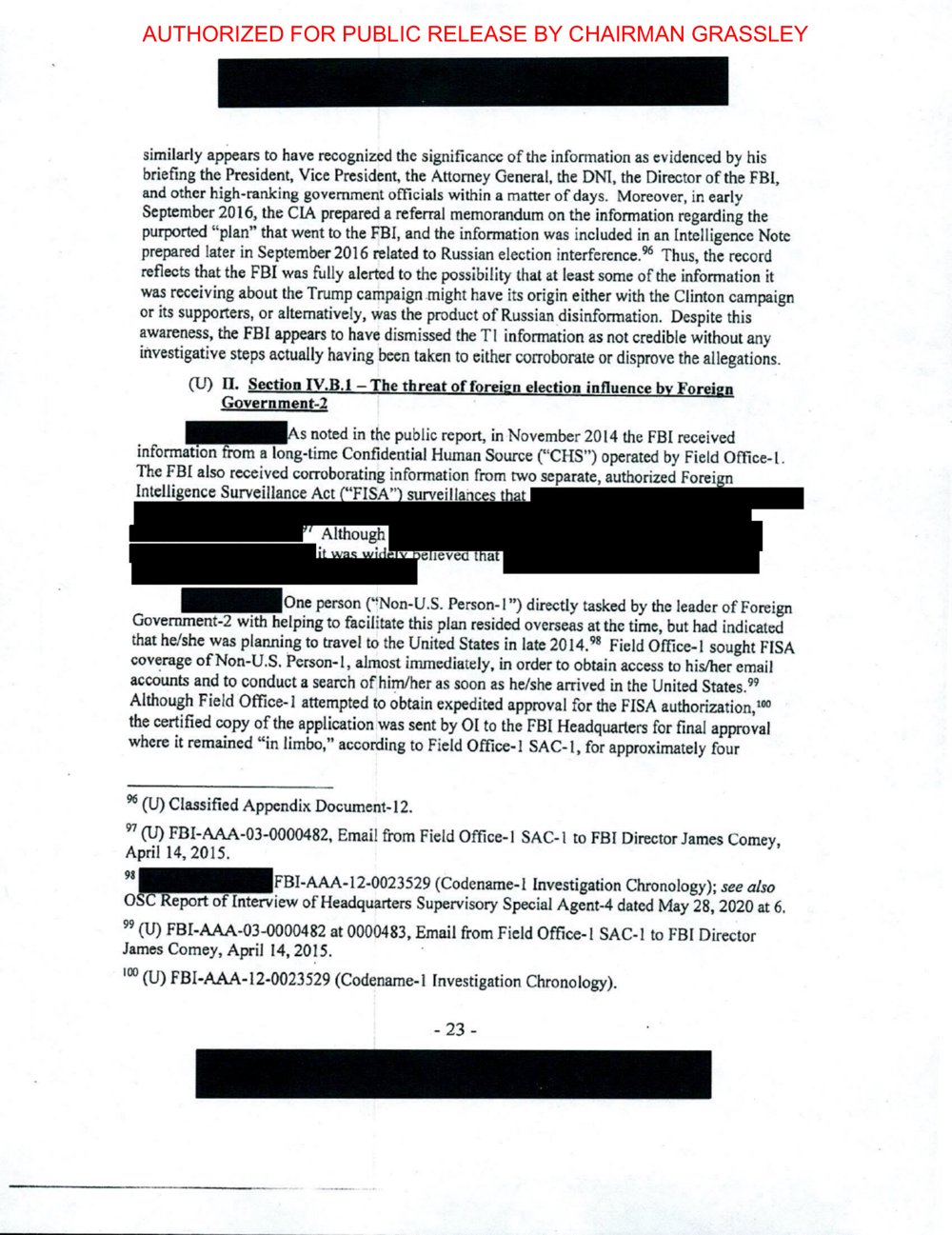
A person tasked by that foreign government's leadership to help carry out the plan was living overseas but told contacts he planned to travel to the United States by the end of 2014. The FBI field office running the case moved fast, requesting emergency FISA coverage so it could search the person's email accounts the moment he set foot in the country. Then the paperwork sat. According to the annex, the certified application landed at FBI Headquarters and stayed there "in limbo" for roughly four months. One agent told Durham's investigators everyone involved was being "super more careful" and "scared with the big name [Clinton]" attached to the case, because there was a real chance she'd be the next president. A supervisor put it more bluntly: the bureau was "tippy-toeing" around Hillary Clinton.
The delay meant the target's travel plans changed before the FISA authority ever came through. The Justice Department eventually approved the surveillance, but only after securing a commitment that Clinton and the other Americans targeted by Foreign Government-2 would be given defensive briefings warning them they were being targeted. Those briefings did happen. They just took about eleven months from the day the original tip came in. A four-month bureaucratic freeze followed by an eleven-month wait for a briefing meant to protect the people being targeted is its own kind of finding, and it has nothing to do with the Steele dossier, Fusion GPS, or anything else this piece has already covered. It's a different case entirely, and the annex treats it as a footnote to the bigger story instead of the standalone caution-versus-urgency problem it actually is.
The Carter Page section of the annex is less ambiguous, and less flattering to the FBI. It walks through Page's sworn congressional testimony about a July 2016 Moscow trip, side by side with how the FBI characterized that same trip inside applications submitted to the secret court that approves national security surveillance.
Page was never charged with anything. He spent years afterward arguing, correctly according to the annex itself, that the surveillance applications used against him rested on a characterization of his Moscow trip he had already contradicted under oath before the later renewals were even filed.
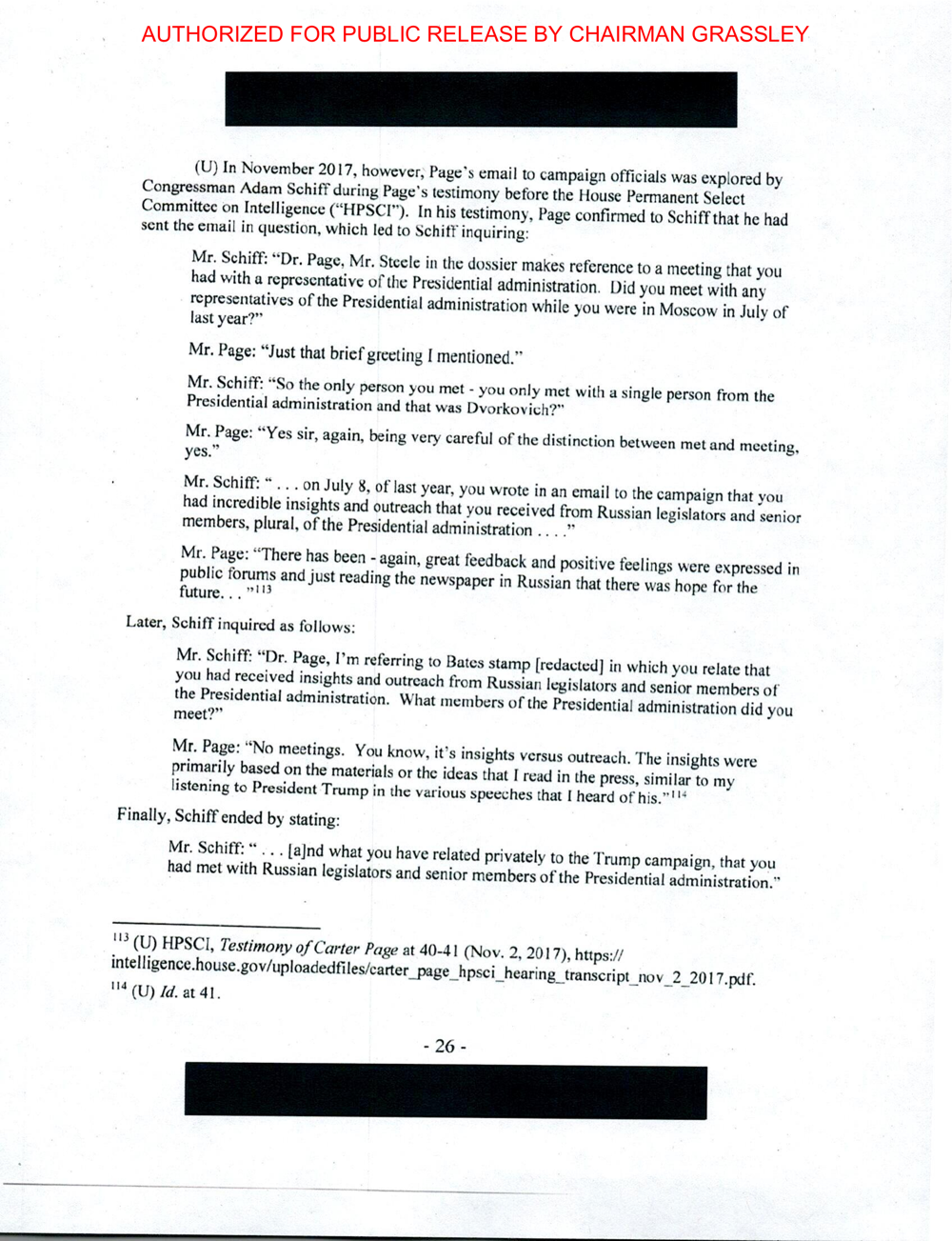
Page told Congress under oath that he'd had a brief greeting with one Russian official and no other government meetings. The FBI's own surveillance applications, submitted around the same time, described his trip as evidence he'd met with senior Kremlin officials including Igor Sechin. The annex doesn't resolve which account was right so much as document that the FBI kept using the more dramatic version in front of a secret court without ever squarely testing it against what Page had already said on the record, in public, under oath. That gap, sitting in an appendix that took two more years to become public after the report itself, is exactly the kind of granular follow-through that convictions alone never would have produced.
Laid out section by section, the classified appendix maps directly onto the unclassified report Congress and the public actually got, and the gap between the two is its own kind of evidence. Several of the unclassified sections lean on findings, comparisons, and characterizations that read differently once you can see how thin or how padded the classified backing actually was, running anywhere from a quarter of a page to ten.
A few of those descriptions are pointed enough that they deserve to be argued with directly rather than left sitting in a table cell. The sharpest one concerns how the report treats the Steele dossier's arrival at the FBI. One section compares the bureau's inaction on the Clinton Plan referral to how it supposedly moved fast on the dossier, using that contrast to make the FBI's slowness on the referral look worse by comparison. Read against the report's own timeline elsewhere, that comparison doesn't hold up: a separate section of the same document describes the FBI sitting on the Steele dossier for weeks after first receiving it, not moving on it quickly at all. A report that uses one of its own sections to make an unflattering comparison, while a different section of that same report undercuts the comparison, is a real inconsistency, not just a matter of interpretation, and it's fair to hold that against the finished product.
The second one is sharper still. The section on Fusion GPS's press outreach describes the firm pushing Steele dossier material and Alfa Bank allegations to reporters in a way that, according to the annex's own critics, misstates how that information actually reached the FBI, in a manner that conflicts with evidence that came out at Sussmann's trial the following year. If that's accurate, it means part of the narrative framing in Durham's own report didn't survive contact with sworn testimony in his own prosecution, which is about as direct a contradiction as this kind of document can produce.
The third sits in the "Prosecution decisions" row, and it's less a factual error than a tension the report never resolves. Durham criticizes the FBI for not acting on the Russian intelligence he's grouped under the Clinton Plan label, and frames that inaction as evidence of confirmation bias. In the very same section, he acknowledges he found no evidence that a crime had actually been committed. Accusing an institution of letting its assumptions decide what evidence to take seriously, in a passage that itself assumes the worst reading of inaction without ever finding a chargeable offense, is close enough to the thing being criticized that it deserves to be named, not just filed away as one more row in a chart. None of that makes the annex worthless, and none of it undoes the restraint documented elsewhere in this piece. It does mean the report shouldn't get treated as above the kind of scrutiny it applies to everyone else in this story.
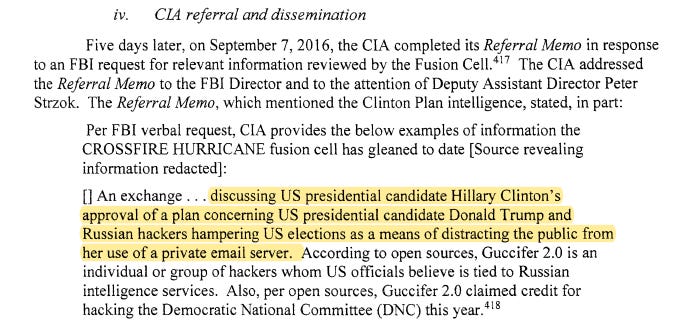
The report's own body backs up a couple of those table rows with primary text worth reading directly. The CIA referral row above traces back to an actual memo, dated September 7, 2016, that the CIA sent the FBI Director and a deputy assistant director naming the Clinton Plan intelligence explicitly.
A few pages later, the report describes something stranger: an FBI attorney assigned to review the material recalled being told, during a meeting involving conspiracy author Jerome Corsi, to deliver findings only orally rather than in writing. The attorney called it the most inappropriate directive he'd heard in his career at the bureau.
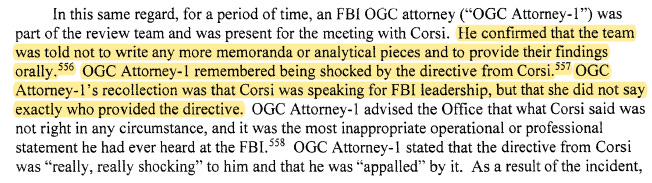
Neither excerpt proves anything on its own. Together they're a small window into how much of this investigation runs on secondhand recollection of verbal instructions nobody wrote down at the time, which is exactly the kind of gap a table full of page counts can't fully capture.
The Trials Didn't Go His Way, And That's Not Nothing
Here's the part any honest account has to sit with. Durham brought exactly three cases out of a four year investigation. Kevin Clinesmith, a former FBI lawyer, pleaded guilty to altering an email used in a FISA renewal application and was sentenced to probation. Michael Sussmann, a lawyer with ties to the Clinton campaign, was tried on a charge of lying to the FBI and acquitted by a D.C. jury in 2022. Igor Danchenko, a primary source behind the Steele dossier, was tried on similar charges later that same year and also acquitted.
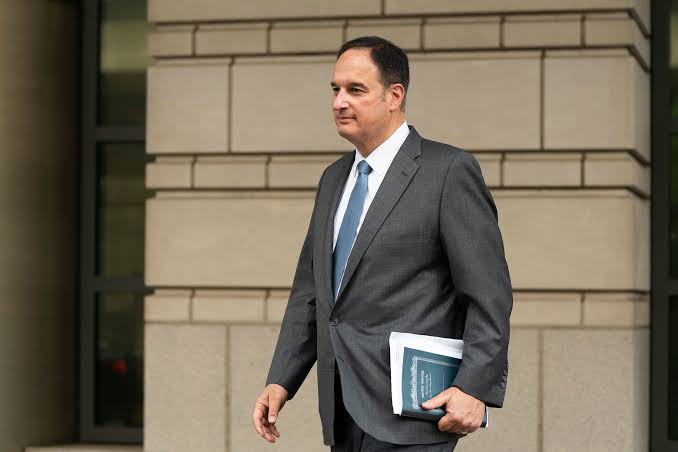
That's Sussmann leaving the same D.C. courthouse where a jury would clear him within hours. Durham showed up to plenty of courthouses himself over those four years, usually on the other side of the same doors.
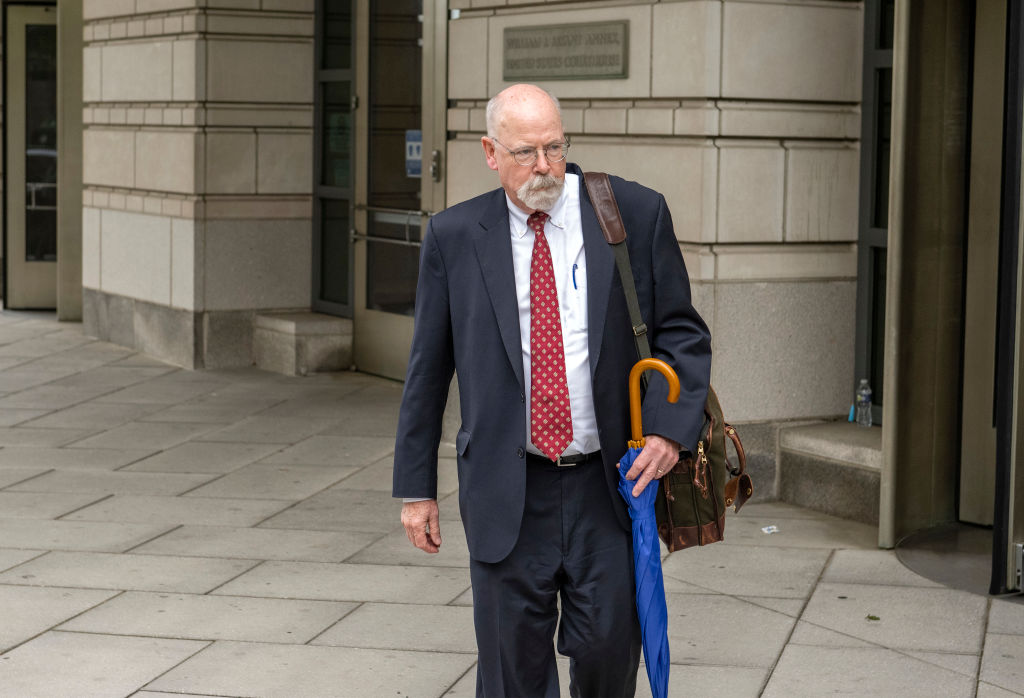
Two acquittals in two trials is a real record, and it's fair to weigh it heavily. But it's worth noticing what Durham didn't do after those losses. He didn't file new charges against the same people on different theories. He didn't go on television to relitigate the verdicts. He accepted two juries telling him he hadn't proven his case beyond a reasonable doubt, and moved on to finishing the written report instead. That is the same institutional restraint his own findings accused others of lacking, applied to himself when it would have been easy not to.
Even His Sharpest Critics And His Biggest Fans Couldn't Fully Claim Him
The reactions split about how you'd expect, and then didn't quite stay split. Bill Barr called the underlying investigation a grave injustice. Congressman Jim Jordan used the report's findings to argue federal law enforcement had become dangerously political. On the other side, TIME called the document a choose-your-own-reality report, and CNN noted that under direct questioning at his June 2023 House Judiciary Committee testimony, Durham himself declined to endorse the "Russia hoax" framing that some of his own report's biggest boosters wanted him to validate.
That refusal is easy to miss, and it matters more than most of what got quoted that week. A witness with every incentive to hand his loudest supporters the sound bite they were fishing for chose instead to stick to what his own report actually said. Neither side got to fully own him, which by this point in his career should surprise nobody.
Then He Did Something Rarer Than A Conviction
In August 2025, federal prosecutors investigating former FBI Director James Comey brought Durham in for an interview about the case they were building. According to later reporting, Durham reiterated what his own team had concluded years earlier: the conduct in question didn't support false-statements charges. The prosecutor leading the new case pursued an indictment against Comey anyway, over Durham's own assessment.
Think about what that means. The man whose entire investigation had been treated by one political faction as a vehicle for taking down its opponents used his own credibility, years after his report was finished, to undercut a prosecution that same faction wanted. That's not the move of someone who ever saw the work as a team sport. It's the move of someone who was actually doing the job the whole time.
A Footnote Nobody In The Press Corps Wanted To Write
Looking back at all of this from 2026, one loose thread never got tied off, and it says as much about the press as it does about Durham. Earlier this month, three veteran political reporters, Maggie Haberman, Jonathan Swan, and Charlie Savage, published a piece warning that a future president could install a loyal prosecutor and direct him to charge political opponents without much regard for whether the evidence actually held up. It was framed entirely as a hypothetical, a warning about a danger still ahead of us. Read next to everything above, that framing is hard to square with the last several years. The piece skips past its own timeline in a couple of places, too, describing Bill Barr's Justice Department going after Michael Flynn without mentioning that the case ended in a pardon rather than a successful motion to dismiss.
Two of the three bylines have earned the benefit of the doubt here. Savage has spent years writing exactly this kind of accountability piece about Durham specifically, so an omission in one article reads more like an editing choice than a blind spot. Swan's history with this story is different, and it's worth walking through slowly, because it didn't start this month.
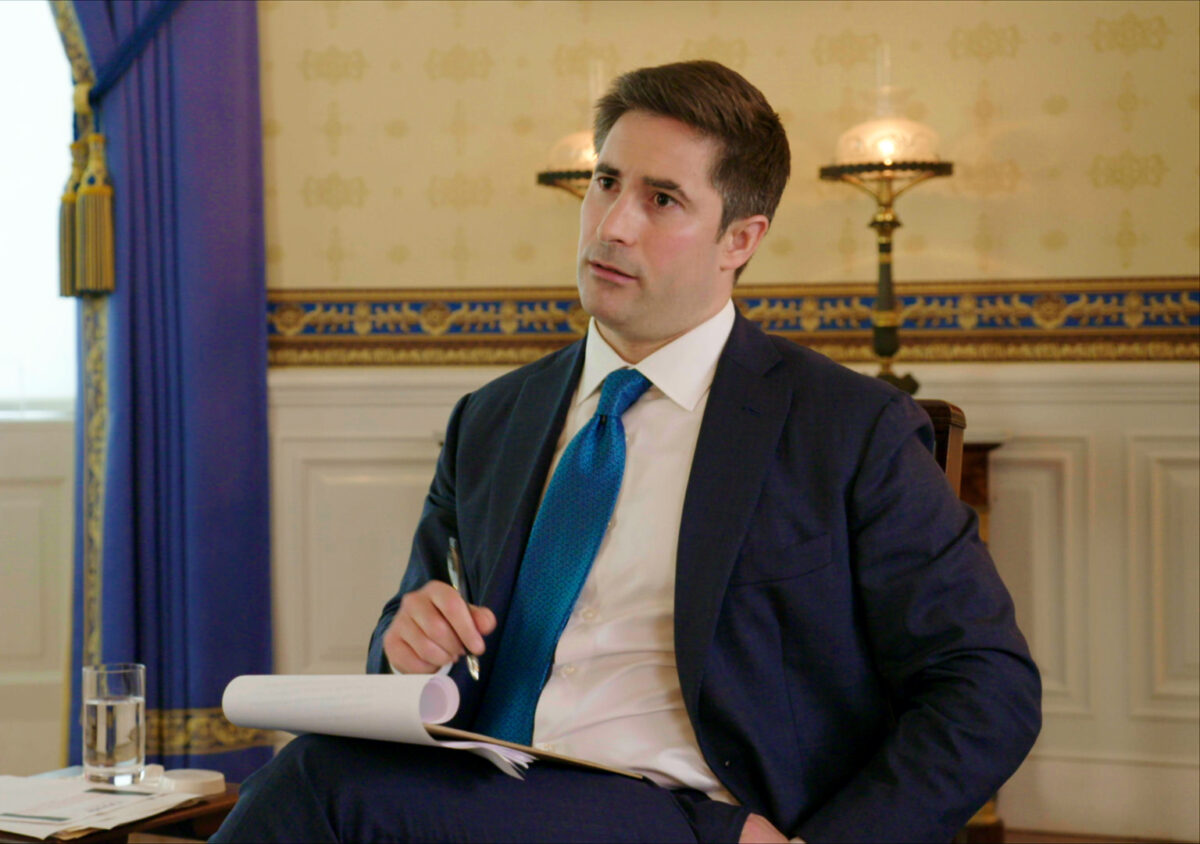
Rewind to the fall of 2021, back when the Danchenko indictment was still brand new and nobody yet knew how a jury would eventually rule on it. Tracing how that indictment came to exist in the first place takes a longer path than most people realize, from the original dossier reporting, through a source dispute over one specific contact, into the FBI, and only years later into Durham's hands.
The day the indictment dropped, Swan posted a tweet distilling it down to one line for his followers: Democrats had funded the dossier, and on top of that a "longtime Clinton/Dem operative" had personally fed the rumors about Trump into it. He added his own two cents on the way out, calling it something that "doesn't get much worse."
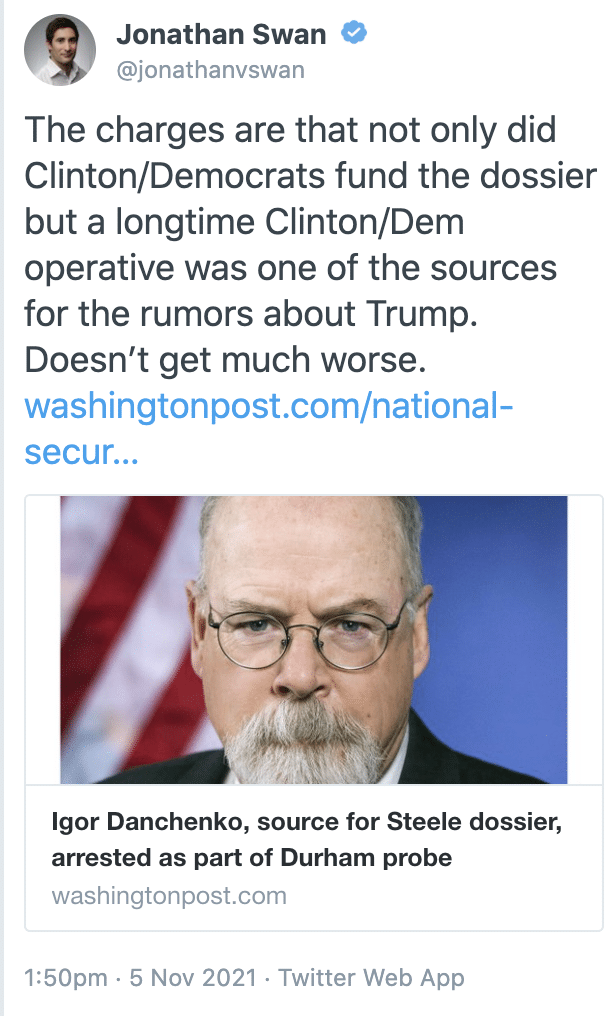
Set next to the actual charging document, that summary was already running ahead of the facts. The indictment didn't accuse anyone of being a planted operative. It accused Danchenko of lying to the FBI about a single conversation, with a public relations consultant named Charles Dolan, the same underlying charge a jury would later decide Durham hadn't proven at all. None of that nuance made it into 280 characters, and the tweet spread fast, well past anyone who was going to go read the indictment themselves.
Someone eventually pushed back on Swan directly, quoting his own tweet back at him. He didn't try to defend the wording. He allowed that it was inaccurate and took it down, with nothing more than that brief acknowledgment left behind, no thread walking back the claim for everyone who'd already shared it, and nothing said to either man the tweet had implicated. A year on, a jury cleared Danchenko in a matter of hours.
Years later, when people brought the tweet back up, Swan's defense was that he'd never covered Durham the way a beat reporter covers a long running story. That's fair as far as it goes, and it also isn't really the point. A single post from someone with a big enough audience can do more to lodge an idea in the public's head than a year of careful, unread reporting, and that's exactly the window Swan's tweet landed in, right when the case was new and the loudest interpretation of it was still up for grabs. Some of what the public still assumes about Danchenko traces back, in some small part, to that one afternoon.
None of that requires writing off Durham's investigation entirely, and this piece hasn't tried to. It only asks that the standard apply evenly. Warning about a hypothetical prosecutor weaponizing charges is worth a byline. So is naming the one who already did it, and naming the coverage that helped his weakest claims travel further than the facts ever supported.
A Historic Figure, In A Good Way
Every name in this piece, Durham's included, worked underneath the same flag.
Line up the whole career and the pattern holds from one end to the other. An FBI agent protecting mob informants, convicted. A governor from the party that appointed him, convicted. A CIA program, investigated twice under two different attorneys general. A politically explosive counterintelligence case, four years of findings that embarrassed people on every side of it, followed by two losses at trial that he absorbed without complaint. Then, years after the report was closed, he told the government his own side didn't want to hear that the evidence didn't support a charge it badly wanted brought.
None of that adds up to a perfect record, and it shouldn't be sold as one. It adds up to something rarer than a perfect record: a federal prosecutor who kept following the same evidence-first instinct through every administration that employed him, whether or not the people in power at the time liked where it led. That consistency is the actual story, and it's the reason his name is going to outlast whatever headline first attached to it.