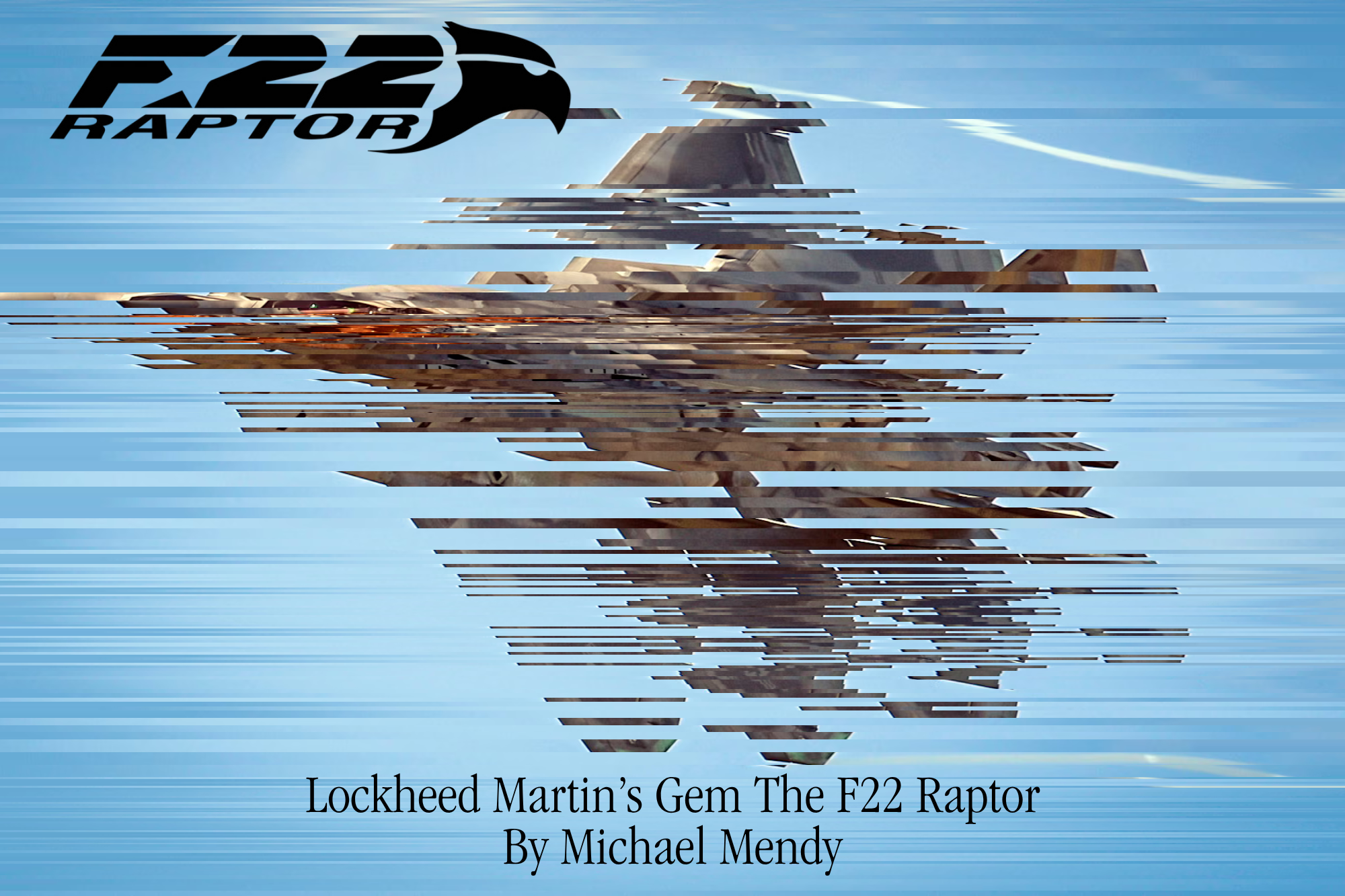
There is exactly one air-superiority fighter on the planet that was designed from the ground up to own every layer of contested airspace simultaneously: the F-22 Raptor. It supercruises at Mach 1.82 without afterburner, maneuvers with thrust-vectoring nozzles that modern physics says should not work that way at altitude, and carries an active electronically scanned array radar behind a fuselage that reflects energy the size of a steel marble. The Air Force acquired 187 operational copies before Congress canceled further production in 2009, making the Raptor both the most capable and the most controversially finite air-dominance platform in American history.
This post breaks down the aircraft's design, its manufacturing partnership, its performance data, and why the F-22 remains in a class of its own more than two decades after first flight.
F-22 Raptor: Control Surfaces
3/4 perspective — hover a label to highlight the surface
Origins: The Advanced Tactical Fighter
By the late Cold War, the United States Air Force recognized that the F-15 Eagle, dominant since 1976, would eventually face threats it could not handle. Soviet fourth-generation fighters like the Su-27 and MiG-29 were closing the performance gap. Stealth, demonstrated so dramatically by the F-117 Nighthawk in 1989, was proving its operational value. The Air Force launched the Advanced Tactical Fighter (ATF) program in 1981 to define the next generation of air superiority.
Two competing teams emerged. Northrop / McDonnell Douglas flew the YF-23, a sleek design that prioritized stealth above everything else. Lockheed / Boeing / General Dynamics flew the YF-22, which balanced stealth with agility. After a fly-off evaluation, the Air Force selected the YF-22 design in April 1991. Lockheed subsequently merged with Martin Marietta to form Lockheed Martin, and Boeing retained its role as the major subcontractor.
The resulting aircraft entered service as the F-22A Raptor in December 2005 at Langley Air Force Base, Virginia.
The Manufacturing Partnership
The Raptor was not built by a single factory. Four distinct organizations split the airframe and systems work. The diagram below maps each section of the aircraft to the company responsible for it.
F-22 Raptor: Manufacturing Partnership
Top-down view — hover any section to see contractor details
The workshare reflected each company's core competencies:
- Lockheed Martin (Marietta, GA) designed and built the forward fuselage, mid fuselage, wing box, and led systems integration. The Marietta plant, one of the largest aircraft factories in the world, served as the final assembly line.
- Boeing (Seattle and St. Louis) was responsible for the aft fuselage, pilot training systems, and significant avionics integration. Boeing also managed the mission planning systems and simulator infrastructure that allowed the F-22 to be operated effectively.
- Lockheed Martin (Fort Worth, TX) contributed to the forward fuselage design and avionics bay integration, drawing on its experience with the F-16 production line.
- Pratt & Whitney designed and produced the F119-PW-100 turbofan engine, a genuinely revolutionary powerplant producing 35,000 lbf of thrust per engine with full-authority digital engine control and two-dimensional thrust-vectoring nozzles.
The combined value-of-work allocation shown in the diagram above represents approximate contract share by value. Lockheed Martin held program lead and integration responsibility, reflected in its larger share relative to raw parts count.
Performance: The Numbers
The F-22's capabilities exist at the intersection of five separate technologies matured simultaneously: broadband low-observable shaping, active electronically scanned array radar, supercruise, thrust vectoring, and an integrated avionics suite that fuses sensor data faster than any previous fighter.
5th-Gen Fighter Performance Comparison
F-22A vs F-35A, Su-57, J-20 across key performance metrics
Note: figures are unclassified public estimates. Actual classified specs may differ significantly.
A few figures worth isolating:
Supercruise is the ability to sustain supersonic flight without afterburner. The F-22 achieves Mach 1.82 in supercruise, which has three tactical implications: fuel consumption stays manageable over long missions, the aircraft arrives at the engagement zone before the enemy can reposition, and the kinematic energy available to missiles at launch is substantially higher than from a subsonic platform.
Service ceiling of 65,000 feet places the Raptor above the altitude envelope of virtually every surface-to-air missile system that was operationally deployed when the aircraft was designed. High-altitude operations also allow the AN/APG-77 radar to detect targets at extended range before they can detect the Raptor.
Rate of climb exceeding 62,000 feet per minute is a consequence of the high thrust-to-weight ratio. Loaded with fuel and internal weapons, the F-22 has a thrust-to-weight ratio above 1.08, meaning it can accelerate vertically.
Stealth: The Radar Cross-Section
The F-22's radar cross-section in its clean internal configuration is estimated at approximately 0.0001 square meters. To put that in context: a conventional fighter like the F-15 has an RCS around 12 square meters. A small bird has an RCS of roughly 0.01 square meters. The F-22 at combat configuration reflects less energy than a large insect.
Radar Cross-Section (RCS) Comparison
Estimated RCS in square meters by platform and configuration (log scale)
F-22 internal configuration: ~0.0001 m² (approximately a steel marble). External stores increase this by 4 orders of magnitude.
This is achieved through several techniques:
- Planform alignment: all edges of the aircraft (wing leading edges, control surfaces, inlet lips) are aligned to a small number of specific angles, which concentrates radar reflections into narrow lobes that do not point at the threatening radar.
- Diverterless supersonic inlet: eliminates the bulky boundary layer splitter plates of legacy fighters, which are large radar reflectors.
- Internal weapons carriage: the main and side weapons bays keep all stores inside the fuselage. External pylons increase RCS by two to three orders of magnitude.
- Radar-absorbent materials (RAM): applied to all external surfaces, though the exact formulation remains classified.
- Edge treatments and panel gaps: the canopy frame, door seals, and access panel edges are all engineered to avoid retroreflection.
The penalty for opening the weapons bay is significant, as the RCS chart shows. The standard engagement sequence therefore minimizes door-open time: fire, close.
F-22 Weapons Carriage Capability
Click a configuration to explore each loadout
The Capability Profile vs. Peer Competition
The F-22 was designed when the realistic adversary set consisted of Su-27 derivatives. Two decades later, Russia fields the Su-57 and China operates the J-20. The radar chart below plots unclassified estimated capability scores across six dimensions.
5th-Gen Fighter Capability Profile
Composite score out of 100 across key capability dimensions
The F-22 holds meaningful leads in stealth and supercruise. The Su-57 edges ahead on raw speed and possibly supercruise, depending on which public estimates you trust. The J-20 appears to emphasize range and avionics for long-range intercept missions rather than within-visual-range dogfighting. The F-35A trades away maneuverability and speed for multi-role capability, sensor fusion, and exportability.
What the radar chart cannot capture is the combination effect. The F-22 is the only aircraft in the world that simultaneously scores above 90 in stealth, maneuverability, supercruise, and avionics. That combination is what the designers called "first look, first shot, first kill" and it remains unmatched.
Production History
The original requirement was for 750 aircraft. Secretary of Defense Robert Gates cut the program to 187 operational frames in 2009, citing cost and the changing threat environment. The final aircraft was delivered in May 2012.
F-22 Raptor Annual Production (2003 to 2011)
187 operational aircraft delivered before program ended · Lockheed Martin, Marietta GA
Total delivered: 187 operational + 8 test aircraft = 195 total frames
The cancellation decision remains debated. The per-unit cost of $143 million flyaway (approximately $412 million when development and sustainment are amortized over the total buy) was real, but it reflected a truncated production run amortizing fixed development costs over far fewer units than planned. Had the program continued to 381 aircraft, the flyaway cost would have fallen substantially.
Cost Analysis
The F-22's reputation as expensive deserves context.
Fighter Aircraft Unit Cost Comparison (USD Millions)
Flyaway cost vs fully-burdened program cost per unit (2009 dollars)
- Flyaway cost
- Program cost/unit
The B-2 Spirit bomber makes the F-22 look economical at $143 million flyaway versus the B-2's $737 million per unit. The F-35A has come down in cost significantly over its production run and now approaches $80 million flyaway, but represents a different capability class (multi-role versus dedicated air superiority). The F-15EX, a fourth-generation aircraft, is cheaper but carries none of the low-observable characteristics that define fifth-generation competition.
The real question is not whether $143 million is expensive in absolute terms. It is whether $143 million buys you capability that is otherwise unavailable at any price. For air superiority in a denied environment against a peer adversary, the answer during the Raptor's operational period was yes.
The Airframe Anatomy
The F-22 weighs approximately 43,340 lbs empty and 83,500 lbs at maximum takeoff weight. The wingspan spans 44.5 feet and the airframe stretches 62.1 feet nose to tail. Two F119-PW-100 engines produce a combined 70,000 lbs of thrust in full afterburner.
| Specification | Value |
|---|---|
| Crew | 1 |
| Length | 62.1 ft (18.9 m) |
| Wingspan | 44.5 ft (13.6 m) |
| Height | 16.7 ft (5.1 m) |
| Empty weight | 43,340 lb (19,700 kg) |
| Max takeoff weight | 83,500 lb (37,900 kg) |
| Powerplant | 2x P&W F119-PW-100 |
| Max thrust (each) | 35,000 lbf (156 kN) w/ AB |
| Max speed | Mach 2.25+ (classified ceiling) |
| Supercruise speed | Mach 1.82 |
| Combat radius | 530 nm (980 km) |
| Service ceiling | 65,000 ft (19,800 m) |
| Rate of climb | >62,000 ft/min |
| Wing loading | 77 lb/ft² |
| Thrust/weight | 1.08 (combat loaded) |
The materials mix is notable: approximately 39% titanium, 24% thermoset composite, 16% thermoplastic composite, 1% aluminum, and 20% other. The titanium concentration is driven by the high operating temperatures near the engine bays and by structural requirements for supersonic maneuvering loads.
The Radar: AN/APG-77
The AN/APG-77 active electronically scanned array is arguably as important as any aerodynamic feature of the aircraft. Unlike mechanically scanned radars that point a dish, the AESA uses thousands of transmit/receive modules to steer beams electronically, with no moving parts, in microseconds.
F-22 Raptor: Avionics Architecture (Figure 5)
Integrated avionics software and hardware stack — AOS/ASM layered architecture
Link to
Sensors
Display
Link to
Displays
Layer
Layer
Layer
Source: F-22 Integrated Avionics Architecture (Figure 5) — Modular Open Systems Architecture
AN/APG-77 AESA Radar: Operating Modes
The APG-77 interleaves all six modes simultaneously without switching — each beam is formed electronically in microseconds. Hover a beam to see mode details.
Operational advantages include:
- Simultaneous modes: the radar can interleave air-to-air search, air-to-ground mapping, and electronic attack in a single scan period.
- Low probability of intercept: the waveform can be spread across a wide bandwidth, making it difficult for an adversary's radar warning receiver to identify the transmission as a fire-control radar lock.
- Electronic attack: at close range, the APG-77 can focus energy to jam or disrupt adversary sensors, a capability sometimes called "electronic warfare without a jamming pod."
- Detection range: classified, but consistently estimated at over 125 miles against fighter-sized targets.
Why Congress Stopped at 187
The proximate reason for program cancellation was cost, but the underlying logic was strategic. Secretary Gates argued in 2009 that no adversary in the near term could field a credible fifth-generation air force, that the F-35 would cover lower-end air-superiority requirements, and that the procurement dollars were better spent on ISR assets, cyber, and unmanned systems.
Critics responded that this reasoning was short-sighted. By 2015, China had flown the J-20. By 2019, the Su-57 was in limited production. The United States was left with 187 Raptors and no production line to reopen: the tooling was partially destroyed after program closure, and a restart has been estimated at $50 billion before the first new aircraft rolled out.
The Air Force has since launched the Next Generation Air Dominance (NGAD) program to replace the F-22. Meanwhile, the existing fleet continues to operate, with upgrades to the Increment 3.2 avionics standard adding improved targeting modes and expanded electronic warfare capability.
Legacy
The F-22 Raptor represented a genuine generational leap when it entered service, and it retains operational relevance today because no successor has yet been fielded. It flew its first combat missions over Syria in September 2014, dropping 1,000-pound GPS-guided bombs in an air-to-ground role that its designers never intended as the primary mission.
The aircraft's structural margin, engine performance, and sensor architecture have proven more extensible than the original design anticipated. Pilots consistently describe it as the most capable aircraft they have flown. Adversary air defense planners consistently describe it as the most difficult aircraft to counter.
Lockheed Martin built 195 frames, including test aircraft. Pratt & Whitney built 390 engines. Boeing contributed the aft fuselage on every single one. The result is an aircraft that, two decades after its introduction, still has no direct peer in the air-superiority role.
That is not a marketing claim. It is the most honest possible summary of what $66 billion in development spending, four decades of aeronautical research, and the combined industrial capacity of three of the largest defense contractors on earth can produce when the requirement is simple: build the best air-superiority fighter in the world, and settle for nothing less.