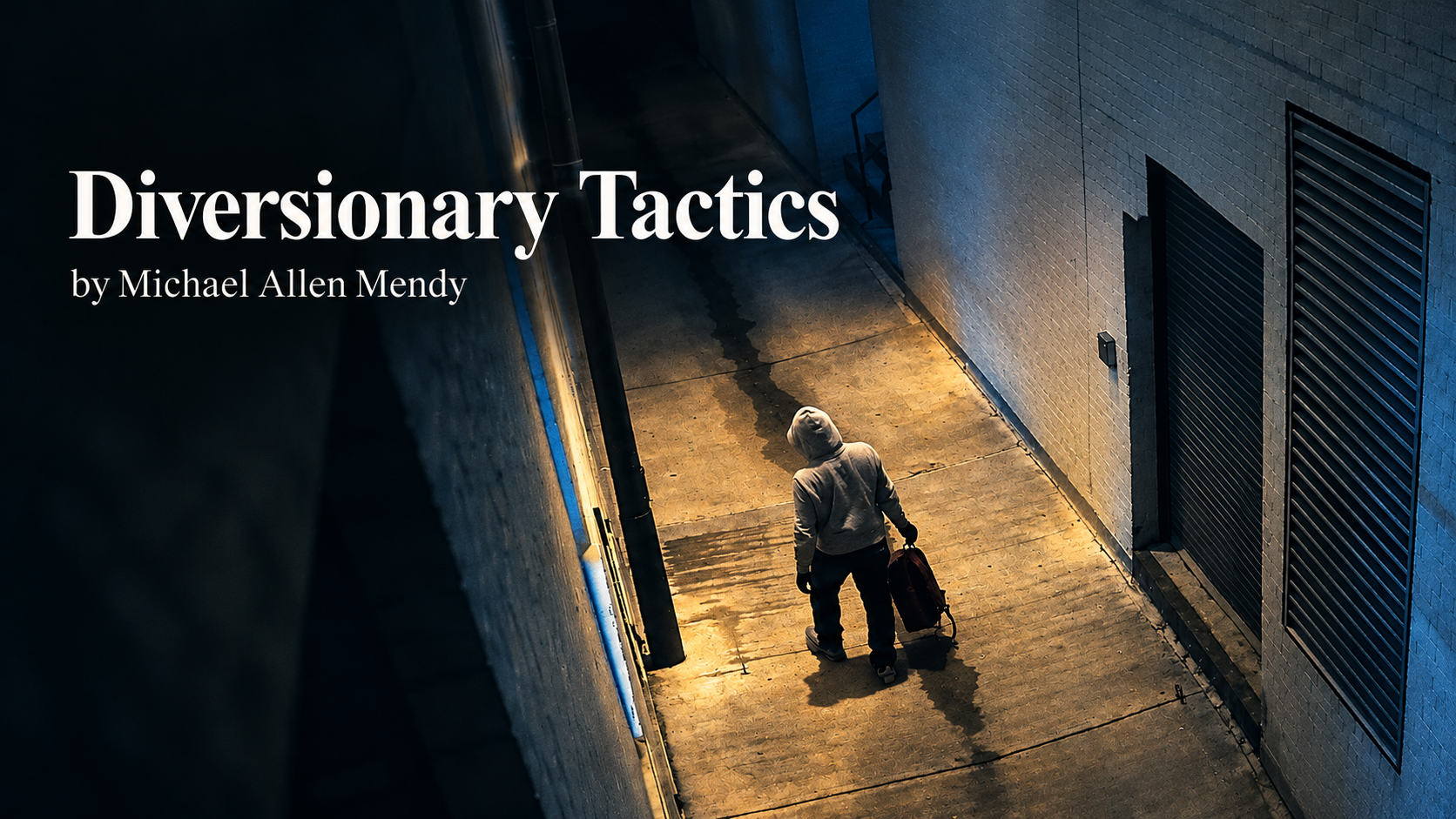
At 12:38 in the afternoon on Wednesday, January 6, 2021, a woman who lived on Capitol Hill walked back to the laundry room behind her building and noticed something sitting next to a dumpster in the alley. It was a length of pipe with wires coming out of it. The alley ran behind the Capitol Hill Club and the headquarters of the Republican National Committee, a few blocks south of the Capitol. Within half an hour a second device turned up beside a bench outside the Democratic National Committee. Fifteen minutes after police began responding to the first one, the crowd on the Capitol's West Front pushed through the bike-rack barricades, and the worst day for the building since 1814 was underway.
Both bombs had been planted the night before. Neither went off. For almost five years the FBI couldn't say who put them there, and the case turned into one of the most argued-over mysteries of the whole January 6 story, a gap that people filled with every theory they could think of. The most persistent was right there in the timing: the bombs were found just as the riot started and pulled police away from the Capitol at the worst possible moment, so maybe that was the point. Maybe they were a diversion.
In December 2025, agents arrested a 30-year-old man from Woodbridge, Virginia, named Brian Cole Jr. Prosecutors say he confessed. His lawyers say the confession was coerced and that he's the wrong man. What follows is drawn from the FBI's affidavit, the government's detention filings, the court's rulings, the House report on the investigation, and the reporting done since, laid out as plainly as the record allows. Everything about Cole here is an allegation. He has pleaded not guilty and has not been tried.
The Night Before
The person who placed the bombs first shows up on camera at 7:34 on the evening of January 5, walking north past the Capitol Power Plant in a gray hooded sweatshirt, a face mask, gloves, glasses, and a backpack. The shoes were the most distinctive thing on them, a pair of Nike Air Max Speed Turf sneakers, a model that sold only about 23,000 pairs in the United States before that night. For the next fifty minutes, a patchwork of building and street cameras across the neighborhood caught the same figure again and again.
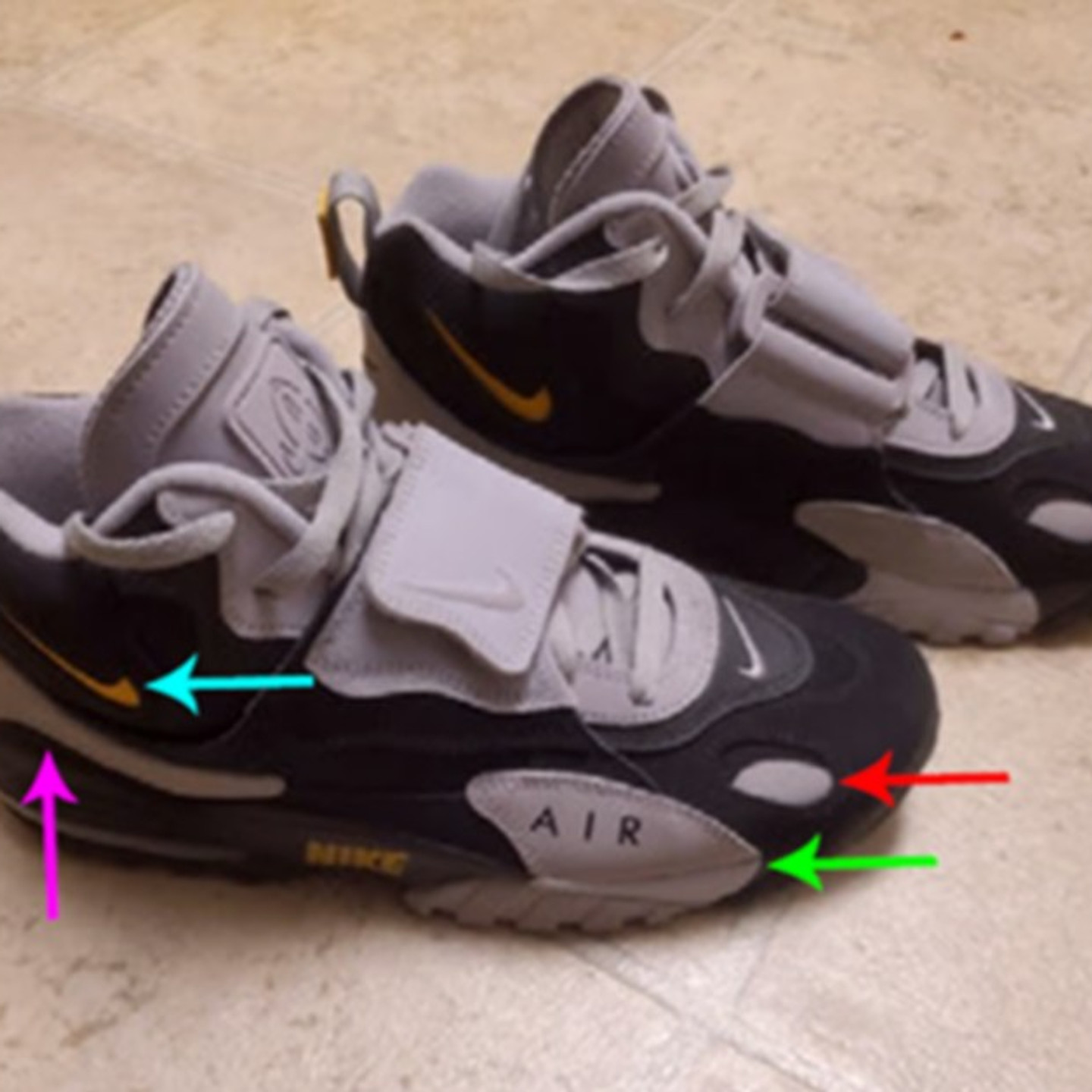
This is the shoe. A pair of Nike Air Max Speed Turfs in the same black, gray and yellow, with arrows marking the details investigators could pick out on the surveillance footage even when they couldn't see anything else: the yellow swoosh on the side, the pale stripe running back along the heel, the oval cutout near the toe, and the big gray panel stamped AIR. On grainy night video, a shoe is sometimes more distinctive than a face, and for years these four details were one of the best leads the FBI had.
The route is not the route of someone in a hurry. The figure walks south toward the DNC, stops halfway down the block, turns around, and walks back to the top of the street. Then south again, to a bench on the west side of the building, where they sit for a while. Then a loop around past the DNC's front entrance and back, and a second bench right next to the first. At about 7:54 the first device goes down in the bushes beside that bench. Then the figure drops off camera for roughly eight and a half minutes, reappears near the RNC, cuts through the alley between the RNC and the Capitol Hill Club, circles the block, and leaves the second device next to a trash can in that alley at about 8:16. The last camera sighting is two minutes later, walking east on Rumsey Court.
This is the turnaround, at 7:40 on South Capitol Street, a few minutes before the first device went down. The figure walks along the row of brick houses in the gray hoodie and lingers on this one stretch of sidewalk, moving one way and then back again. Partway through, someone walking a dog goes right past on the same sidewalk without a second glance. It's a strange thing to watch knowing what's in the backpack, and it's the hesitation that made the route look so odd to investigators.
This is the FBI's footage from the alley between the RNC and the Capitol Hill Club at 8:14, shot from a camera mounted high on the wall. The figure passes right under the camera with the hood up and a bag in hand, then keeps walking away down the alley until they're a speck at the far end of the frame. Two minutes later the second device would be sitting in this same alley next to a trash can.
Within the same minute, at 8:14:21, a camera under the Capitol Hill Club's awning at 300 First Street SE picks the figure up on the sidewalk out front, walking past the hedges with the backpack and the same gray hoodie and right past the club's front doors. A car passes on First Street a moment later. Nobody on the street gives the figure a second look.
The devices themselves were simple. Each was a steel pipe about an inch across and eight inches long, capped at both ends, filled with a homemade powder and wired to a kitchen timer and a battery. Whether they could actually have exploded is still in dispute. For five years the FBI called them viable and said they could have caused serious injury or death. In January 2026 Cole's lawyers filed a report from Brennan Phillips, a 20-year veteran of the ATF, who concluded that the two devices "do not contain an explosive filler capable of causing an explosion." Going by lab photos, he wrote that the powder was mostly coarse white particles with flecks of dark, a poorly mixed batch rather than real black powder, and that a single 9-volt battery and a small square of steel wool couldn't have made enough heat to set it off anyway. No court has ruled on which side is right.
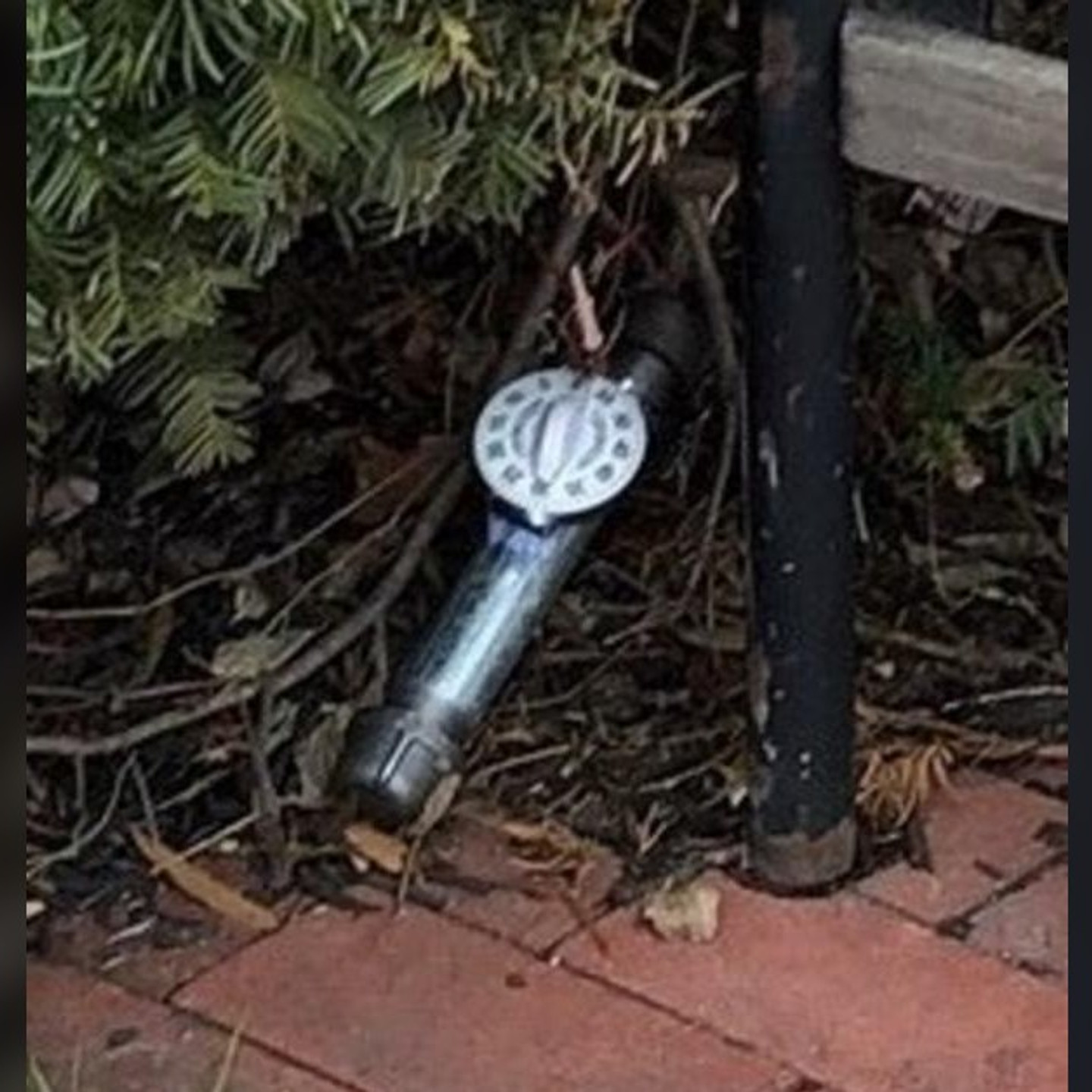
This is what one of them looked like where it was found, tucked under a shrub at the edge of a brick sidewalk. A short length of galvanized pipe, a dark cap on each end, and a cheap white kitchen timer strapped to the side, the same kind of dial you'd use to time a roast. Nothing about it was hidden very well, whether or not it could ever have gone off. It just sat low enough in the bushes that nobody walking by happened to look down.
A Day Of Near Misses
The bombs sat there all night, and for most of the next day, while a lot of very important people moved around them.
That morning the Secret Service swept the DNC with dogs ahead of a visit from Vice President-elect Kamala Harris. The officer who handled the outside sweep later told the Department of Homeland Security's inspector general that it didn't include the bushes where the device was sitting. Harris's motorcade drove past it at 11:25 and into the DNC's garage, about twenty feet away, and she stayed inside for more than an hour. She was still in the building when the first bomb was found behind the RNC and police started looking for others.
This is street camera footage from that morning, stamped "declassified" and timestamped from 11:24 to 11:27 on January 6. A few people cross on foot, the street goes quiet, and then just after 11:25 a police SUV leads a line of black SUVs around the corner and in off the street while more police cruisers hold the intersection. The timing lines up with the inspector general's account of Harris's motorcade arriving at the DNC, with a pipe bomb still sitting in the bushes outside.
The second device was found at 1:05 by a plainclothes Capitol Police countersurveillance team that had been sent out to search for more. By then three of the department's four countersurveillance teams were tied up with the bombs. The Secret Service got Harris out at about 1:15, and Capitol Police began evacuating the Cannon House Office Building and the Library of Congress's Madison Building. At 1:21 a Virginia Railway Express commuter train rolled across the bridge beside the DNC, a few yards from the device, and an Amtrak train followed two minutes later. The House report later noted that nothing in the record shows anyone asked for the trains to be stopped. The standard federal guidance for a suspected pipe bomb calls for clearing at least 70 feet in every direction, and preferably 1,200. At 2:26, with the Capitol already breached, Speaker Nancy Pelosi's motorcade drove right past the DNC device on its way out of the building.
This is the radio traffic from the moment the second device turned up. Through the static an officer reports a "similar device" at the DNC to the one found at the RNC, dispatch keeps asking him to repeat it because the transmission is breaking up, and he finally gets it through: same device, on the corner of Canal Street, in the bushes. From there it turns into logistics. Units ask for technicians and a response vehicle, someone asks whether they need to evacuate the block, and a command post gets set up at the main entrance of the Capitol Power Plant, the same building the bomber walked past on camera the night before.
The police working the RNC scene found something else while they were there. Parked near the Capitol Hill Club was a red pickup truck belonging to Lonnie Coffman of Alabama, loaded with eleven Molotov cocktails, guns and hundreds of rounds of ammunition. Coffman had nothing to do with the pipe bombs, and he later pleaded guilty to weapons charges, but the find is a good measure of what that block of Capitol Hill was like that afternoon.
The DNC scene was declared clear at 4:20, after two controlled disruptions with a bomb robot. The RNC scene was cleared at 6:30. The Capitol itself was secured at 8:00, and Congress went back into session about an hour later to finish counting the electoral votes.
Five Years Of Nothing
The FBI threw an enormous amount at the case early on. More than fifty agents were assigned in the weeks after the riot. They collected video from every camera they could find, subpoenaed cell tower records and Google location data, and worked the components. The battery connector turned out to be sold only through a small set of hobby shops, which looked like a real lead and went nowhere. The sneakers produced a list of almost 1,200 credit card purchases, which were cross-checked against bomb component sales and phone data and eventually led to a gym employee who was cleared. A man who'd photographed the party headquarters was looked at and cleared. Agents found a teenager in Georgia who had been buying bomb parts, and he had nothing to do with this either. By January 2023, when the FBI, ATF and D.C. police raised the reward to $500,000, investigators had done about 1,000 interviews, visited more than 1,200 homes and businesses, collected more than 39,000 video files and worked through nearly 500 tips.
By January 2025, House Republicans had lost patience. A joint interim report from Representative Barry Loudermilk's oversight subcommittee on House Administration and Representative Thomas Massie's Judiciary subcommittee concluded that the bureau had made "little meaningful progress" and had begun pulling resources off the case as early as February 2021. The report said the FBI identified 186 phone numbers of interest from cell tower and geofence data within weeks. It also took apart one of the bureau's explanations for why the phone work stalled. A senior official from the Washington Field Office had testified in 2023 that one carrier had handed over corrupted data. The subcommittees wrote to all three major carriers, and all three said they'd provided no corrupted data and had never been told of any problem with it.
Into that silence came the theories. The one with the most staying power held that the FBI knew who the bomber was and was protecting them. Dan Bongino called the case "the biggest scandal in FBI history" on his podcast before he became the bureau's deputy director. On November 8, 2025, Blaze Media published a story headlined "Former Capitol Police officer a forensic match for Jan. 6 pipe bomber, sources say." It used a "gait analysis" of the surveillance video to point to Shauni Kerkhoff, who had left the Capitol Police and gone to work for the CIA, and it ran her name and photo. The lead reporter was Steve Baker.
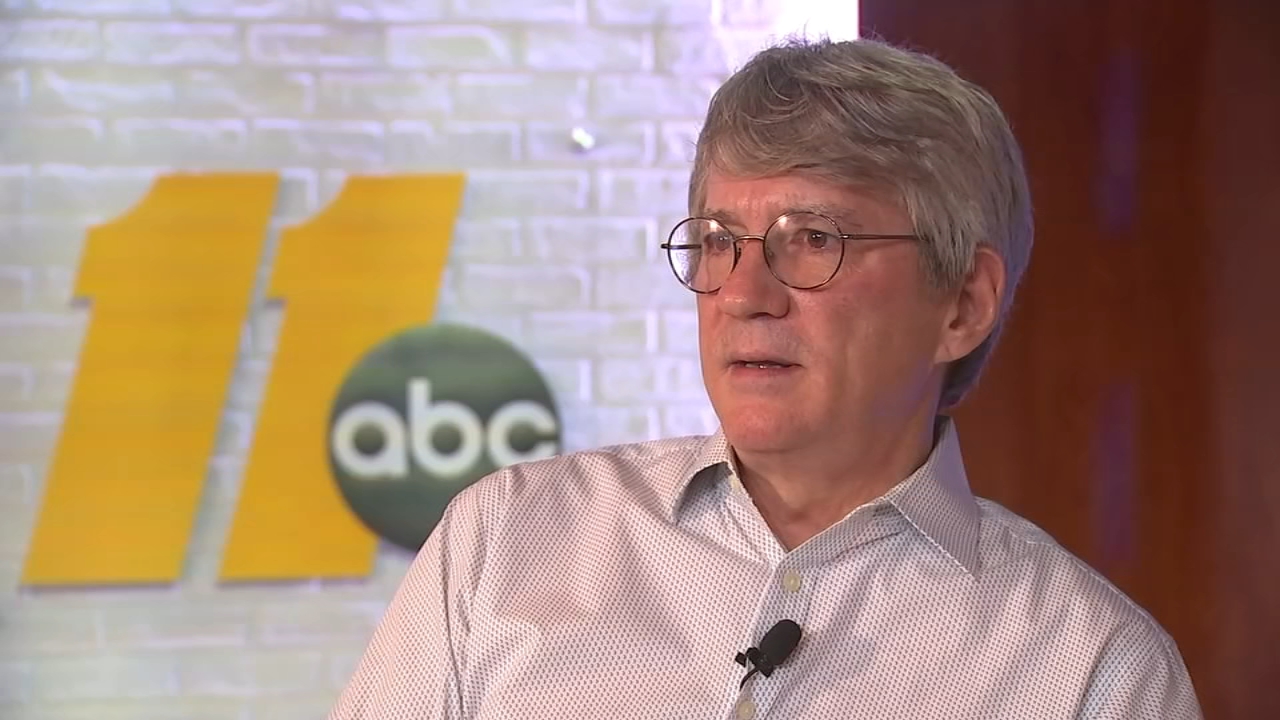
That's Baker in 2022, talking to ABC11 in North Carolina, and he had his own history with that day. He was at the Capitol on January 6 as a freelance journalist, went inside with the crowd, and later sold his video of it to The New York Times and HBO. He was arrested in 2024 on the four misdemeanor counts charged in most January 6 cases, pleaded guilty to all of them that November while saying he was confident he'd be pardoned, and was, in January 2025. By then he was writing for the Blaze, where he reported again and again on the pipe bombs and on what he argued the government wasn't telling the public about them. The Kerkhoff story was the biggest thing he published on it.
It didn't hold up. Kerkhoff's lawyers called the claims recklessly false, and Blaze retracted the story in December, the same month Cole was arrested. In April 2026 she sued Blaze Media, Baker and his co-author Joseph Hanneman for defamation, saying the coverage got her placed on administrative leave at the CIA and brought FBI agents to search her home in Alexandria. Baker no longer works for the Blaze.
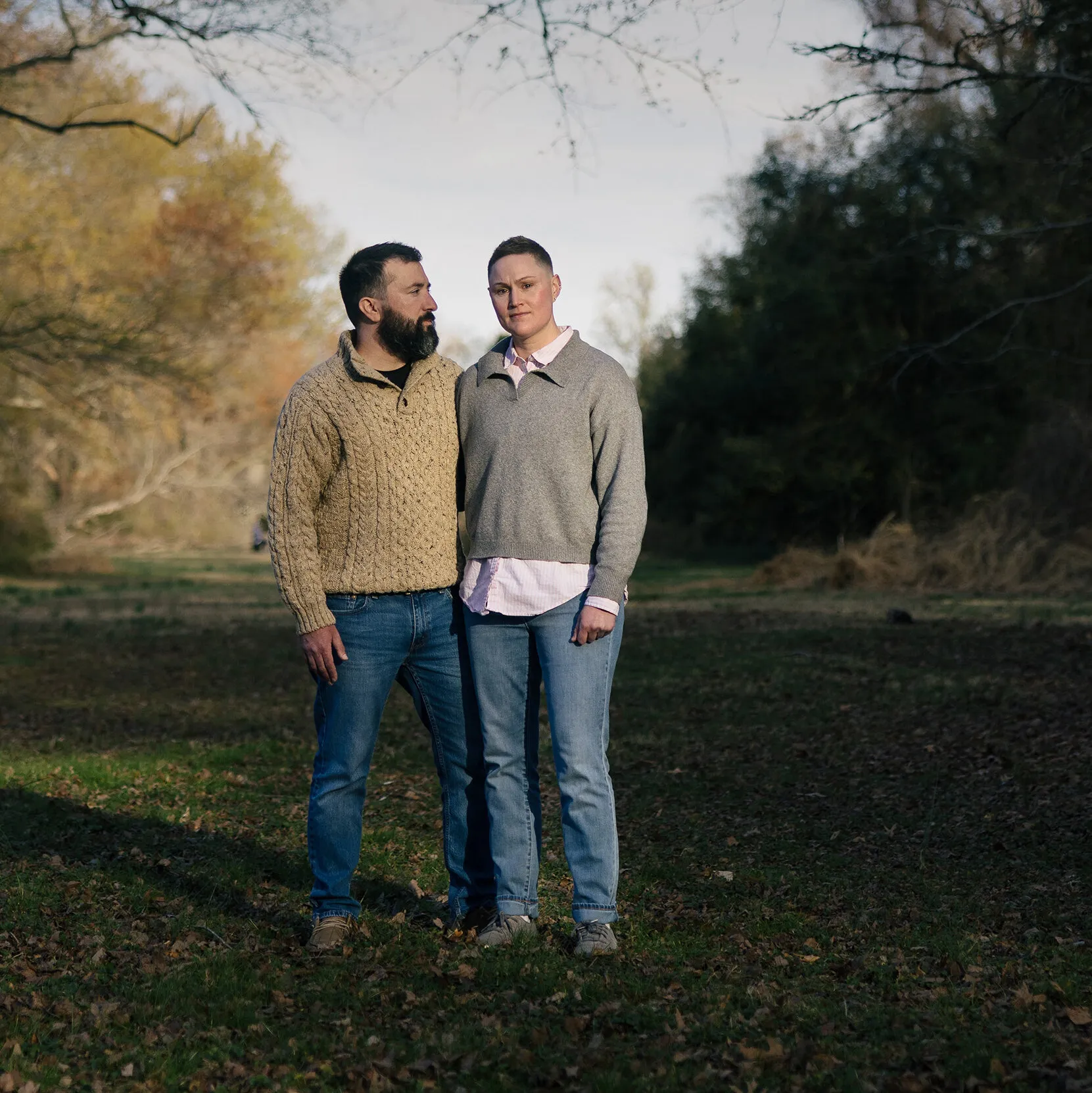
That's Kerkhoff, photographed for The New York Times this spring. She's a real person with a name and a face, and a lot of people online became sure she'd tried to blow up two buildings, and some still are, all on the strength of a video analysis of someone whose face was never visible on camera.
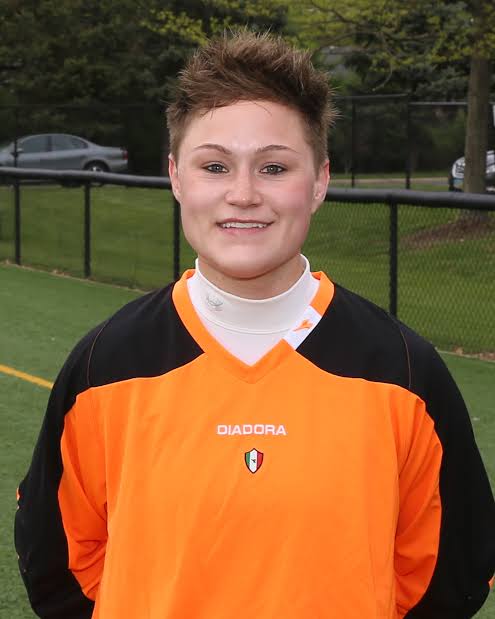
The Puppies Alibi
What cleared her wasn't a lawyer's letter or a second opinion on the gait analysis. It was home video. Asked on CBS News what Kerkhoff's alibi was, the network's senior White House reporter Jennifer Jacobs said it was a recording from the night the bombs were placed.
"She had timestamped video of herself playing with her puppies, her young dogs," Jacobs said, "and she shared this video with the FBI, and that was part of what convinced the FBI that she had nothing to do with this crime." The segment ran under the banner "Innocent woman clears her name after being tied to thwarted pipe bomb attack." So the woman a forensic "match" had put behind the RNC with a backpack was, according to her own timestamped video, playing with her dogs that night, and the FBI accepted it.
Brian Cole Jr.
The FBI arrested Cole on Thursday, December 4, 2025. He was 30 and lived in Woodbridge, Virginia, in a house he shared with his mother and other relatives, working in the office of his father's bail bonds business. He'd graduated from C.D. Hylton High School in 2013, had no criminal record, and wasn't registered to vote. His lawyers later said he has mild autism spectrum disorder and obsessive-compulsive disorder.
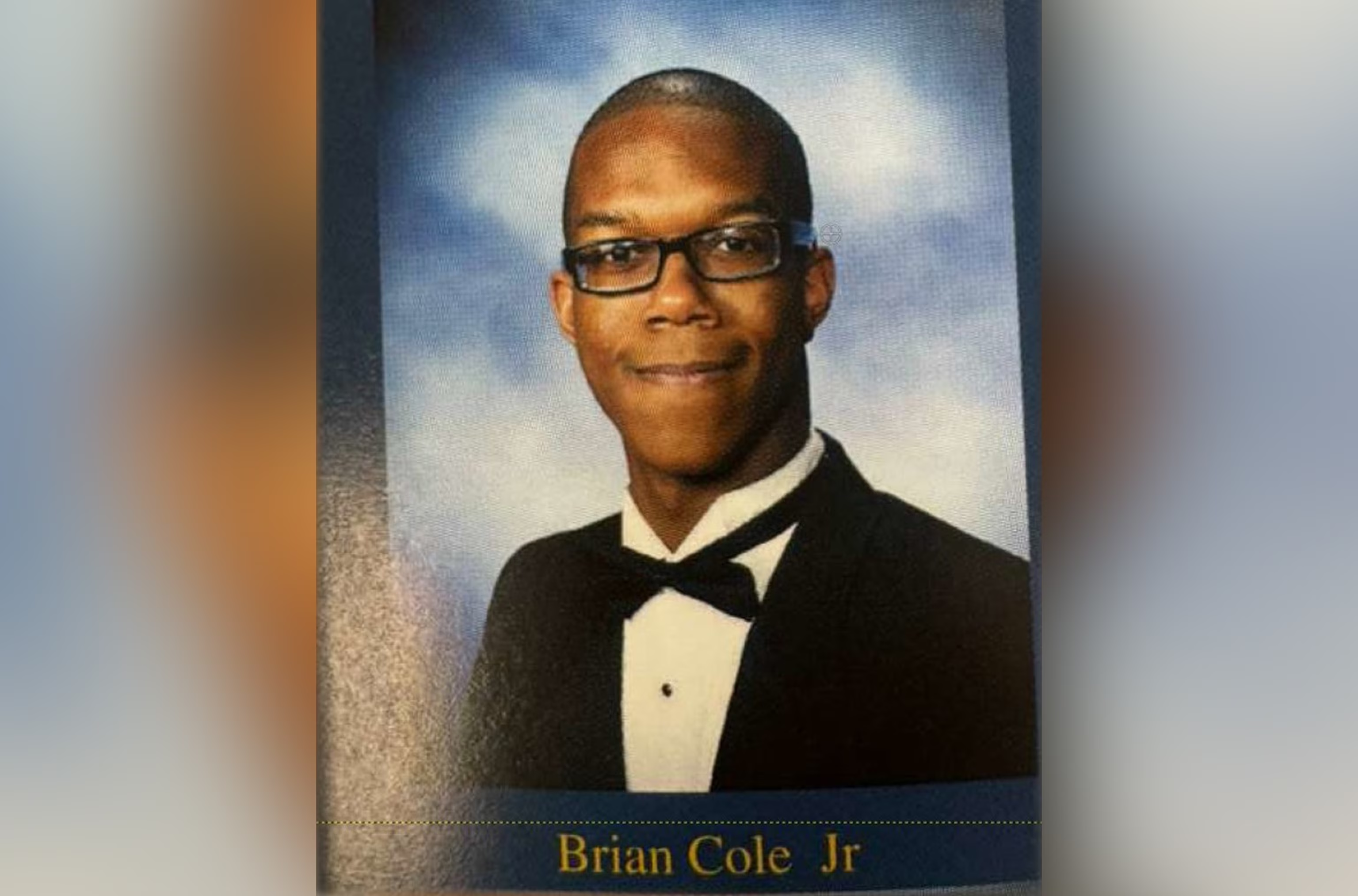
That's Cole's senior portrait from the Hylton yearbook, the photo that ran everywhere the day his name came out, in glasses and a tuxedo years before the night the government says he walked those blocks behind the Capitol.
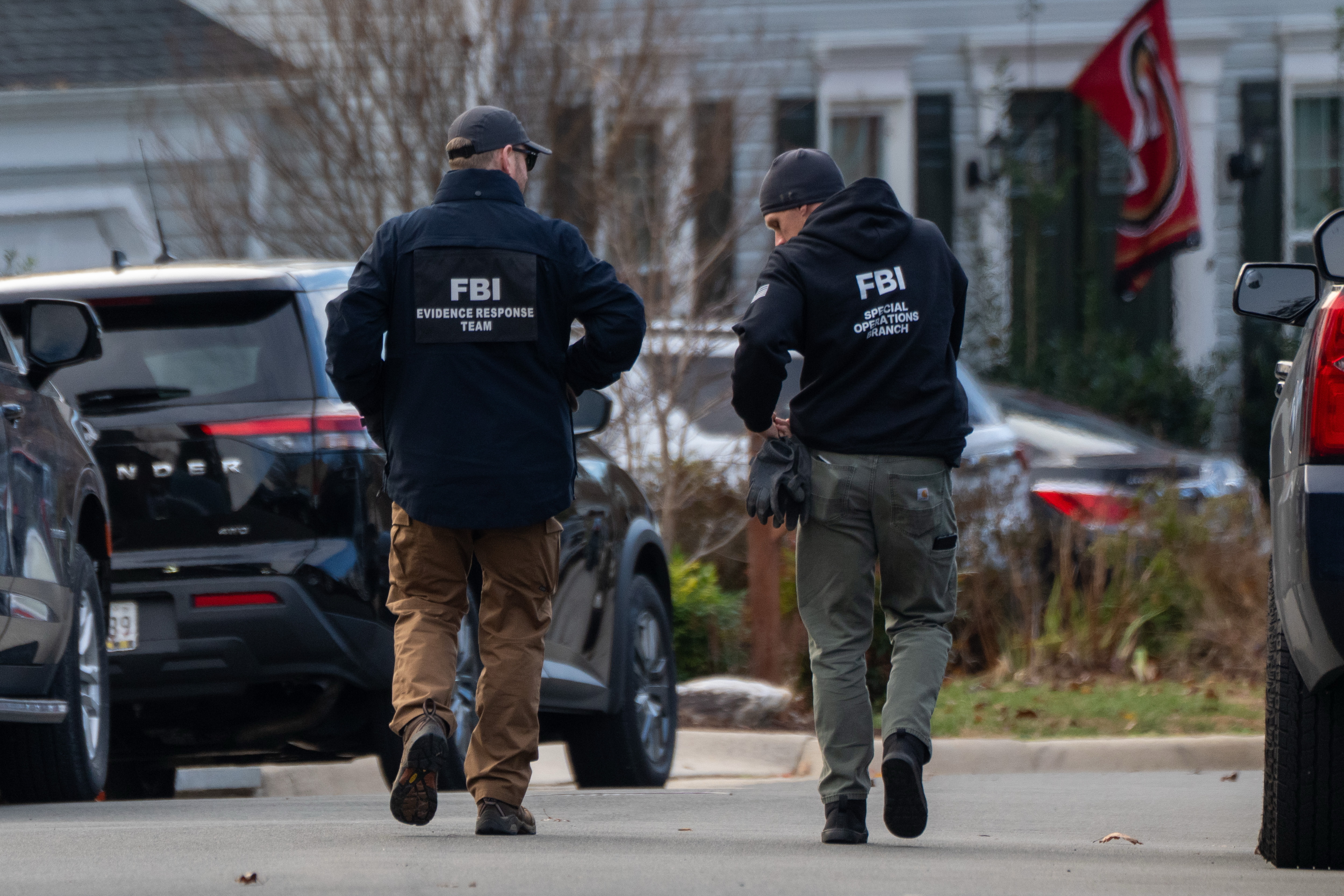
The arrest brought a lot of the bureau out to a quiet suburban street in Woodbridge. Agents from the FBI's Evidence Response Team, the people who document and collect physical evidence, and its Special Operations Branch worked the neighborhood around the Cole family's house as the search got underway, one of them still pulling on gloves on the way back in.
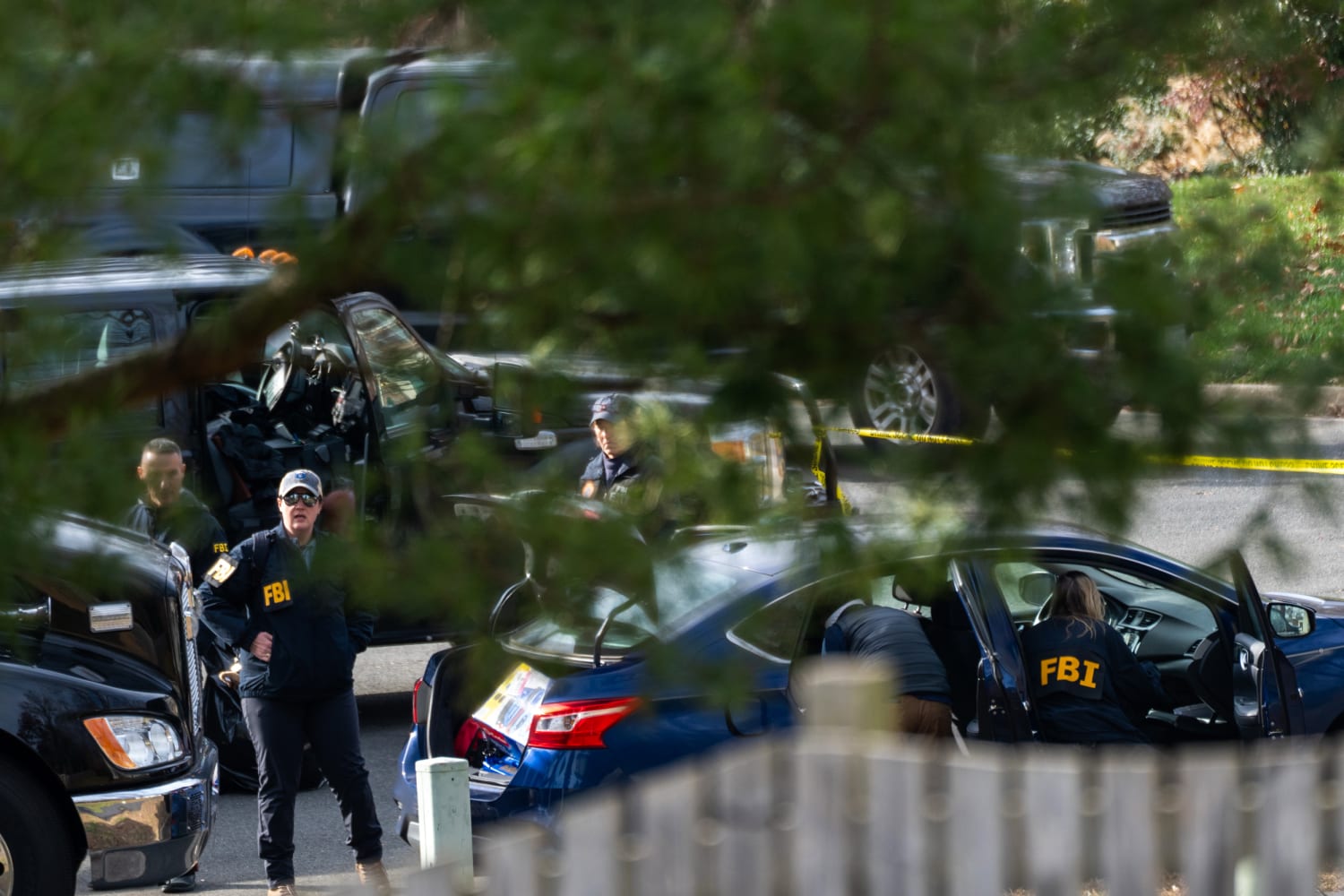
Through the trees and over a neighbor's fence, agents went through a blue sedan with the trunk up and both doors open, one of them leaning across the driver's seat while others stood by behind the tape. For a case that started with a license plate reader catching a car coming off I-395, the car was always going to be one of the first things they searched.
FBI officials said the break didn't come from a new tip. It came from a fresh set of eyes on evidence the bureau already had. According to the affidavit, Cole had bought items consistent with every component of the bombs, including galvanized pipes, end caps, kitchen timers and wire, at Home Depot, Walmart, Lowe's and Micro Center over 2019 and 2020, and he kept buying the same kinds of parts after January 5. A license plate reader logged his 2017 Nissan Sentra coming off I-395 at South Capitol Street at about 7:10 that evening, less than half a mile from where the bomber was first seen on foot. His phone opened about seven data sessions on towers covering the DNC and RNC between 7:39 and 8:24. The bomber had been estimated at about 5 foot 7. Cole is 5 foot 6. Both wear glasses.
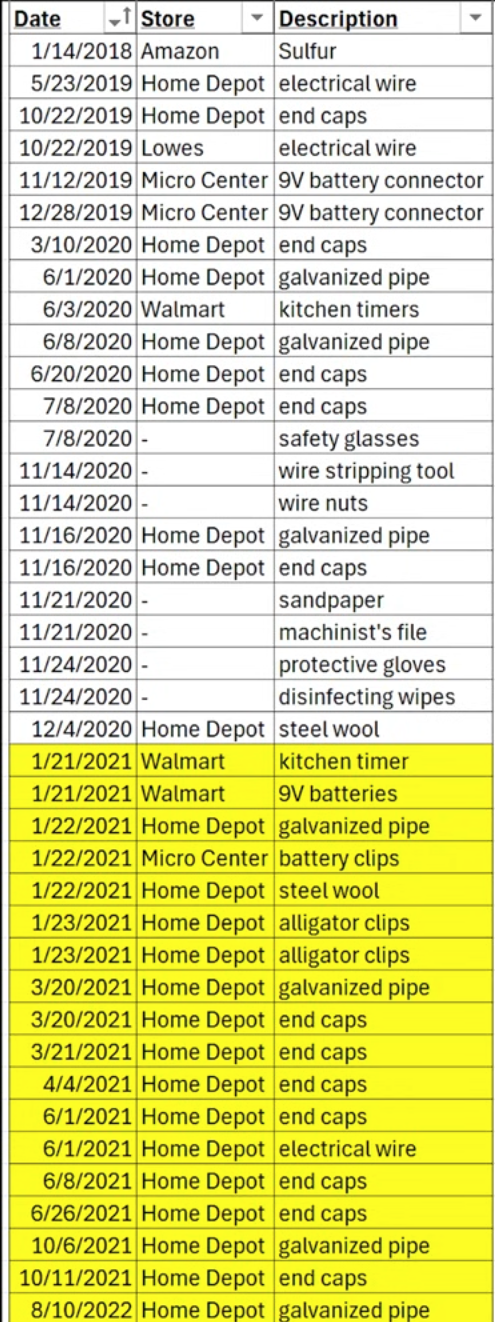
Laid out by date, the purchases read like a parts list. It starts with sulfur, one of the three ingredients in black powder, ordered from Amazon in January 2018. Then, over the next two and a half years, come wire, end caps, galvanized pipe, 9-volt battery connectors from Micro Center, kitchen timers from Walmart, and in the last few weeks of 2020 the finishing work: safety glasses, a wire stripper, wire nuts, sandpaper, a machinist's file, gloves and steel wool. The last purchase before the bombs is steel wool from Home Depot on December 4, 2020.
The rows in yellow are everything after January 5, 2021, and they're the part prosecutors lean on hardest. Sixteen days after the bombs were planted, the buying started again with a kitchen timer and 9-volt batteries from Walmart, then pipe, battery clips, steel wool and alligator clips over the next two days, and it kept going in bursts for more than a year and a half, eighteen more purchases ending with one last length of galvanized pipe in August 2022. It was a big reason two judges decided he was too dangerous to release.
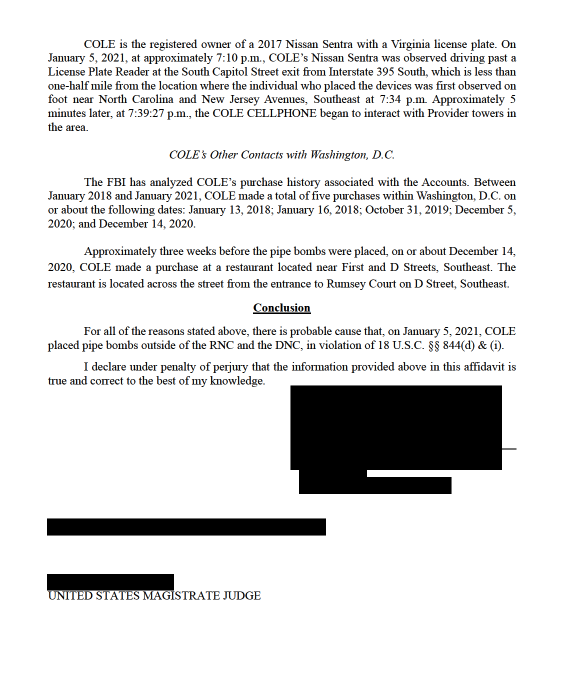
The last page of the affidavit is where the agent puts it together, and it has one detail that doesn't get much attention. Between January 2018 and January 2021, the FBI found only five purchases Cole made inside Washington at all. One of them, on December 14, 2020, about three weeks before the bombs, was at a restaurant near First and D Streets Southeast, across the street from the entrance to Rumsey Court, the same little street where the bomber was last seen on camera walking away. Then the conclusion: probable cause that Cole placed the pipe bombs outside the RNC and DNC, signed by an agent and a magistrate judge whose names are blacked out.
That's the circumstantial case. The part that would make it more than circumstantial came after his arrest.
The Confession
According to the government's detention filing, Cole started the interview by denying everything. He told agents he'd driven into Washington on January 5 to go to a protest. About two hours in, they showed him a still image from the surveillance video, and he admitted it was him. Over the rest of an interview that ran more than four hours, prosecutors say, he gave a detailed account.
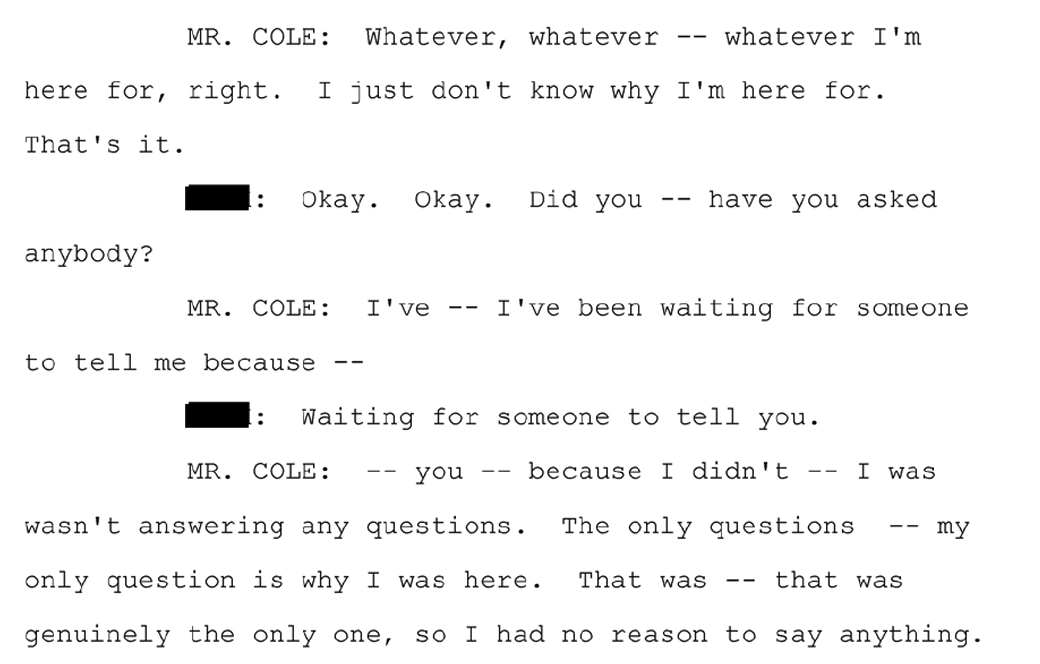
The government's filings summarize that interview. The transcript, which the defense attached in full to its motion to suppress, gives a much better sense of what it was like in the room, and the first stretch of it is a man who says he has no idea why he's there.
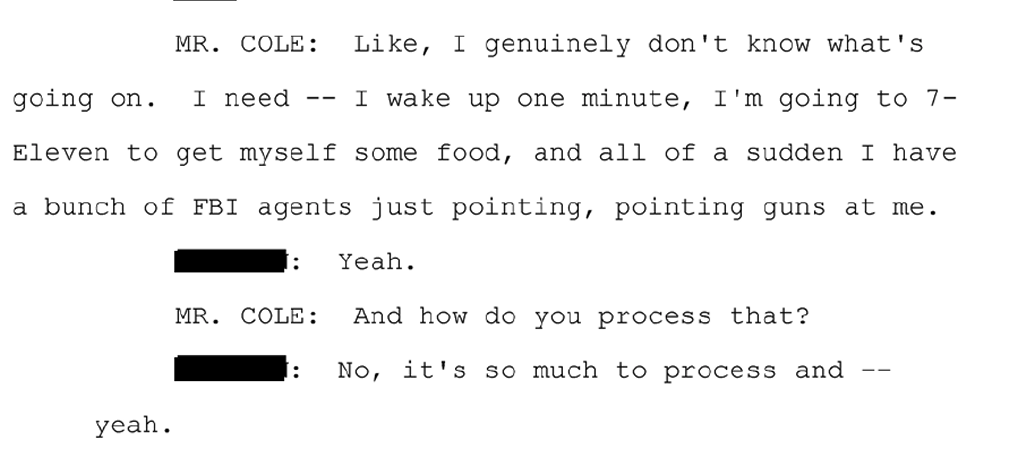
That's how Cole described his arrest to the agents, picked up on the way to a 7-Eleven for food with guns pointed at him. A little later he says the only thing he wants to know is why he's there.
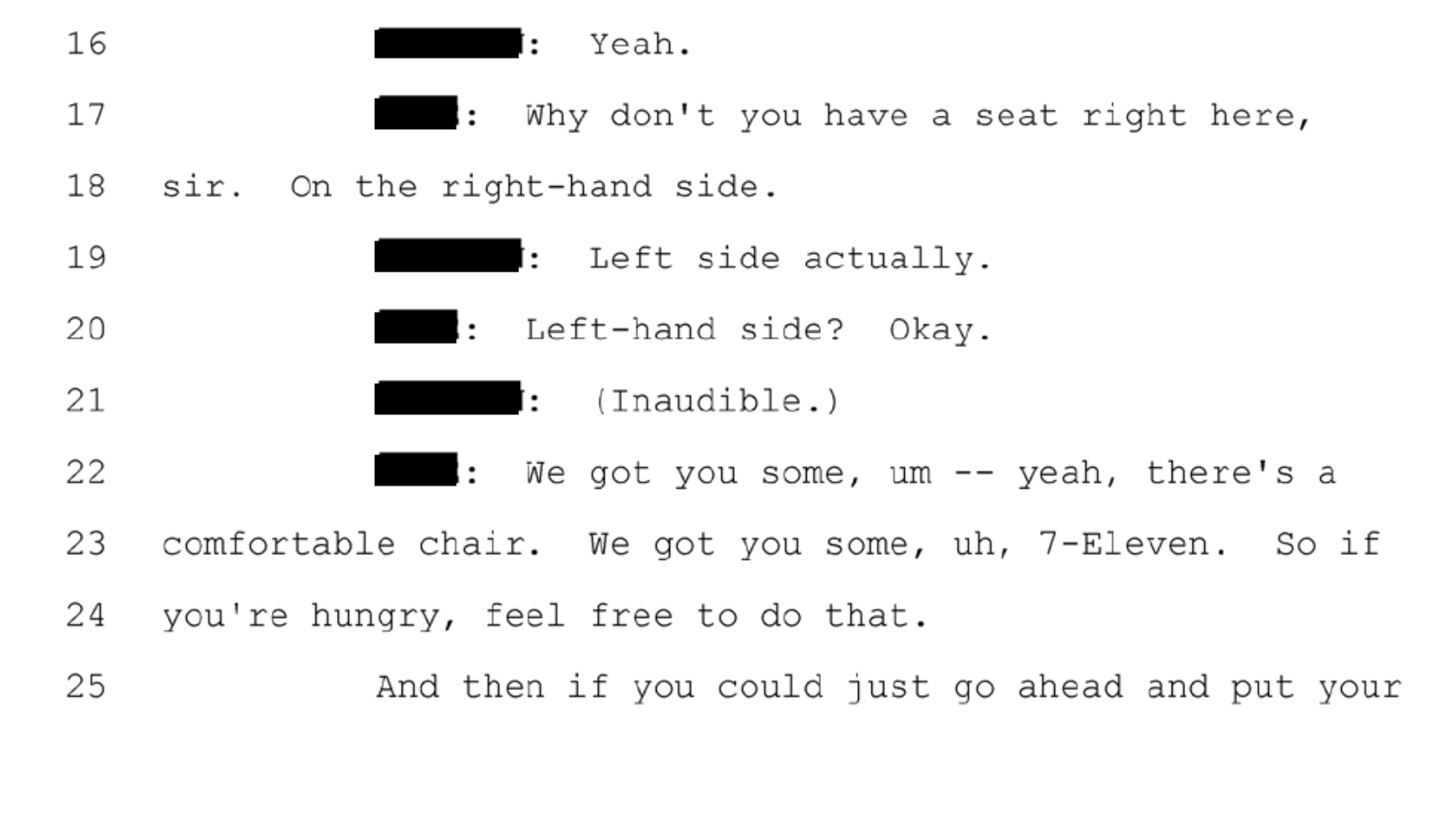
The agents set the tone for a long session. One of the first things they did once he sat down was point him to the food, and of everything they could have picked, they'd brought him 7-Eleven.
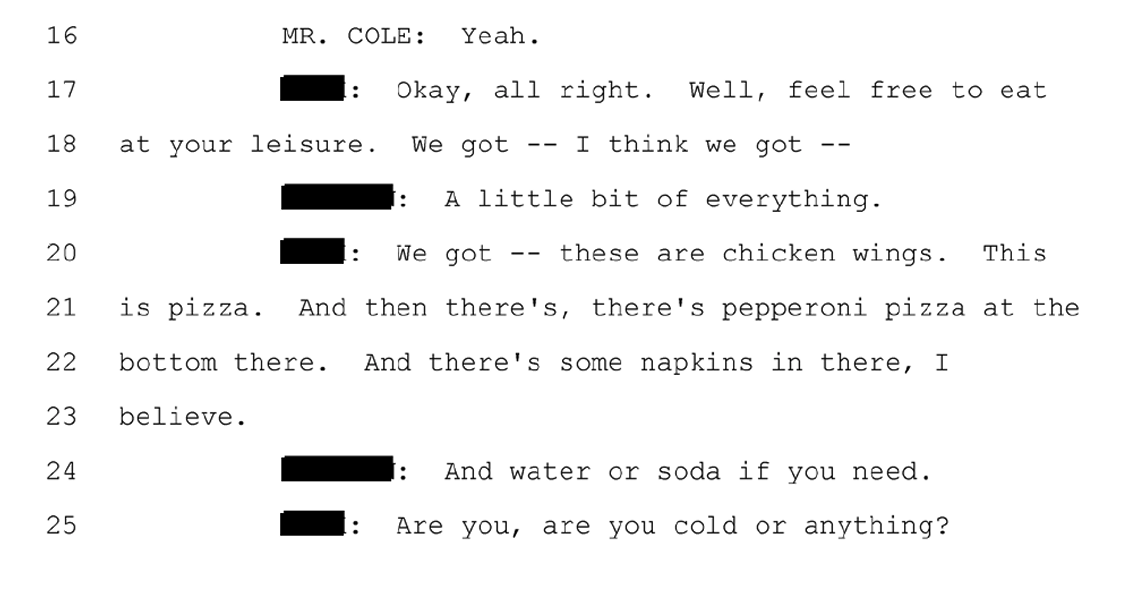
The store he says he was heading to when the guns came out. Then they walked him through the rest of the spread, wings and two kinds of pizza, offered water and soda, and asked if he was cold.
And for a long time he kept saying no. When agents told him they weren't accusing him and that they understood he wanted to block that night out, he swore he hadn't done it.
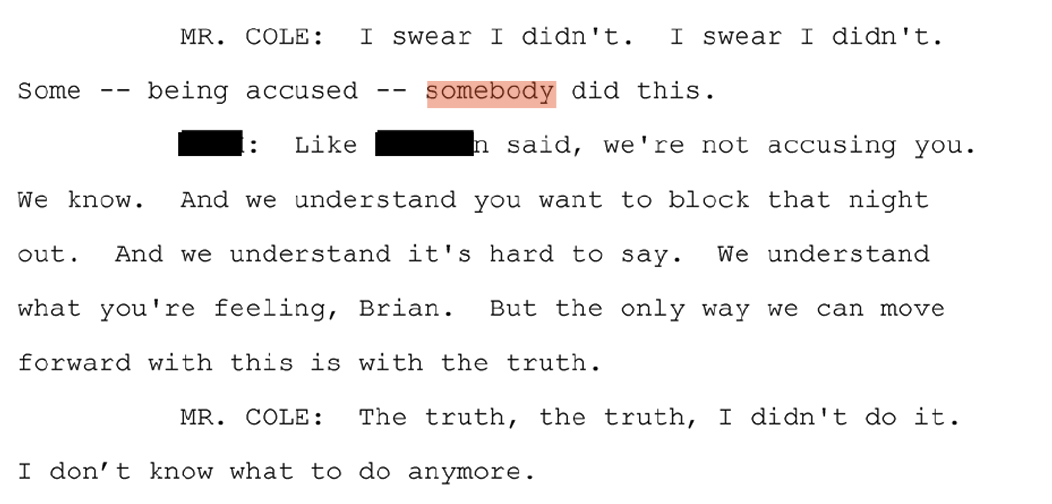
Those denials are the heart of the defense's suppression motion. Prosecutors point to what came after them.
He said he'd assembled the devices in the hours before he drove into the city. He said he set both timers for sixty minutes, then left, picked up some food, and went home. He said he hadn't tested them. Asked why he chose the RNC and DNC, he told agents, "I really don't like either party at this point," and said he went after both because "they were in charge." He described following the 2020 election on YouTube and Reddit and becoming bewildered by the claims that it had been stolen from Donald Trump, and he said that after "watching everything, just everything getting worse," something "just snapped." He told agents he got the idea for pipe bombs from reading about the Troubles in Northern Ireland, that he learned to make black powder from a video game that listed its ingredients and from science videos on YouTube, and that he kept the materials hidden in a closet so a family member wouldn't find them.
He also said things that cut against the worst reading of what he did. He told agents he placed the bombs at night because he "did not want to kill people," that he "was not really thinking about how people would react" beyond hoping it would make the news, and that he was "pretty relieved" when they didn't go off. After the FBI started putting out its videos asking for tips, he said, he threw his bombmaking supplies away at a nearby dump and never told anyone. Prosecutors said he appears to have wiped data from his phone almost a thousand times. They also wrote that it was "luck, not lack of effort" that nobody got hurt, a line the defense's explosives expert disputes, since by his reading the devices were never capable of hurting anyone.
And he denied, specifically, that any of it was aimed at Congress or the vote count on January 6.
Diversionary Tactics
That denial is where the oldest theory about this case runs into the record.
The diversion theory was never crazy. Steven Sund, who resigned as Capitol Police chief after the riot, called the bombs diversionary tactics within days and told 60 Minutes he believed they were "purposely done to draw resources away from our perimeter." The timing on January 6 really is remarkable. Police were called to the RNC at 12:42 and on scene by 12:46. The West Front barricades gave way at 12:53. The second bomb was found at 1:05, two minutes after the joint session convened. Countersurveillance teams, bomb technicians and evacuations were all committed a few blocks away during exactly the hour the crowd was building up on the Capitol's steps. Whatever anyone intended, the bombs worked as a diversion.
But a diversion has to go off when you need it. If Cole's account is true, both timers were set for an hour. The first device was meant to go off at about 8:54 on the night of January 5, the second around 9:16, on dark and mostly empty streets, roughly sixteen hours before anyone stormed the Capitol. That is not how you build a distraction for a riot the next afternoon. They were still sitting there at lunchtime on January 6 because they didn't go off, either because they failed, as the government tells it, or because, as the defense's expert says, they never could have. Seen either way, the timing everyone found so suspicious was an accident, not a plan.
That only holds if you believe the confession, and that's exactly what the defense is fighting.
The Case Against The Case
Cole has been in custody since his arrest. On January 2, 2026, Magistrate Judge Matthew Sharbaugh ordered him held until trial, and on January 29, District Judge Amir Ali upheld that order, finding that releasing him would pose an "intolerable risk of danger to the community." In April a grand jury returned a superseding indictment that added attempted use of a weapon of mass destruction and committing an act of terrorism while armed under D.C. law, which brought the potential sentence up to life. Cole pleaded not guilty on April 22.
His lawyers have tried several ways to end the case before it reaches a jury. They argued that Trump's January 2025 pardons for the January 6 defendants should cover him, since the government's own theory ties the bombs to the events at the Capitol. Judge Ali rejected that on July 6, ruling that the pardons covered only people convicted of offenses connected to the attack. Two days later he set trial for February 16, 2027. In April the defense also filed a document saying the FBI had formally named Shauni Kerkhoff, the former officer from the Blaze report, as a person of interest in November 2025, weeks before Cole's arrest, and claiming she'd failed a polygraph. Prosecutors called it a debunked theory and said she'd been cleared.
Outside the courtroom, the doubts about Cole have run on the same kind of evidence behind the retracted claim about Kerkhoff. Massie has said publicly that the FBI may have the wrong man, citing differences in gait and posture that an analysis published by the Blaze said it found between Cole and the person in the surveillance video.
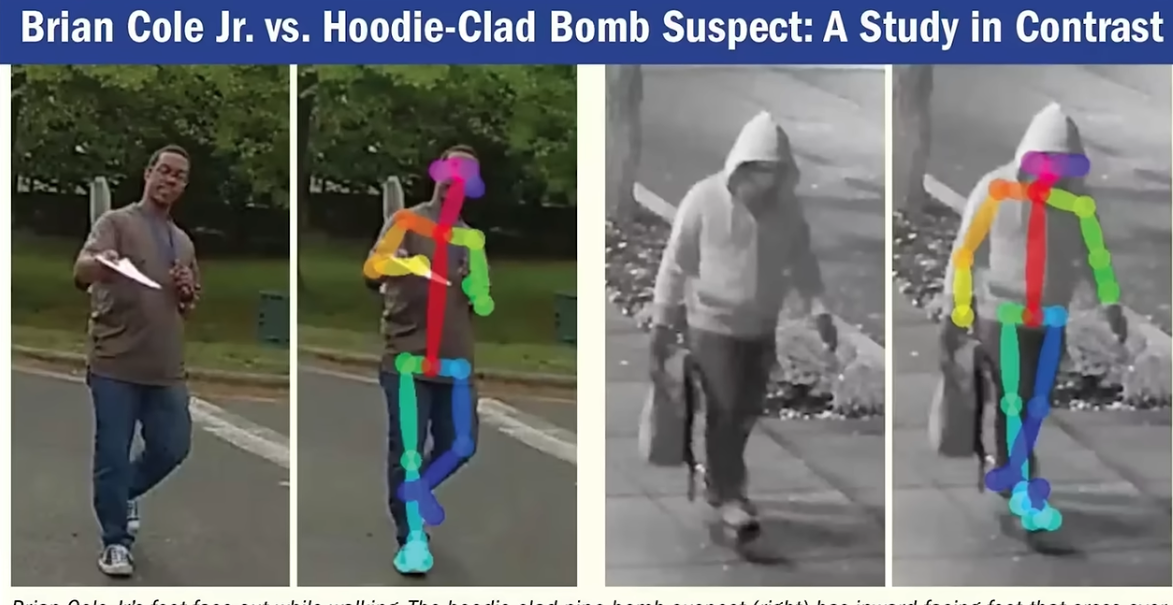
Graphics like this one went around widely after the arrest. Each puts a photo of Cole walking next to a frame of the suspect, runs both through pose-estimation software that draws a stick figure over the joints, and argues the two walk differently. Here the claim is that Cole's feet point outward and the suspect's point inward and cross over. A single photo of a man walking down a road in daylight, set beside a single grainy night frame of someone carrying a heavy bag, is a thin thing to hang a conclusion on in either direction, and the same kind of analysis had already been used to accuse Kerkhoff, in a story the Blaze retracted within a month.
Video versions spread too. This one loops the hooded figure walking past the trash can with the bag beside an inset of a different person crossing a sports field, inviting you to decide whether the two walks match. It's the same method in motion, and it has the same problem: seven seconds of grainy night footage of someone in a hood, set beside a few steps of someone else in daylight, can be made to look like a match or a mismatch depending on what the person making it already believes.
It also helps to see how little the cameras actually captured. Zoom in on the suspect as far as the footage allows and this is what's there.
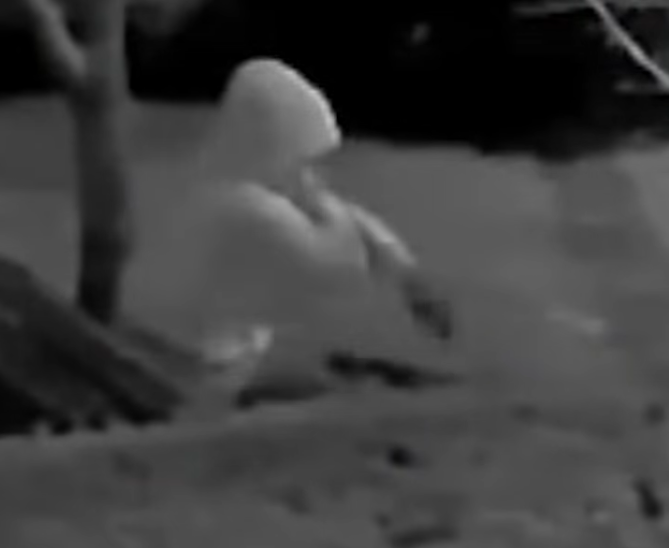
This frame has drawn more argument than almost any other. The figure has one arm pulled in toward the chest and shoulder, and people online have read the gesture in very different ways. One reading that spread widely says the bomber is reaching under the hoodie to fix a sports bra strap, which would make the bomber a woman, and that reading got folded into the claims about Kerkhoff. Others say it's someone shifting the strap of a backpack or adjusting a glove, and some see no particular gesture at all. Nothing in the frame settles it. Look closer and the detail only gets worse.
A hood, a shoulder, an arm, and a smear where a face would be. Everything anyone has claimed to see in the bomber's body, whether it's the supposed match to Kerkhoff's walk, which the Blaze retracted, the supposed mismatch with Cole's feet, or a bra strap, has been read out of footage like this. That's a large part of why the government's case leans on purchases, phone records and a license plate, and why the confession matters as much as it does.
The biggest fight is over the confession. In early October the defense filed a motion to suppress everything Cole told agents, attaching the full transcript of the interrogation and arguing it was psychologically coercive in ways his autism left him unable to withstand. Their account of the turning point is narrow. When agents first showed him the footage and asked if he recognized the person, he said no, and no again when asked if he'd seen the video before. The agents then reminded him that lying to federal agents is a crime. Asked again, his lawyers say, he gave the opposite answer, and when an agent asked, "Is this individual you?" he said yes. They argue the threat produced the confession, not the video, and they plan to call an expert on false confessions at trial. The government filed yet another indictment that same week, adding more counts. Massie, who spent years accusing the FBI of sitting on the case, has now called for Director Kash Patel to resign over how the interrogation was handled.
Judge Ali hasn't decided whether to hold a hearing on the motion.
Reasonable Doubt
Strip the confession away and look at what's left, and there's a real argument that Brian Cole Jr. didn't do this. It's the argument his lawyers will make in February, and it deserves to be laid out as carefully as the government's.
Start with the confession, because everything else depends on it. By the defense's account, Cole spent the first two hours denying it. He said he didn't know why he was there, that he'd been grabbed on the way to a 7-Eleven, that somebody else did this, that he didn't know what to do anymore. The turn came at a specific moment, right after agents reminded him that lying to the FBI is a federal crime, and to a man his lawyers describe as autistic and obsessive-compulsive, that can sound less like a warning than an instruction to agree. Researchers who study false confessions have documented exactly this pattern for decades, a long interrogation, a vulnerable suspect, repeated denials, and then a yes that the person later can't explain. Courts throw out confessions like that. Juries sometimes don't believe them even when they come in.
Then the video. Nobody has ever seen the bomber's face. Everything the government can say from the footage, a person of about 5 foot 7 in glasses with a backpack, describes a huge share of the men and women in the Washington area, and the analyses Massie has pointed to argue the suspect doesn't even walk like Cole.
Then the phone and the car. A cell tower doesn't put a phone on a particular sidewalk. It puts it somewhere in a sector that can cover several blocks of one of the densest few square miles in the country, on a night when thousands of people were pouring into the city for a rally the next morning. Cole told agents he drove in for a protest, and a plate reader on a main highway exit is consistent with that. More telling, the FBI had the cell tower data within weeks. The House report says agents had narrowed it to 186 numbers of interest by February 2021. If Cole's phone was in that data the whole time, the defense will ask why nearly five years of the most intensive search in the bureau's recent history never landed on him.
The purchases have the same problem. Pipe, end caps, wire, kitchen timers and battery connectors are things hardware stores sell every day. The battery connector was supposed to be the bureau's best lead in 2021, and according to The Washington Post, agents cross-checked buyers against phones near the bomb sites and came up with nothing.
Then there are the devices themselves. The government's terrorism and weapons of mass destruction charges assume Cole tried to set off two bombs. The defense's expert says there were no bombs to set off, just pipes full of a powder that wasn't mixed well enough to explode and a battery too weak to ignite it. If a jury believes him, the most serious counts in the case get much harder to prove, no matter who carried the backpack.
And there was another suspect. The defense says the FBI formally named Shauni Kerkhoff a person of interest in November 2025, just weeks before it arrested Cole, and that she failed a polygraph. Prosecutors say she was cleared, and there is no public evidence tying her to the bombs. But the order of events matters to the defense. Before he became the bureau's deputy director, Dan Bongino had called this case the biggest scandal in FBI history. In the new leadership's first year in charge, the FBI went from naming one person of interest who was then cleared to arresting another a few weeks later.
None of this proves Cole is innocent, and the government has answers to most of it. The confession includes details, the sixty-minute timers, the trip to the dump, the closet, that prosecutors will say only the bomber would know. The purchases after January 5 are hard to explain away. But Cole doesn't have to prove anything. The government has to prove its case beyond a reasonable doubt, and if a jury decides the confession can't be trusted, what's left is a car, a phone, and a stack of hardware store receipts.
What's Left
It's easy, after five years of arguing about who the bomber was, to lose track of why the question ever mattered so much. The pipe bombs were never the main event of January 6. They were a footnote to it, two devices beside a trash can and under a bush that never went off, found by a woman doing her laundry and a police team out looking for more. What made them matter was where they sat and when they turned up, a few blocks from the Capitol, in the same half hour the barricades gave way.
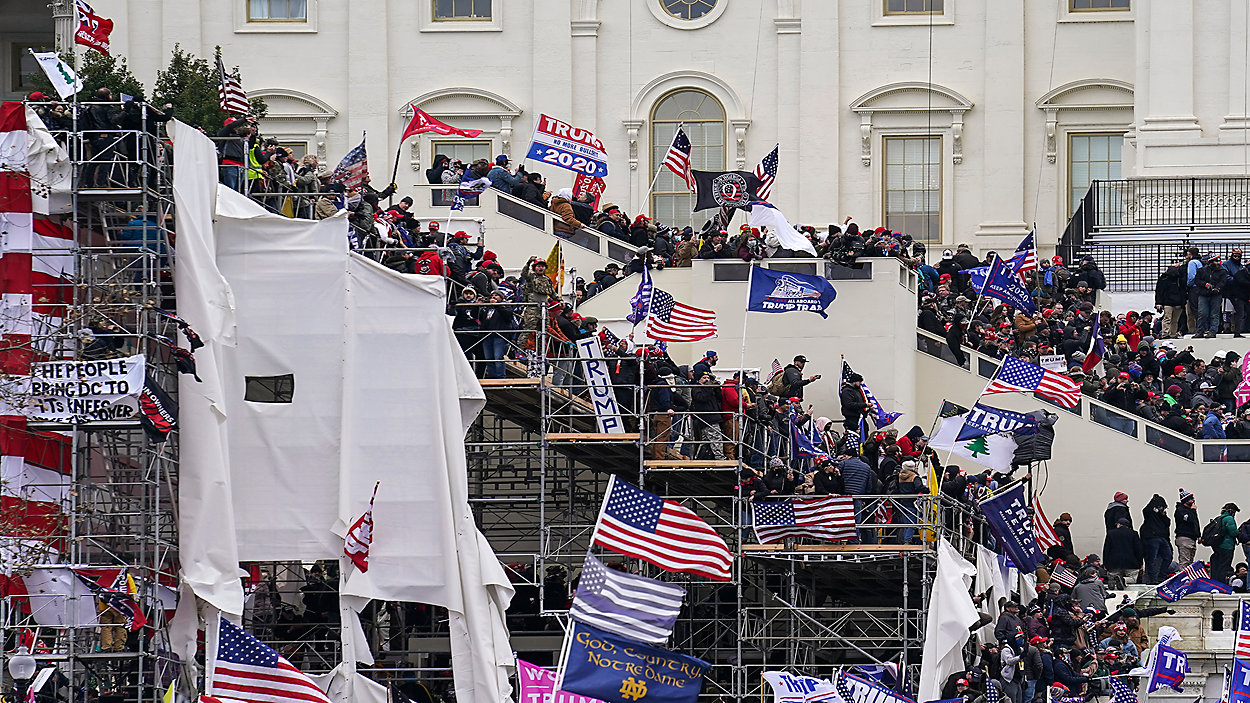
This was the West Front that afternoon, the crowd up on the scaffolding built for the inauguration and spilling up the stairs toward the building, flags and Trump banners everywhere. It's the scene the diversion theory was always trying to explain, and it was happening a few blocks from two bombs that most of the people in this picture never knew were there.
If the confession comes in, the government has a defendant who admits building and planting the bombs, a car half a mile away, a phone pinging the right towers at the right minutes, and years of matching purchases. If it's thrown out, prosecutors still have the car, the phone and the receipts, which is a lot more than they had for the first five years, though a jury will have to decide whether it's enough.
Either way, the case has already answered some of the questions people asked for five years and left the rest open. The FBI did eventually find a suspect, and it found him in data it had been sitting on, not through a tip or a leak. Whether the devices could ever have exploded is still being fought over, between an FBI that called them viable for five years and a former ATF explosives expert who says they were never capable of it. What isn't in dispute is that they sat outside both parties' headquarters for seventeen hours while the incoming vice president, the Speaker of the House, two commuter trains and a lot of police walked or drove past them, and that nobody was hurt. Whether they were meant as a diversion depends almost entirely on whether you believe what Brian Cole Jr. told the FBI on December 4, 2025, and a jury in Washington is scheduled to start deciding that in February.
Sources: FBI affidavit in support of the criminal complaint, United States v. Brian J. Cole Jr. (D.D.C., Dec. 2025). Government's memorandum in support of pretrial detention (Dec. 2025). Memorandum opinion and order on detention (D.D.C. Jan. 2, 2026) and the district court's ruling on review (Jan. 29, 2026). Superseding indictment (Apr. 2026). Order on the defendant's motion to dismiss on pardon grounds (July 6, 2026). Defendant's motion to suppress statements (Oct. 2026). Committee on House Administration, Subcommittee on Oversight, and House Judiciary Committee, Subcommittee on the Constitution and Limited Government, "Four Years Later: Examining the State of the Investigation into the RNC and DNC Pipe Bombs," interim staff report (Jan. 2, 2025). DHS Office of Inspector General, review of the U.S. Secret Service's response to the DNC device (2024). DHS-DOJ Bomb Threat Stand-off Card. Reporting by the Associated Press, The Washington Post, CNN, NBC News, ABC News, CBS News and NBC4 Washington.