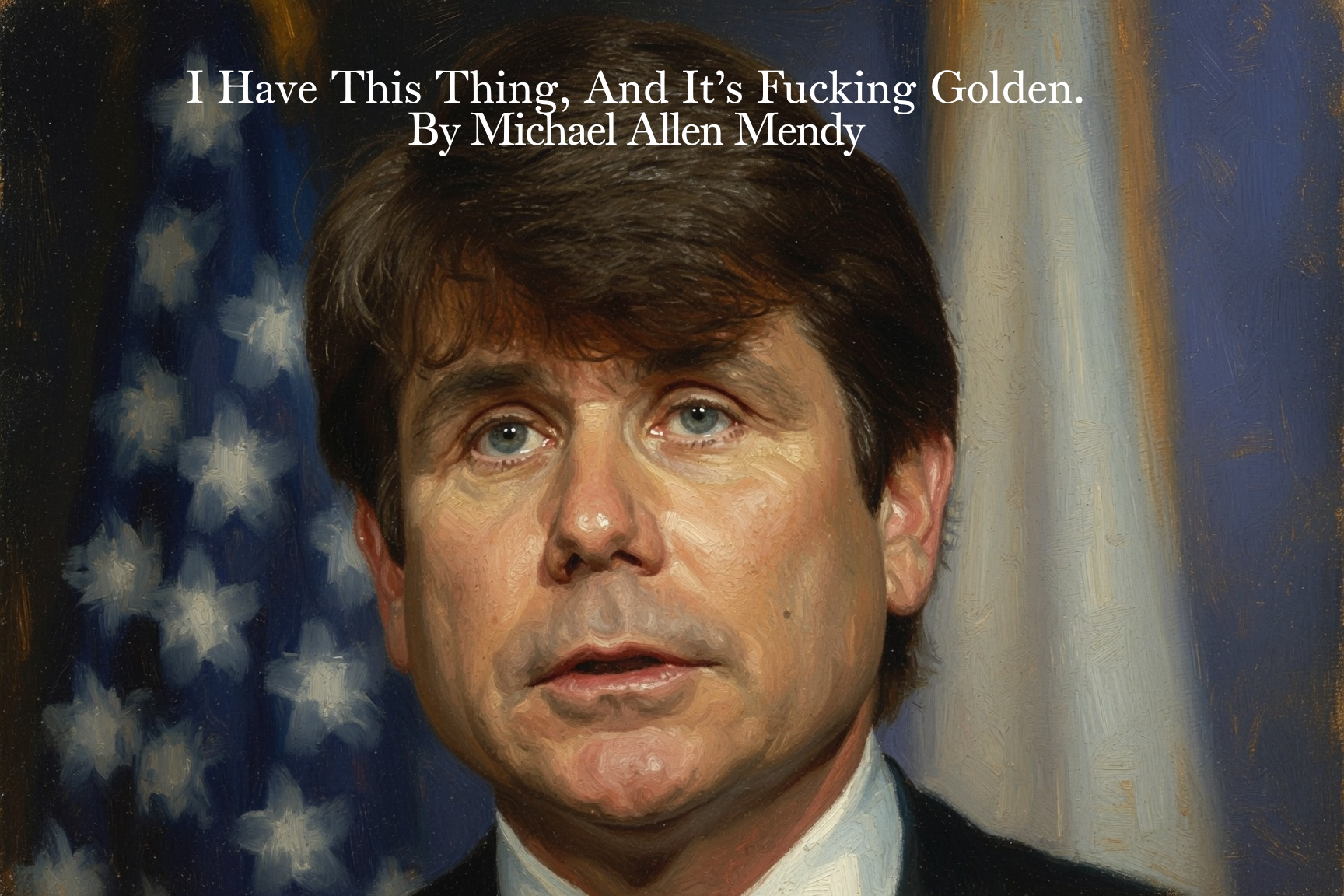
On November 5, 2008, a week after Barack Obama won the presidency, the governor of Illinois picked up the phone to talk about the U.S. Senate seat Obama was about to vacate. The call was already being recorded, part of a wiretap the FBI had running on Rod Blagojevich's phones since October under a court order nobody around him knew about. "I've got this thing and it's fucking golden," he told the aide on the other end, "and, uh, uh, I'm just not giving it up for fuckin' nothing. I'm not gonna do it. And, and I can always use it. I can parachute me there." That sentence, paragraph 96 of a criminal complaint nobody had seen yet, is the entire reason most people can still picture this governor's face sixteen years later.
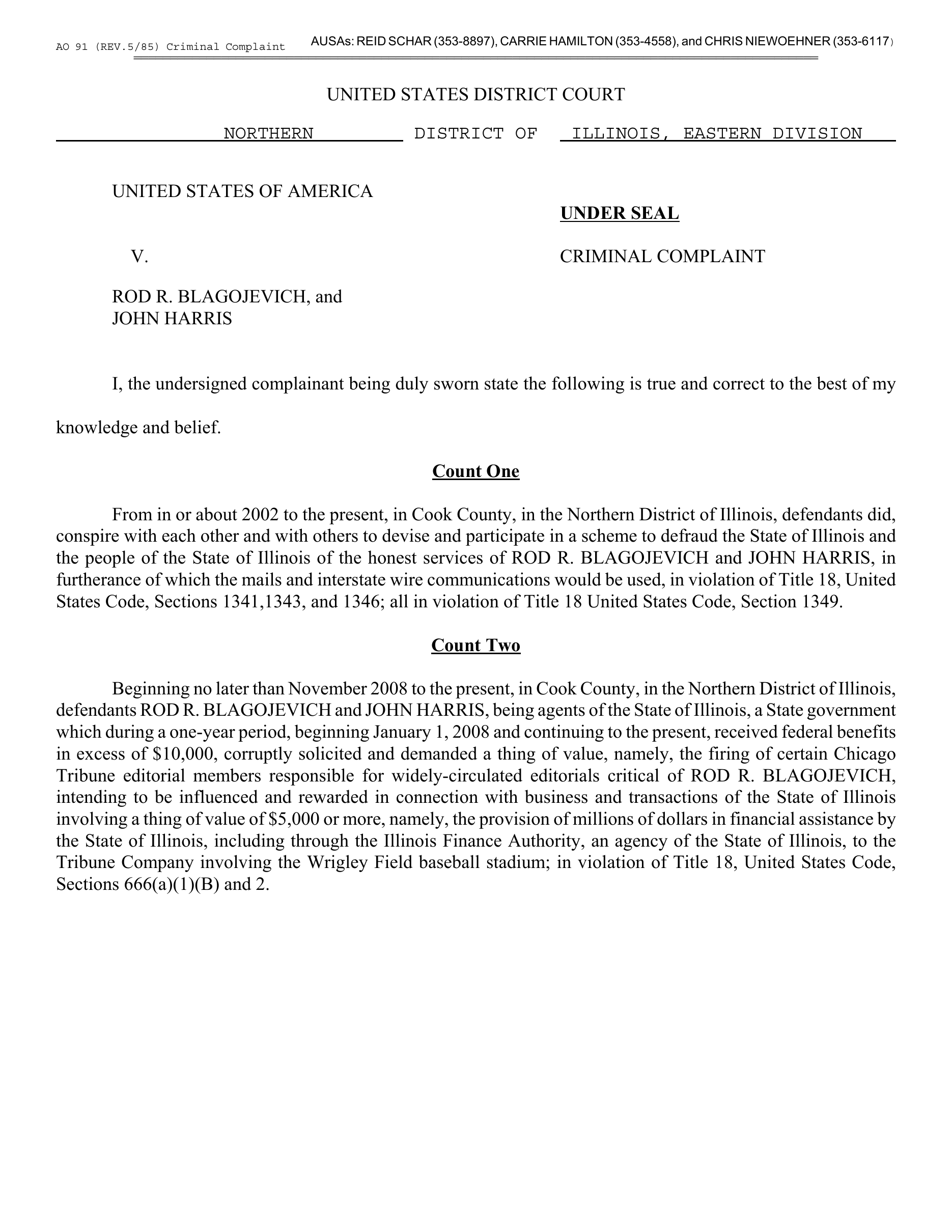
That's the actual complaint, sworn out under seal on a Sunday and unsealed two days later when agents came to arrest him. It runs 78 pages, and almost none of it is about the Senate seat alone.
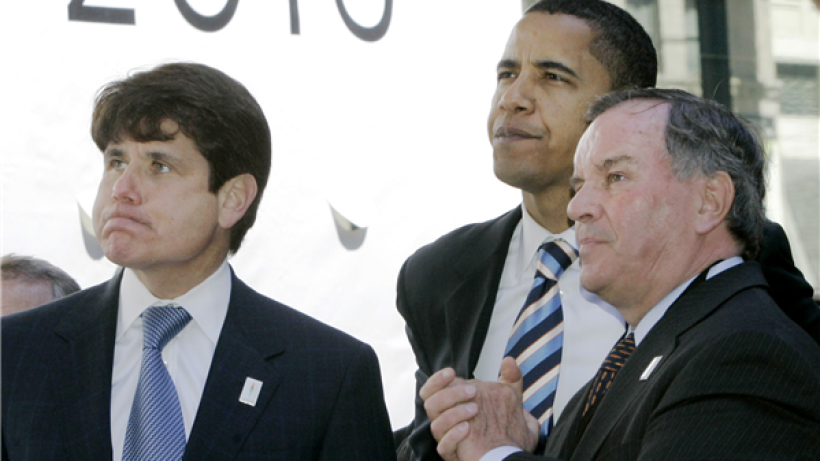
Both men climbed through Illinois Democratic politics on roughly the same timeline. Obama was a state senator representing Chicago's South Side when Blagojevich, then a congressman from the North Side, won the governor's race in 2002. Obama campaigned for him in that race and again in 2006, and by the time Obama won his own U.S. Senate seat in 2004 the two were routinely photographed together at the same party events, two Illinois Democrats on parallel tracks upward. That overlap is the only reason Blagojevich ended up holding the pen on Obama's replacement four years later; it had nothing to do with the presidency and everything to do with them happening to share a state.
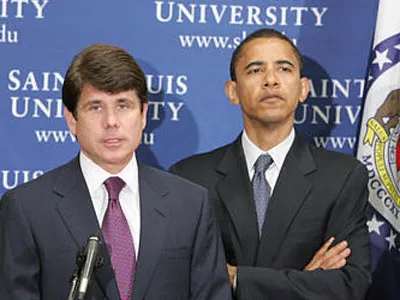
The two men had campaigned together for years before that seat, and the vacancy it created, turned their relationship into evidence.
The Phone Call, In The Government's Own Words
The line everyone remembers gets paraphrased so often that the original wording has drifted. Headlines and late-night monologues tend to render it as the seat being "fucking gold." The transcript the FBI actually put in front of a magistrate judge says "golden," and the difference matters a little, because "golden" is the word a man uses when he thinks something is going to keep paying out, not just that it's valuable once. Here's the page as the government filed it.
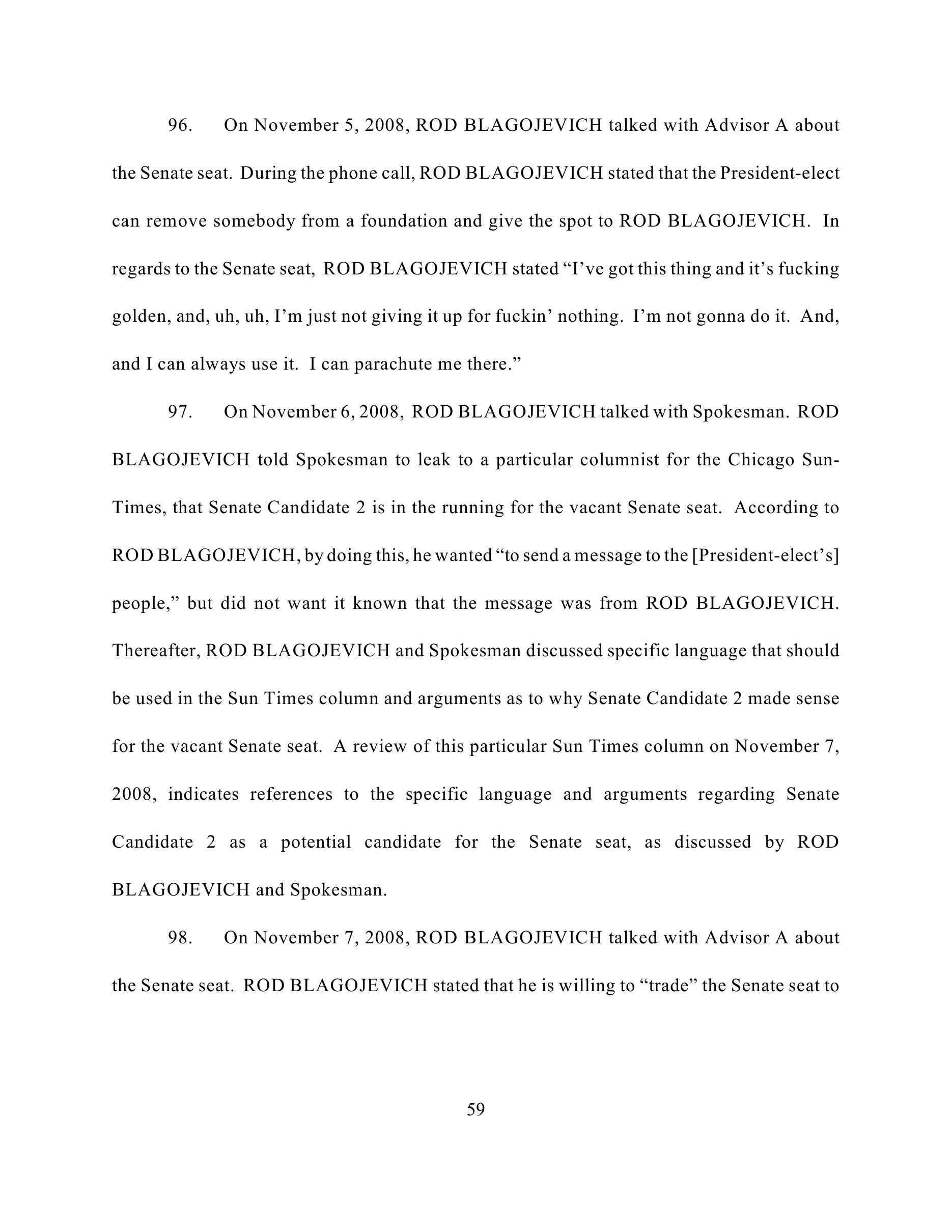
The paragraphs around it, numbers 94 through 98, show the idea evolving in real time over about 72 hours: Blagojevich and his chief of staff John Harris researching whether a president-elect could install him at a private foundation "heavily dependent on federal aid," Blagojevich asking how much such a position would pay, and, a day after the "golden" line, Blagojevich telling his spokesman to plant a story in the Chicago Sun-Times floating a different Senate candidate, so the story would look like it came from somewhere other than the governor's office. None of that is a cash auction. It's closer to a man testing every lever in front of him to see which one moves.
The recording itself outlived the paper it was first quoted in.
It Was Never Only About The Senate Seat
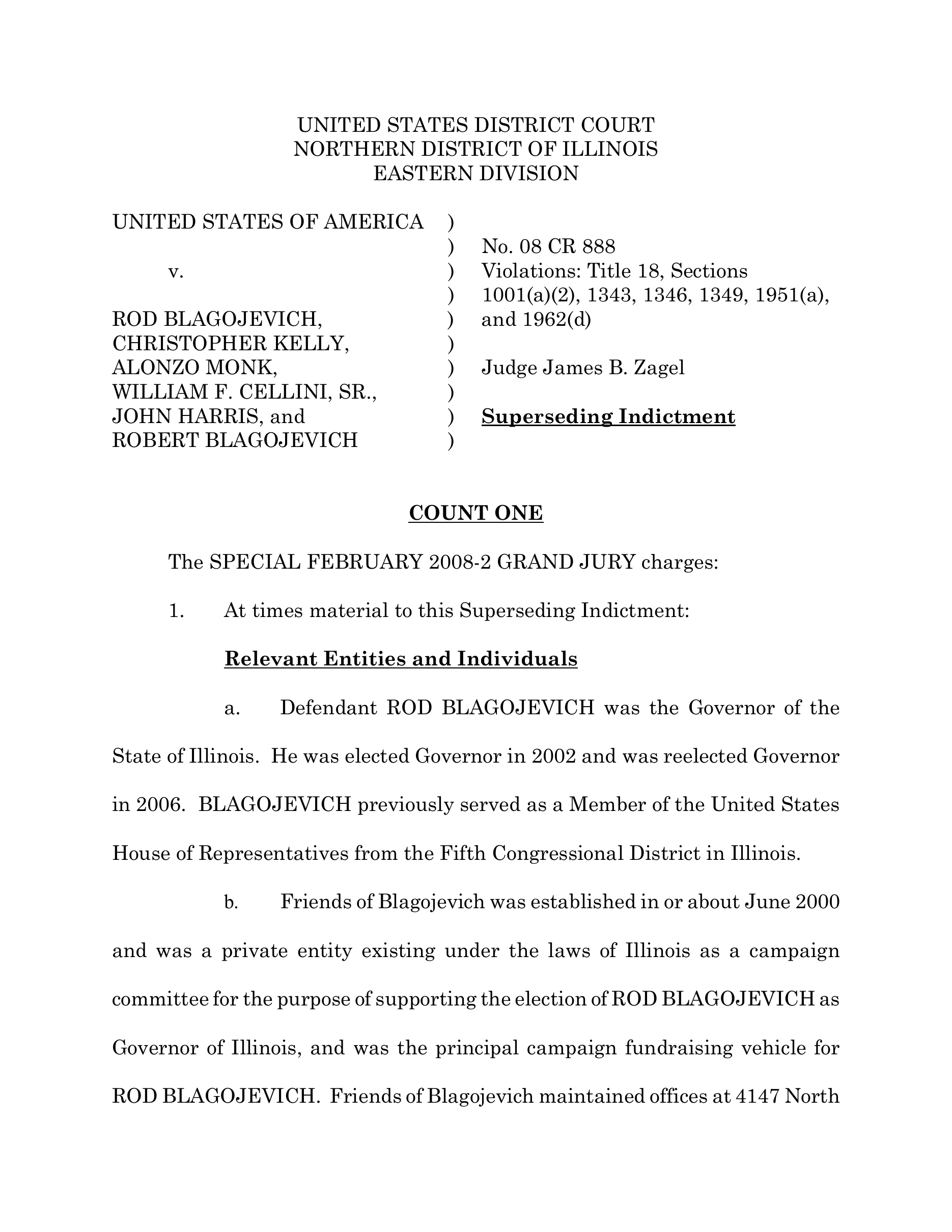
The complaint's Count Two isn't about the Senate at all. It alleges that Blagojevich and Harris tried to withhold state financial assistance the Tribune Company needed for the sale of Wrigley Field, in order to pressure the paper into firing Chicago Tribune editorial board members who had been writing critically about him. By the time the case became a formal indictment eleven weeks later, the list of schemes had grown to include a sitting Illinois governor, his brother, a fundraiser, a lobbyist, and a downstate power broker, all named on one caption page.
The hospital count is the cleanest one to explain because it has no ambiguity built into it at all. On October 8, 2008, Blagojevich told a lobbyist he intended to raise the Illinois Medicaid reimbursement rate for pediatric specialists, a change hospitals had wanted for years, and that he wanted $50,000 in campaign contributions from the CEO of Children's Memorial Hospital in exchange. Nine days later he called the CEO himself to tell him the rate increase was coming. Five days after that, his brother and campaign chairman, Robert Blagojevich, called the same CEO and asked him to arrange $25,000 by the end of the year, half the original number but the same trade.
The racetrack count runs the same shape through a different set of hands. Illinois legislators had passed a bill requiring casinos to funnel money to the state's horse racing tracks, and Blagojevich told his former chief of staff Alonzo Monk he wanted $100,000 raised from a track executive before he'd sign it. After the bill passed the legislature that November, the recordings show Blagojevich and Monk going back and forth for weeks over sequencing: Monk telling the executive there would be "skittishness" if the bill got signed before the money arrived, Blagojevich telling Monk "good job" when he heard the message had landed, and Blagojevich agreeing to personally call the executive to dangle his signature as leverage. A third, less remembered count alleges he leaned on a highway construction executive the same way. None of these required Barack Obama to have won an election. They required a governor who signed things for a living to notice that signing things was worth money.
Arrested Before 6 A.M.
Federal agents took Blagojevich into custody at his home in Chicago's Ravenswood Manor neighborhood on the morning of December 9, 2008, the same day Harris was arrested. U.S. Attorney Patrick Fitzgerald and the FBI's Chicago Special Agent-in-Charge, Robert Grant, announced it a few hours later. Fitzgerald did not undersell it. "The most cynical behavior in all of this," he told reporters, "was he tried to sell the appointment of the United States Senate seat." Asked to characterize the broader case, he said the conduct "would make Lincoln roll over in his grave."
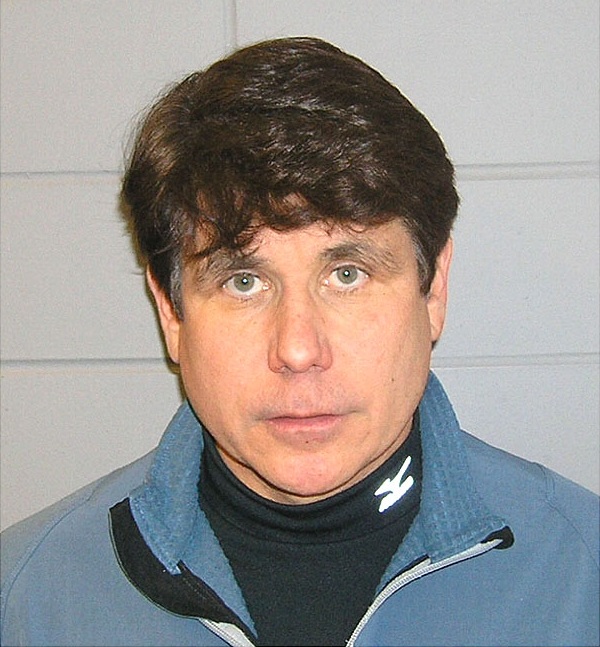
Blagojevich was 51 that morning, Harris was 46, and both were due to appear later that day before U.S. Magistrate Judge Nan Nolan. The booking photo above is a federal government work and carries no copyright; it is, for what it's worth, one of the most recognizable mugshots of the decade, precisely because almost nobody who saw it that week had any idea yet how much more paperwork was coming.
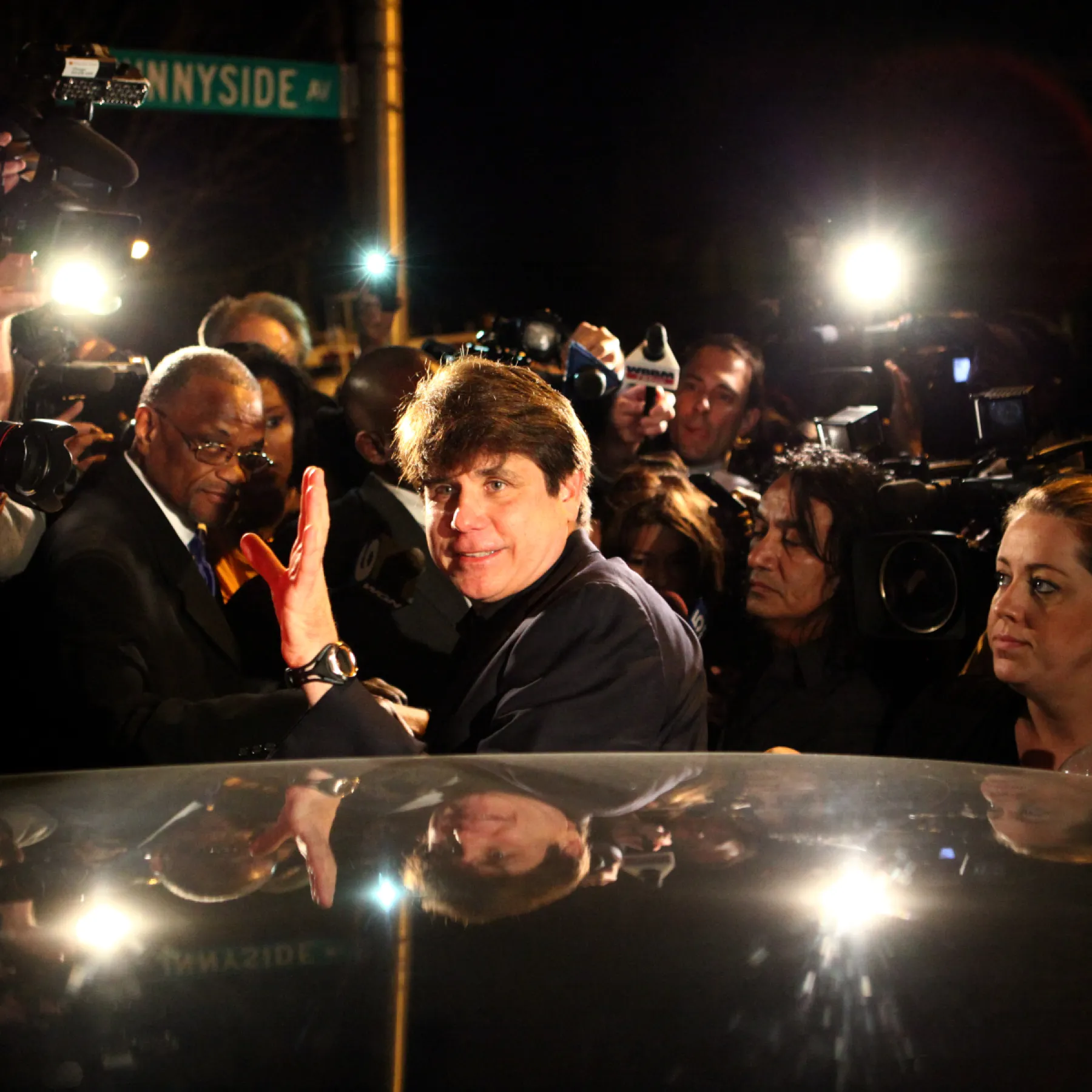
The street sign in that photo says Sunnyside Avenue, and it wasn't a coincidence; it's the block in Ravenswood Manor where Blagojevich actually lived, the same house federal agents came to that December morning, and the same one reporters kept camped outside of for most of what came after.
Impeached Twice, Because The Calendar Made Them
Illinois moved fast, and then had to move again because of a technicality. The state House voted 114-1 on January 9, 2009, to impeach Blagojevich; Rep. Milton Patterson of Chicago was the only "no." But the legislative session ended five days later, and the incoming 96th General Assembly had to re-pass the same impeachment resolution to keep it alive, which it did on January 14, by a vote of 117-1, with Patterson again the lone dissent.
The Illinois Senate held the actual trial, with Illinois Supreme Court Chief Justice Thomas Fitzpatrick presiding over what amounted to a four-day proceeding beginning January 26. Senators sat as the jury and heard the wiretapped calls played aloud in the chamber, the same recordings quoted earlier in this piece, entered into the record as evidence rather than just described secondhand.
Associated Press footage of the Illinois Senate trial, via AP Archive.
On January 29, 2009, the Senate voted 59-0 to remove Blagojevich from office, the first and only time an Illinois governor has been ousted this way, and then voted again, also unanimously, to bar him from ever holding state office in Illinois again. Lieutenant Governor Pat Quinn was sworn in as governor within the hour. None of it required a single federal conviction; impeachment in Illinois, like everywhere else, is a political judgment the legislature is free to reach on its own timeline, running on a completely separate track from the criminal case grinding forward in Judge Zagel's courtroom.
Two Trials To Get To Eighteen Felonies
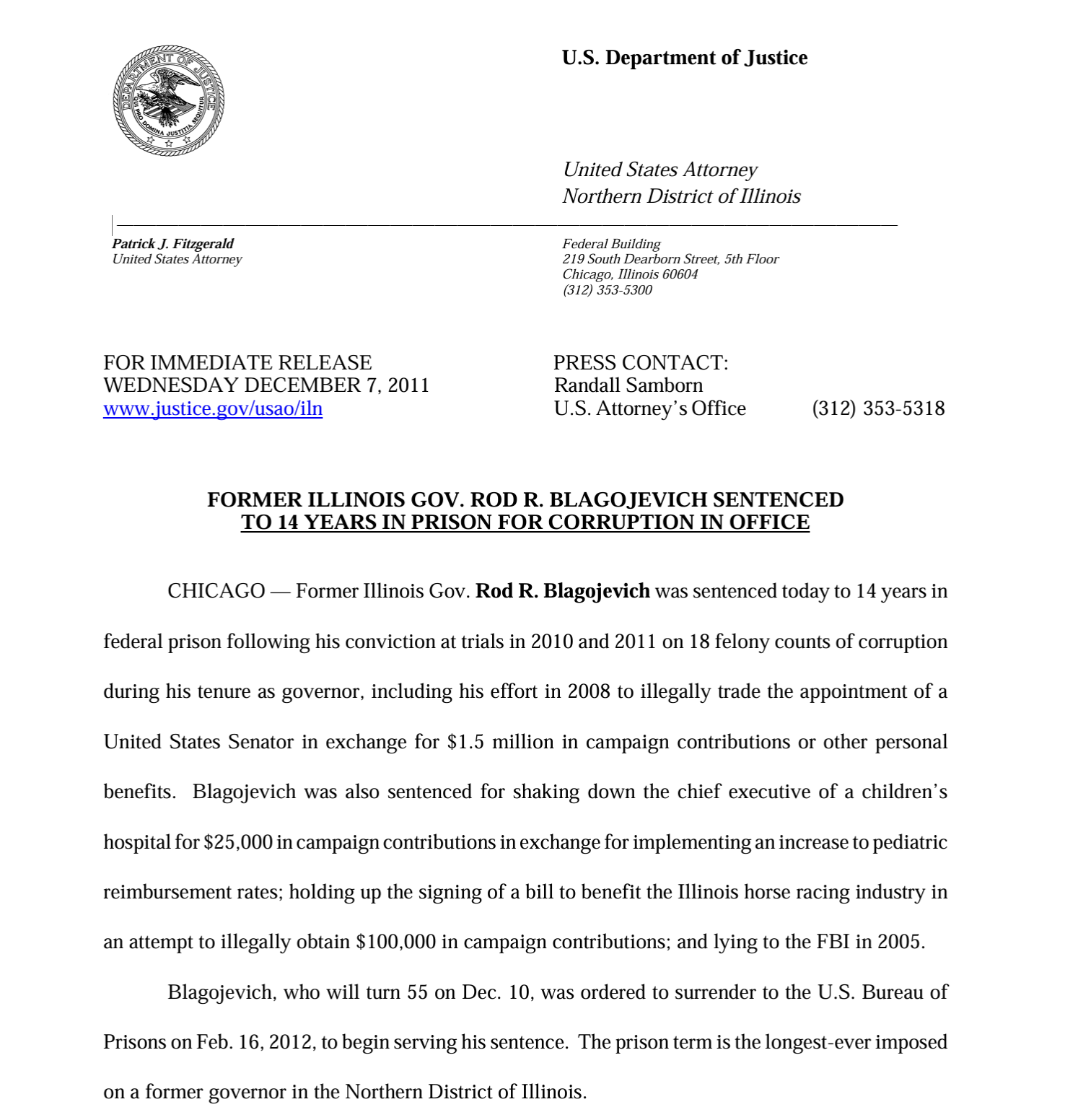
The first trial, in the summer of 2010, was a near-miss for prosecutors. The jury convicted Blagojevich on exactly one count, lying to the FBI during a 2005 interview about how closely he tracked his own campaign contributions, and deadlocked on the other 23. Rather than retry the whole sprawling case again, the government trimmed its presentation and went back in 2011. The second jury convicted him on 17 more counts: ten counts of wire fraud, attempted extortion, conspiracy to commit extortion, and both soliciting and conspiring to solicit bribes. Combined with the 2010 conviction, that put his total at 18 felonies.
Judge Zagel sentenced him that December to 14 years, the longest term ever handed to a former governor out of the Northern District of Illinois, plus two years of supervised release and a $20,000 fine. "When it is the governor who goes bad," Zagel said from the bench, "the fabric of Illinois is torn, disfigured and not easily repaired. The harm here is not measured in the value of money or property... the harm is the erosion of public trust in government." Blagojevich surrendered to federal prison in February 2012.
The Appeal That Actually Mattered
Blagojevich's strongest argument on appeal wasn't that he'd been framed. It was that the trial court had blurred two things the law treats very differently: trading an official act for money, and trading one official act for another. In July 2015, writing for the Seventh Circuit, Judge Frank Easterbrook agreed, at least partly.
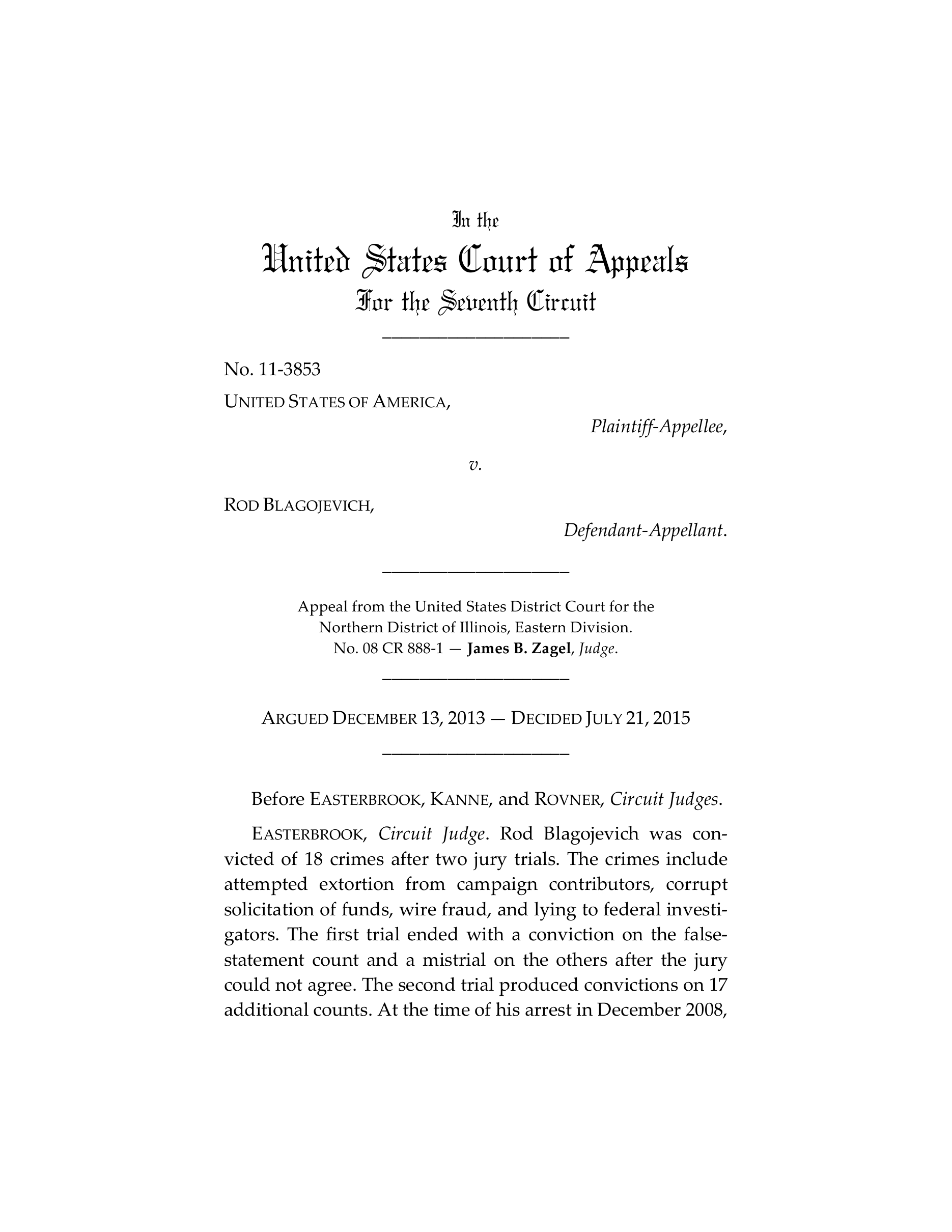
The specific proposal at issue was Blagojevich's idea to appoint Valerie Jarrett, Obama's preferred candidate, to the Senate in exchange for Blagojevich himself getting a seat in Obama's Cabinet. Easterbrook's opinion calls that "a form of logrolling," the ordinary legislative practice of trading one public act for another, no different in kind from a senator agreeing to confirm one nominee in exchange for another senator's vote on a bill. "Governance would hardly be possible without these accommodations," the opinion says. The court asked the prosecutor at oral argument whether logrolling had ever, in American history, been the basis of a criminal conviction before this case. Counsel didn't know of one, and the court's own research didn't find one either.
That distinction only applied to the counts built on the Cabinet-seat theory. The court vacated convictions on Counts 5, 6, 21, 22, and 23, affirmed everything else, and sent the case back for the district court to decide whether to retry the vacated counts or move straight to resentencing.
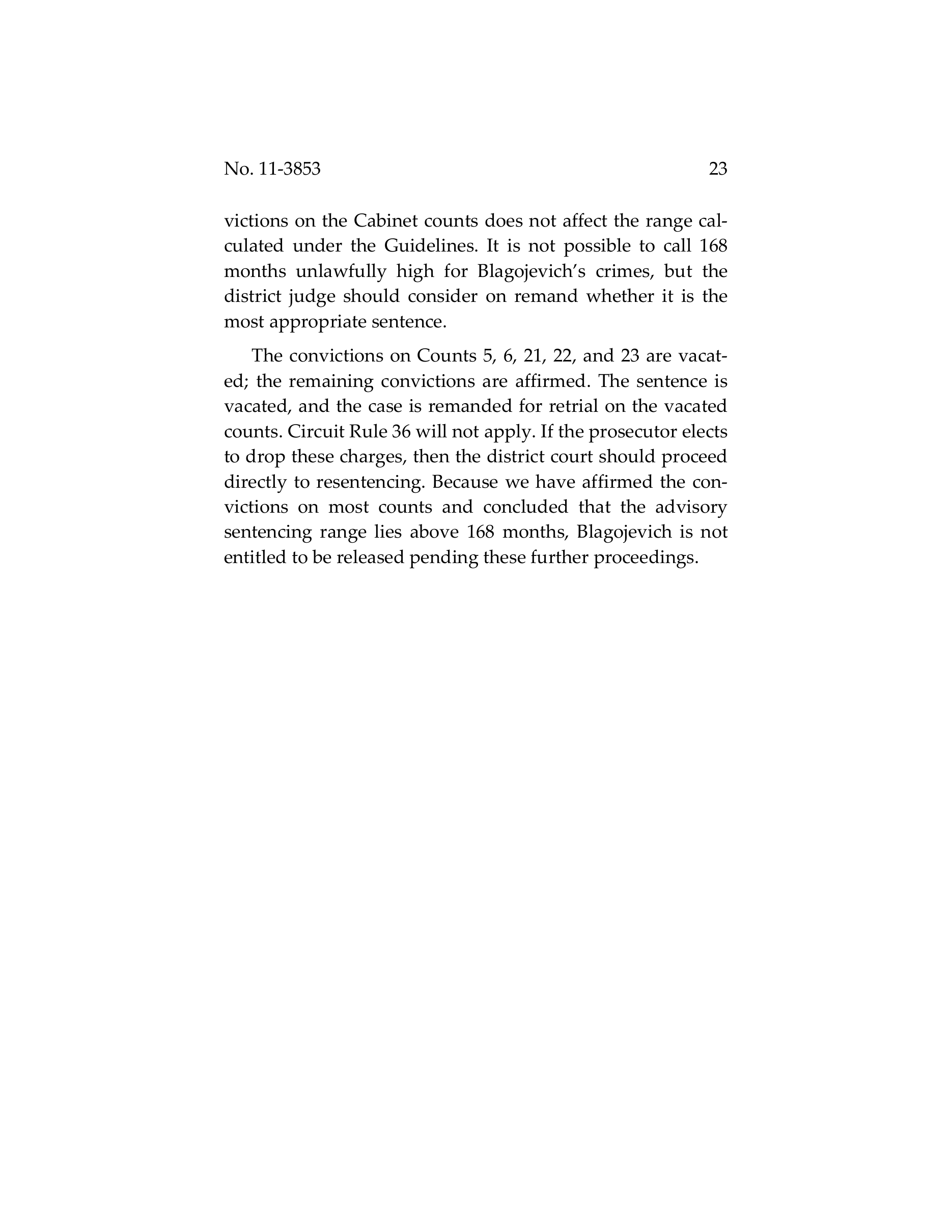
Prosecutors declined to retry the five vacated counts. Thirteen convictions stood, covering the hospital scheme, the racetrack scheme, the Tribune scheme, the false statement, and the underlying attempt to sell the Senate seat for something other than a Cabinet post, and in 2016 Judge Zagel reimposed the identical 168-month sentence, which the Seventh Circuit upheld again in 2017. The appeal that people cite as proof this was all overreach actually left the bulk of the case exactly where it started.
Trump, Twice
Blagojevich's path back into the news started, oddly, on reality television. He appeared on Trump's Celebrity Apprentice in 2010, between the two trials, and Trump fired him in the fourth episode. A decade later, with Blagojevich roughly eight years into his sentence, President Trump commuted the remaining prison time on February 18, 2020. A commutation ends a sentence; it does not erase a conviction, and it didn't touch the Illinois Supreme Court's decision that same year to disbar him from practicing law in the state.
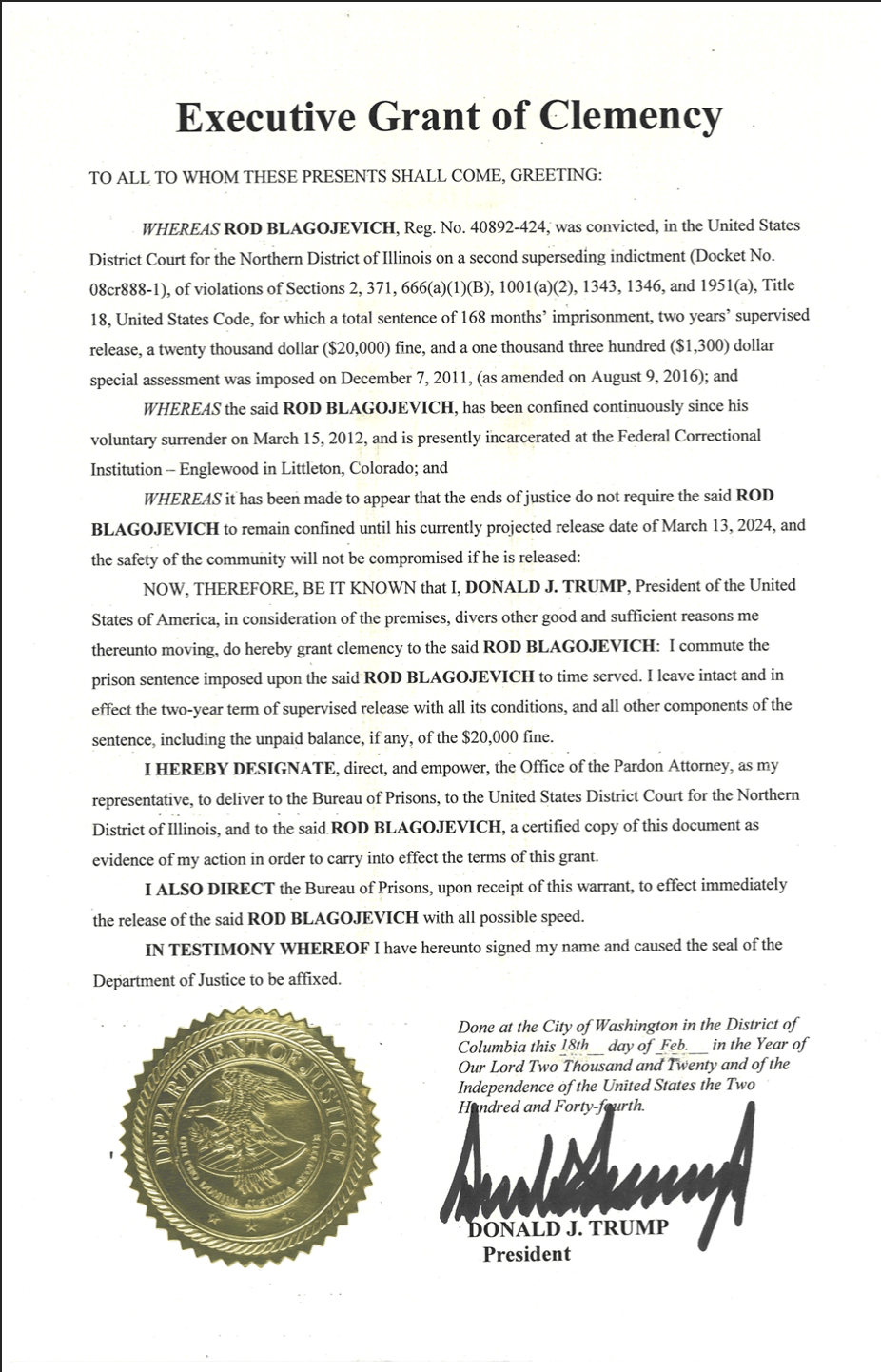
The warrant itself is narrow by design: it commutes the prison term to time served and explicitly leaves "intact and in effect" the two-year supervised release and the unpaid balance of the $20,000 fine. It also names the exact statutes the second superseding indictment had charged him under, Sections 2, 371, 666(a)(1)(B), 1001(a)(2), 1343, 1346, and 1951(a) of Title 18, the same alphabet soup running through the indictment cover page above, as amended in August 2016 once the Seventh Circuit's vacated counts were sorted out.
On February 10, 2025, Trump went further and granted him a full pardon. "He was set up by a lot of bad people," Trump said in the Oval Office. "This should never have happened... he's now cleaner than anybody in this room." The Justice Department's own clemency record is more clinical about what, exactly, was being forgiven: "wire fraud under color of official right (eight counts); conspiracy/attempted; attempt to commit extortion under color of official right; conspiracy to solicit and solicitation of bribe (three counts); making false statements." That's the pardon covering the hospital shakedown and the racetrack shakedown as much as it covers the Senate seat, whatever the headlines that week led with.
The pardon didn't touch the 2009 impeachment, either. Illinois removed him and barred him from state office through its own legislature, on its own finding, years before a jury ever returned a verdict, and a federal pardon has no mechanism for reaching back into a state's own constitutional process to undo it.
Bottom Line
There was a genuine legal problem with part of this prosecution, and the Seventh Circuit found it: treating a Cabinet-seat swap as though it were indistinguishable from a cash bribe stretched the law further than it should go, and five convictions came down because of it. But the claim that Blagojevich's case was really just an ambitious prosecutor criminalizing ordinary politics doesn't survive contact with the rest of the record. Thirteen convictions never depended on the Jarrett-for-Cabinet theory at all. A children's hospital was asked for cash in exchange for a Medicaid rate increase. A horse track was told its bill's timing depended on a $100,000 check. A newspaper's editorial board was targeted through the state's control over a stadium deal. Those counts are why the actual paperwork, the complaint, the indictment, and the opinion vacating five counts while affirming the other thirteen, tells a fuller story than the punchline the wiretap left behind.